
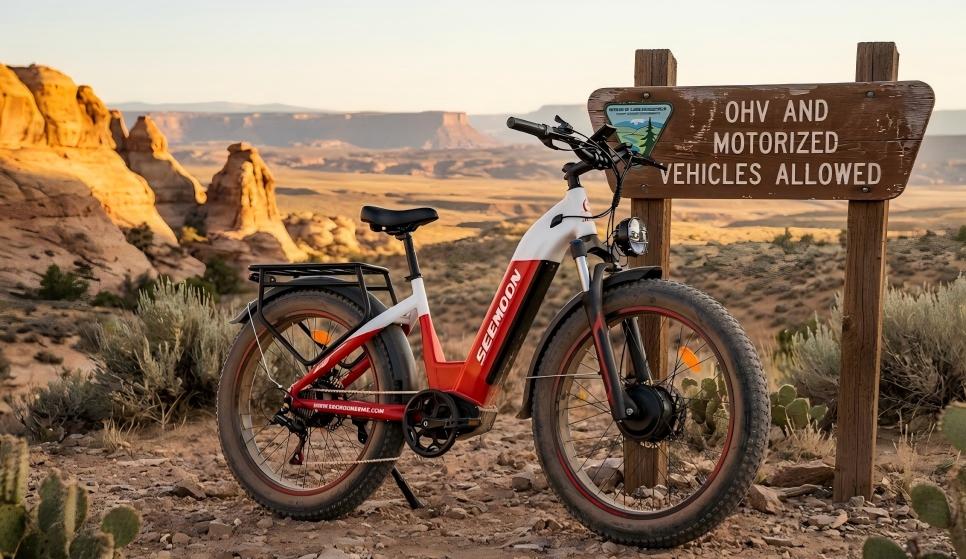
Knowing the Rules Before Hitting the Dirt
Purchasing a high-voltage, dual-motor all-terrain vehicle completely redefines your relationship with the outdoors. It allows you to explore deeper, climb steeper, and carry more gear than a traditional mountain bike ever could. However, before you load up your rig and head to the mountains, you need to understand that the immense power of an The Ultimate Guide to Off Road Ebikes in 2026: Conquer Any Terrain places it in a unique legal category across the United States.
For riders itching to hit the dirt, here is your TL;DR for legal backcountry riding and touring:
-
The Law: High-power models often exceed standard Class 1 and 2 definitions due to their throttle capabilities. You must cross-reference your bike's settings with local Bureau of Land Management (BLM) and US Forest Service (USFS) rules.
-
The Trails: While non-motorized singletrack might be off-limits, the US offers millions of acres of OHV (Off-Highway Vehicle) trails and 4x4 dirt roads perfect for AWD electric machines.
-
The Tech: Long-distance touring requires an unbreakable GPS navigation hub and strict adherence to ergonomic setups.
-
The Preparation: Never tackle a multi-day trail without mastering basic maintenance and understanding your bike's software limits.
Let’s dive into the ultimate 2026 guide for navigating the legal landscape, finding the most epic trails, and outfitting your rig for the long haul, using the ultra-capable Seemoon SM1 as our touring benchmark.
Navigating US E-Bike Laws: The Ultimate Guide to Classes, Public Lands, and OHV Access
The United States features a heavily fragmented legal framework regarding electric bicycles. What is perfectly legal on a rugged Utah BLM trail might earn you a hefty fine in a Colorado National Forest. For off-road enthusiasts and eMTB riders, understanding the nuances of federal, state, and local regulations is your first step toward responsible—and legal—riding. Here is exactly how to navigate the US "Three-Class System," understand your e-bike’s power capabilities, and find the best public lands for high-performance riding.
The Foundation: The US Three-Class E-Bike System
The majority of US states officially recognize a standardized three-class system. Under the federal Consumer Product Safety Act, a low-speed electric bicycle is generally limited to a motor of 750 watts (1 horsepower).
Here is how the three classes break down:
-
Class 1: Pedal-assist only (no throttle), with a motor that ceases to provide assistance when the e-bike reaches 20 mph.
-
Class 2: Throttle-actuated (and pedal-assist), with a motor that ceases to provide assistance when the e-bike reaches 20 mph.
-
Class 3: Pedal-assist only, equipped with a speedometer, and a motor that ceases to provide assistance at 28 mph.
The High-Performance Dilemma: Where Does Your Rig Fit?
So, where does a high-performance wilderness machine fit into this legal matrix? Take a dual-motor or high-voltage rig like the Seemoon SM1. It features a dedicated throttle mode with five adjustable speed levels. Because advanced 52V electrical architectures (which peak at 58.8V fully charged) allow riders to achieve off-road speeds exceeding 30 mph, these machines technically cross the 750W/28mph threshold. From a legal standpoint, most states will classify unrestricted high-power e-bikes as mopeds or Off-Highway Vehicles (OHVs).
The Software Solution: Digital Speed Governing
If you own an over-powered e-bike, you aren't permanently locked out of standard trails. Modern e-bike controllers offer a software-level compliance solution. The advanced LCD display on models like the SM1 allows riders to enter a parameter setting interface. This allows you to digitally govern the motor's top speed and power output. By capping the throttle speed to 20 mph, you can effectively map the bike to align with local Class 2 regulations when transitioning from private OHV parks to restricted local trails.
Important Note: Always verify local ordinances. While software limiting is widely practiced, some strict municipal parks require hard-coded (factory) limits to legally classify a bike as Class 2. For the most accurate, state-by-state legal definitions, we recommend cross-referencing the database managed by PeopleForBikes.
Conquering Public Lands: BLM, USFS, and OHV Access
The good news for high-power e-bike owners? The US possesses vast expanses of public lands where throttle-heavy, off-road electric bikes are not just legal, but are arguably the ultimate way to explore the backcountry. However, you must understand the distinction between the two primary federal land management agencies:
The Bureau of Land Management (BLM)
Operating under the Department of the Interior, the BLM manages millions of acres, primarily in the American West. Following Secretarial Order 3376, local BLM land managers have the authority to exempt certain e-bikes from being classified strictly as motorized vehicles. However, high-speed, throttle-actuated e-bikes (exceeding Class 3) are generally directed toward trails designated for motorized use.
The United States Forest Service (USFS)
Operating under the Department of Agriculture, the USFS generally categorizes all e-bikes as motorized vehicles under their Travel Management Rule. Unless a specific local district has explicitly opened a non-motorized trail to e-bikes, you should assume you are restricted to motorized routes.
How to Find Legal Riding Zones
To ensure you are riding legally and protecting the reputation of the e-bike community, follow these guidelines:
-
Look for OHV Designations: Any trail designated for motorized use—such as ATV trails, 4x4 Jeep roads, and OHV-designated singletrack—is wide open for your high-powered e-bike.
-
Download the MVUM: Always download the official Motorized Vehicle Use Map (MVUM) for the specific national forest or BLM district you plan to visit. If the trail is on the MVUM, you are good to go.
-
Respect "Non-Motorized" Signage: Riding a heavy, throttle-actuated e-bike on a trail explicitly marked "Non-Motorized" (often reserved for hikers, equestrians, and acoustic mountain bikes) causes trail damage and risks severe access closures for all e-bike riders.
The Ultimate US Trails Built for AWD E-Bikes
Once you have verified local e-bike classifications and secured your legal trail access, it is time to unleash the machine. Standard mountain bikes—and even premium mid-drive e-MTBs—often struggle with traction on extreme terrain. But an all-wheel-drive (AWD) e-bike thrives exactly where single-drive systems spin out. If you are looking to test the absolute limits of your rig's dual-motor setup, here are two premier US off-road destinations built for AWD dominance.
1. Moab’s Motorized Slickrock Routes (Utah)
Moab is the undisputed mecca of off-roading. While traditional mountain bikers flock to the non-motorized singletrack, the rugged 4x4 and motorized OHV (Off-Highway Vehicle) routes—such as Fins & Things and Hell's Revenge—are the perfect proving grounds for a high-torque AWD e-bike. The petrified sandstone offers otherworldly grip, but the punishing, near-vertical inclines demand flawless power delivery.
Technical Advantage on the Trail: This unforgiving terrain is where the SM1’s Dual Motor Mode truly shines. The physics of climbing a 40-degree slickrock pitch usually result in the front wheel lifting or the rear tire losing traction. The SM1 mitigates this with simultaneous front-and-rear torque delivery. Read the article [How to Choose the Best Off Road Ebike: Dual Motor vs Single] for a deeper understanding of why dual-motor electric bicycles have such a significant advantage on off-road terrain.

-
Engaging AWD: By pressing the red toggle switch on the left handlebar and twisting the throttle, you instantly activate the front hub motor.
-
Traction Dynamics: Entering "Dual Motor Mode" provides explosive, balanced all-wheel drive. Instead of the rear wheel spinning out on a steep ascent, the front motor literally pulls the bike over the crest while the rear pushes, keeping your center of gravity stable and your tires glued to the rock.
2. The Alpine Loop (San Juan Mountains, Colorado)
For riders chasing breathtaking high-altitude scenery, the Alpine Loop connects the historic mining towns of Silverton, Ouray, and Lake City. This rugged, 60-mile network of rocky Jeep roads and mountain passes reaches elevations over 12,000 feet. Unlike internal combustion dirt bikes that lose significant horsepower in the thin mountain air, your e-bike’s electric motors will deliver 100% torque regardless of altitude.
Technical Advantage on the Trail: Navigating the jagged scree and washed-out gullies of the San Juans requires more than just raw power; it requires stability and smart weight management.
-
Tire Contact Patch: The SM1’s 26-inch anti-slip tires are essential here. Running these high-volume tires at a slightly lower PSI maximizes the contact patch, providing critical shock absorption and preventing pinch flats on sharp Alpine rocks.
-
Walk Boost Mode: If you encounter a rock step or a washout that is simply too steep to ride safely, the SM1’s Walk Boost Mode is a lifesaver. By long-pressing the "-" button, the internal controller signals the motor to propel the bike at a steady 3.7 mph (6 km/h). This overcomes the dead-weight resistance of a heavy dual-motor rig, making pushing the bike up a steep alpine pass practically effortless.
Mastering Long-Distance E-Bike Touring: Advanced Ergonomics & Cockpit Tech
Riding an electric dirt bike for 40 miles deep into the backcountry isn't just a joyride—it’s an endurance sport. While dual-hub motors easily chew through technical terrain, your skeletal system is still absorbing miles of kinematic feedback and high-frequency vibrations. If you're planning multi-day off-grid trips, dialing in your touring ergonomics and bulletproofing your navigation tech aren't just luxuries; they are fundamental survival strategies. Here is exactly how to set up your rig for the long haul.
1. Dialing in Biomechanics & Frame Geometry
When you are carrying heavy overlanding gear, rider posture dictates your stamina. The SM1 is engineered around an aerospace-grade aluminum chassis boasting a massive 330 lb. (150 kg) maximum payload capacity, making it an elite choice for big and tall riders or heavily laden bikepackers. But raw strength requires proper fit.

To mitigate lumbar and shoulder strain, you need to lock in your biomechanics:
-
Optimal Standover Clearance: The golden rule of trail safety is clearance. When straddling the bike with your feet flat on the dirt, ensure a strict 1 to 3-inch (3–8 cm) clearance between your inseam and the frame's top tube.
-
Dynamic Cockpit Adjustment: Pair the correct saddle height with an adjustable handlebar stem. Raising the stack height allows for a more upright, neutral spine angle, massively reducing lower back shear forces during extended saddle time.
-
Combating Grip Fatigue: Hand-Arm Vibration Syndrome (HAVS) and wrist pump are real threats on washboard fire roads. When you hit long, flat connecting trails, leverage the SM1's Cruise Control Mode (activated by long-pressing the "+" button). This allows you to relax your throttle hand, shake out lactic acid, and maintain momentum without constant micro-adjustments.
2. The Expedition Cockpit: Building an Unbreakable GPS Hub
Losing your cell signal in a national forest is expected; losing your navigation is an emergency. In 2026, a smartphone running offline topographic maps (like Gaia GPS or onX Offroad) is your most vital piece of survival kit. The problem? Running high-res GPS mapping at maximum screen brightness will nuke a standard phone battery in just a few hours.
The solution is tapping into your e-bike’s power architecture. The SM1 utilizes the YL81F smart LCD display, which acts as the brain of your cockpit, supporting both Bluetooth connectivity and direct power output.
-
Continuous Power Delivery: By mounting a ruggedized, vibration-damping phone mount (like a Quad Lock or RAM Mount) to your handlebars, you can run a short charging cable directly into the YL81F's integrated USB port.
-
No Range Anxiety: This setup acts as a step-down converter, drawing a virtually unnoticeable parasitic load (5V) from the bike's massive 52V primary battery. Your maps will never go dark, and your overall range won't take a hit.
-
Localized Telemetry: For riders traversing international borders or following localized trail guides, the YL81F display allows for seamless, one-click toggling between Imperial (MPH) and Metric (KM/H) telemetry, keeping your pacing dead accurate regardless of the map you're reading.

What should you do if your electric bicycle suddenly breaks down while riding in the countryside? The article [Expert Maintenance & Repair Guide for Off-Road Electric Bikes] may be of great help to you.
Expert FAQ: Laws, Trails, and Touring Setup
Q1: Can I ride my high-powered off-road ebike on regular mountain bike trails?
A1: Generally, no. Most traditional mountain bike singletracks are designated as "Non-Motorized." High-powered e-bikes with throttles must be ridden on OHV trails, motorized double-tracks, or designated multi-use trails. Always check local BLM signage to avoid fines.
Q2: Are there speed limits for e-bikes on public dirt roads?
A2: Yes. Even on motorized OHV trails, speed limits still apply and vary by region. The SM1 allows you to enter the personalized parameter settings on the LCD display to adjust the speed limit. This is a highly useful feature to ensure you remain legally compliant.
Q3: Is the 330 lbs weight limit just for the rider?
A3: The 330 lbs (150KG) maximum payload capacity applies to the total weight of the rider plus any cargo. The SM1 comes standard with a robust rear cargo rack. If you weigh 250 lbs, you still have 80 lbs of capacity to safely load up camping gear.
Q4: How do I handle steep uphill sections that are too dangerous to ride?
A4: Never risk a dangerous crash on an unrideable incline. Dismount the bike and activate the Walk Boost Mode by long-pressing the "-" button. The motor will intelligently provide just enough power to roll the heavy bike uphill at a steady 6km/h.
Q5: What lighting is required by law if I get caught on the trail after dark?
A5: Federal and state laws require proper lighting for night riding. The SM1 is fully compliant straight out of the box, equipped with a bright LED headlight and taillight. Furthermore, the left handlebar integrates a switch block controlling the turn signals, headlight, and horn to ensure maximum safety.
Conclusion: Mapping Your Next Epic Backcountry Route
Mastering the high-performance e-MTB (electric mountain bike) requires more than just raw throttle input; it demands a synergy between rider intuition and machine calibration. Navigating the complexities of Bureau of Land Management (BLM) regulations and U.S. Forest Service (USFS) trail etiquette isn't just about compliance—it’s about preserving the trail access that defines our sport. By adhering to Tread Lightly! principles and respecting Motor Vehicle Use Maps (MVUM), you serve as a critical ambassador for the burgeoning AWD e-mobility community.
The technical foundation is now in place: your YL81F intelligent display is calibrated for optimal power distribution, your ergonomics are dialed for long-range comfort, and your touring rig is balanced for high-torque climbs. The question now is one of intent. Whether you are staging a self-sustained multi-day overland expedition or scouting remote glassing points for the upcoming hunting season, the sheer utility of an AWD platform with a 330-lb payload capacity remains the industry gold standard. You have the hardware and the technical savvy.
now, where will you point the front hub? [Shop the Seemoon SM1 Today and conquer any terrain]
Discover how outdoorsmen are pushing these vehicles to their absolute limits in our specialized guide:[Hunting & Camping: Ultimate Electric Off Road Bicycle Setup].
Share:
Expert Maintenance & Repair Guide for Off Road Electric Bikes
What is a Hunting Ebike and Why Every Hunter Needs One in 2026