
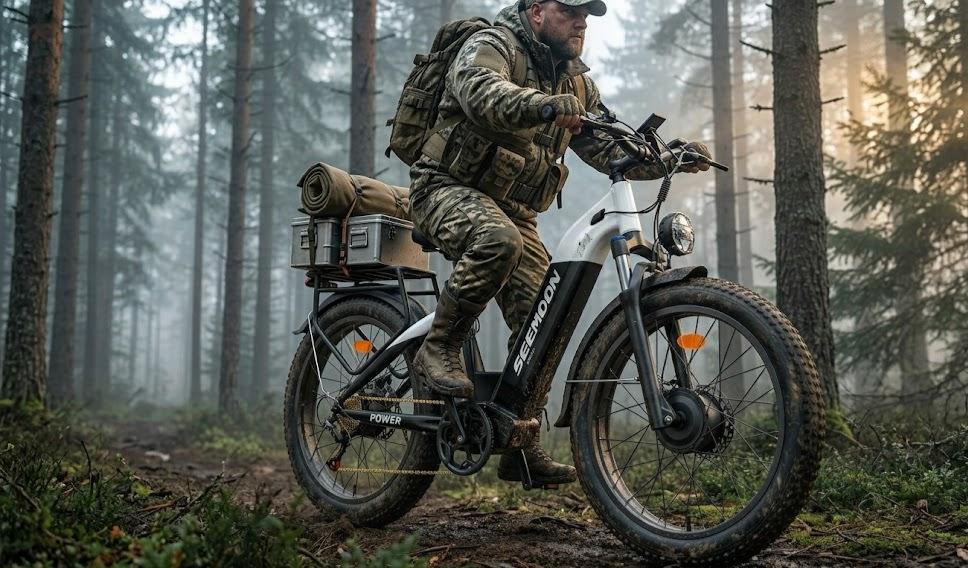
Setting the Benchmark: What Defines the Best Off-Road Electric Bike?
If you’re finally ditching the pavement commute for hardcore backcountry trails, your first major gear hurdle isn't suspension—it's powertrain configuration. The ongoing debate between single-motor and dual-motor all-wheel drive (AWD) systems is the single biggest factor in determining whether you conquer a muddy, 30-degree incline or end up doing the grueling "hike-a-bike" of shame.
Before we geek out on the physics of traction algorithms and continuous amp draw, here is the executive summary on how to spec your ultimate wilderness machine in 2026:
-
Single Motor (Rear Hub & Mid-Drive): The Range Maximizers Ideal for flat dirt paths, fire roads, and maximizing your battery’s watt-hour (Wh) efficiency. While high-torque mid-drives offer a natural pedal feel, single rear-hub motors are notoriously prone to severe traction loss (spin-outs) on loose scree, wet roots, or steep inclines where your rear tire’s contact patch is compromised.
-
Dual Motor (All-Wheel Drive): The Backcountry Gold Standard For extreme conditions, AWD is non-negotiable. By actively pulling from the front axle while pushing from the rear, dual-motor setups deliver unmatched mechanical grip. This is the setup you need to plow through deep snow, thick mud bogs, and highly technical, high-grade rock faces where momentum is everything.
-
The Power Floor: Why Voltage Dictates Performance If you're running a dual-motor rig, never settle for less than a 52V architecture. Because running two motors requires serious controller output. However standard 48V systems simply cannot efficiently manage the thermal load and high amp draw of AWD under heavy strain, leading to massive voltage sag and premature thermal throttling right when you need torque the most.
To fully understand the baseline tech specs—like Newton-meters (Nm) of torque and battery capacity—before comparing these specific powertrains, we highly recommend bookmarking our [Ultimate Guide to Specifying an Off-Road E-Bike]. Now, let’s pop the hood and settle the dual vs. single motor debate once and for all.
Dual Motor vs. Single Motor: The Engineering Truth Behind Off-Road Dominance
When you leave the asphalt behind, the laws of track-day physics no longer apply. On smooth pavement, a single rear-hub motor provides linear thrust because the coefficient of friction (mu) remains relatively constant. However, in the backcountry, friction is a volatile variable. To conquer unpredictable terrain, you don't just need power—you need a smarter way to apply it.
The Traction Equation: Vectoring Power for Technical Climbs
Traditional single-motor e-bikes operate on a "push" dynamic. Under heavy throttle on a steep, loose-incline (like decomposed granite or slick mud), the bike’s center of gravity shifts rearward. While this adds a vertical load to the rear tire, a single motor often applies more torque than the loose surface can structurally support. The result is wheel spin: you lose kinetic energy, your momentum stalls, and you’re forced to dismount.
This is where a Dual Motor All-Wheel Drive (AWD) system, like the one found on the Seemoon SM1, redefines the climb. By utilizing twin 1000W motors, the SM1 transitions from a "pusher" to a "climbing machine."

-
Front-End Pull: The front motor provides a "pulling" vector that helps the tire crest over obstacles—roots, rocks, or ledges—rather than just bumping against them.
-
Redundancy of Grip: If the rear tire loses purchase on a wet root, the front tire—often resting on different terrain just 45 inches ahead—maintains the bike's forward trajectory.
Overcoming Gravity: The 160Nm Torque Ceiling
In the e-bike world, horsepower sells bikes, but torque wins the mountain. Torque is the rotational force applied to the axle, and it is the only metric that matters when the grade exceeds 20%. Most premium single-motor mid-drives or hubs peak at roughly 80Nm of torque. While sufficient for urban commuting, these setups often require the rider to "out-pedal" the motor's limitations on a 30-degree grade. The SM1, however, delivers a combined 160Nm of peak torque,With such high torque, it can ride as smoothly as on flat ground even when facing a 30-degree slope.
-
The 40-Degree Advantage: On a gnarly rock slab in Moab, 160Nm of twisting force ensures the motor handles the heavy lifting.
-
Stability: High torque at low RPMs allows you to remain seated, keeping your center of gravity low and your tires planted, rather than standing and losing rear-wheel traction.
Efficiency vs. Extremes: The Intelligent AWD Toggle
The primary critique of dual-motor systems has historically been parasitic battery drain. Skeptics argue that dual 1000W hubs are "range killers." By 2026 standards, that’s an outdated myth. Modern power management allows for On-Demand AWD. The Seemoon SM1 features a tactical toggle on the left handlebar, allowing the rider to manage the bike’s electrical discharge in real-time:When cruising flat terrain, you operate in high-efficiency RWD. But the moment you encounter a "wash-out" or deep silt, Starting the front motor allows for a peak power output of up to 4000W when both motors are in operation. This isn't just about speed; it’s about extraction power.
| Mode | Configuration | Best For | Estimated Range |
| Eco/Rear-Drive | Single Motor (1000W) | Hard-packed fire roads & pavement | Up to 105 Miles |
| AWD Engage | Dual Motor (2000W+) | Sand, deep mud, and 40%+ inclines | 80-85 miles in multiple field tests. |
Mastering Off-Road E-Bike Terrain: Tire Dynamics and Puncture Prevention on the Seemoon SM1
Translating the immense, instantaneous torque of an electric mountain bike (eMTB) directly to the dirt requires highly specialized rubber. A powerful motor means nothing if you can’t grip the trail. To harness AWD torque, The SM1 is equipped with 26 x 4.0-inch fat tires. It is not just about looking aggressive; it is about "floatation" and the contact patch.
Surface Area and Weight Distribution: A 4-inch wide tire drastically increases the contact patch (the physical amount of rubber touching the earth). This distributes the weight of the bike and the rider over a larger area, preventing the vehicle from sinking into deep, powdery snow or soft beach sand.
Dialing in Your Ride: The Science of Pneumatic PSI
Because the SM1 utilizes a traditional pneumatic tire and inner tube setup, riders unlock a massive advantage: micro-tuning tire pressure (PSI) for specific terrains. Adjusting your tire pressure changes the size of your tire's "contact patch" (the amount of rubber touching the ground). This allows you to adapt to ever-changing trail conditions on the fly:
-
Airing Down (Lower PSI): Dropping the pressure allows the tire to deform and spread out. This creates a wider footprint for crucial floatation and traction in loose sand, deep mud, or fresh snow.
-
Airing Up (Higher PSI): Increasing the pressure stiffens the tire sidewall, significantly reducing rolling resistance for faster, more efficient riding on hard-packed dirt or transitionary pavement.

Factory-Grade Puncture Protection
Any veteran trail rider will tell you: the single biggest fear on an overlanding trip is suffering a pinch flat or puncture miles away from the trailhead.
The Seemoon SM1 addresses this universal pain point directly from the factory. Rather than forcing riders to purchase costly aftermarket armor, the SM1 is equipped with built-in, flat-preventative tire liners. These heavy-duty protective layers sit between the tire tread and the inner tube, acting as a physical barrier against thorns, sharp shale, and glass. This engineered redundancy dramatically reduces range anxiety when navigating dense woods or highly technical rocky descents.

IP54 Protection: Built for the Elements
Off-grid exploring means unpredictable weather. To ensure the bike’s electrical nervous system survives dusty fire roads and inevitable stream crossings, the SM1 boasts a certified IP54 dustproof and waterproof rating.
What does this rating actually mean for your ride?
-
The "5" (Dust-Tight): The bike's critical components are completely protected against the ingress of fine dust, sand, and dirt.
-
The "4" (Water Resistance): The system is sealed to withstand temporary immersion in water up to 1 meter deep for 30 minutes.
(Expert Tech Note: While an IP54 rating means the bike can easily shrug off heavy rain, muddy puddles, and washing, it is still not recommended to deliberately or continuously submerge the hub motor, battery, or bottom bracket in deep water, as high-pressure trail riding can force moisture into bearings over time.)
52V vs. 48V: Why Voltage Architecture is Non-Negotiable for Extreme Off-Roading
If you have decided that a dual-motor setup is the only way to conquer technical terrain, your next critical filter is the electrical architecture. Many manufacturers attempt to drive dual-motor configurations using a standard 48V battery. From an engineering perspective, this is a bottleneck that compromises both performance and longevity.
The Physics of Power: Why Voltage is Your Best Friend
When tackling a steep vertical grade on a heavy electric off-road bike, your motors demand massive wattage. This is governed by Ohm’s Law and Watt’s Law:
In this equation, Power (P) is the product of Voltage (V) and Current (I, measured in Amps). If your voltage is lower (48V), the system is forced to pull significantly more current (Amps) to achieve the same power output. This "high-amp" approach creates two primary failure points for off-road enthusiasts:
1. The Joule Heating Effect
Heat is the primary enemy of lithium-ion longevity. According to Joule’s First Law, the heat generated in a circuit is proportional to the square of the current:
By pulling high amperage from a 48V battery to feed dual motors, you generate excessive thermal energy within the wiring, connectors, and the Battery Management System (BMS). In extreme conditions, this heat can trigger a thermal shutdown exactly when you need peak torque, leaving you stranded mid-climb. A 52V system runs "cooler" by delivering the same power with less current, preserving the integrity of your electronics.
2. Eliminating Voltage Sag
Ever notice your bike losing its "punch" once the battery drops below 50%? That is Voltage Sag. A 52V system operates at a higher electrical potential (or "pressure"). This allows the bike to maintain sustained, punchy torque even as the state of charge (SoC) depletes. With a 52V architecture, that advertised 160Nm of torque remains a reality at the end of a grueling trail, rather than a theoretical number only achievable on a full charge.
Want to learn more about the advantages of high voltage over low voltage for electric bicycles? Please read the article [60V vs 48V E-Bike Engineering: Voltage Sag, Peak Power & Torque Explained] to learn how high voltage avoids "voltage drops" and effectively reduces Joule heating.

Pro Tip: For a deeper dive into the electrochemical thermal dynamics of lithium-ion systems, the researchers at Battery University offer peer-reviewed insights into how higher-voltage architectures preserve cycle life.
To protect your investment and maintain these high-performance cells, following strict 52V charging protocols is paramount. Improper charging of high-capacity packs is the leading cause of premature capacity fade.
The Verdict: Seemoon SM1 as the Top Contender
Choosing the right rig comes down to matching the machine’s capabilities with the brutality of your environment. A single-motor e-bike is a fantastic tool for casual dirt paths and urban exploration. But if your weekends involve hauling 40 lbs of camping gear up a 35-degree washed-out logging road, a single motor will simply leave you stranded.
When evaluating the market for the ultimate dual-motor machine in 2026, the Seemoon SM1 stands in a class of its own. It doesn't just bolt a second motor onto a standard bicycle frame; it engineers a complete ecosystem for extreme survival. By combining the unstoppable 160Nm pulling power of a twin 1000W AWD system with the thermal stability of a 52V 20Ah architecture, it eliminates the performance drop-offs seen in lesser models. Add in the 330-lb payload capacity of its aerospace-grade 6061 aluminum frame and the absolute stopping supremacy of front and rear hydraulic disc brakes, and the debate is effectively over.
If you want to conquer the mountain rather than compromise with it, dual-motor AWD is the only path forward. [Shop the Seemoon SM1 Today and conquer any terrain]
Share:
The Ultimate Guide to Off Road Ebikes in 2026: Conquer Any Terrain
Expert Maintenance & Repair Guide for Off Road Electric Bikes