
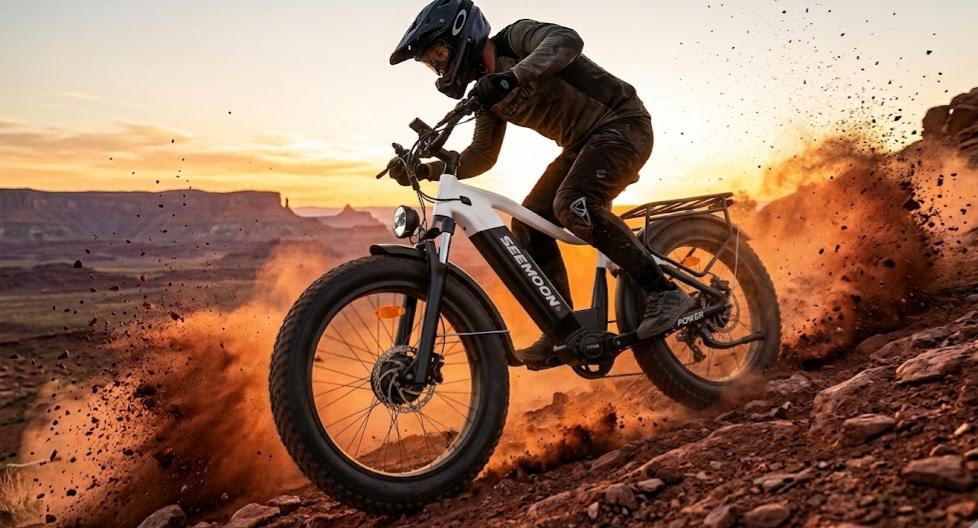
What Makes a True Off Road Ebike?
The landscape of outdoor exploration is undergoing a massive electrical shift. Whether you’re navigating the slickrock of Moab, Utah, or pushing through a snow-covered logging road in the Colorado backcountry, a standard recreational electric bicycle simply won't cut it. To survive and thrive in the wilderness, you need a purpose-built off road ebike.
But with the US market currently flooded with "fat tire" cruisers masquerading as trail machines, how do you separate the pavement-pounders from the true all-terrain beasts? After hundreds of hours of rigorous trail testing, we've identified the non-negotiable elements a premier electric off road bike must feature in 2026:
- All-Wheel Drive (AWD) Capability: Independent front and rear motors (such as a dual 1000W setup) to ensure maximum traction when a standard rear-drive system spins out.
- High-Voltage Architecture: A 52V system (minimum) to combat voltage sag, manage thermal output, and deliver sustained, high-torque power.
- Extreme Payload Capacity: A reinforced 6061 aluminum frame capable of supporting 330 lbs (150 kg)—perfectly accommodating "Big and Tall" riders and heavy outdoor gear.
- Hydraulic Stopping Power: Front and rear hydraulic disc brakes to safely halt heavy momentum on steep, unpredictable descents.
- Mechanical Redundancy: A reliable manual drivetrain (like a Shimano 7-speed) to ensure you can always pedal your way out of the woods if the battery depletes.
If you’re ready to venture far beyond the pavement, this guide will break down the exact technology, physics, and mechanics you need to conquer the wild.
The Heart of the Beast: Why Dual-Motor AWD and 52V Systems Dominate Off-Road E-Bikes
When you push an electric mountain bike to its absolute limits, the powertrain dictates whether you conquer the mountain or face a grueling "hike-a-bike" up a 40-degree grade. The core difference between a casual cruiser and an extreme all-terrain machine lies in the engineering interplay between system voltage and motor configuration.
Let's look under the hood to see what actually drives peak off-road performance.
Why 52V is the New Gold Standard for Trail Riding
You’ll see plenty of e-bikes on the market boasting 48V systems. While 48V is perfectly adequate for paved urban commuting, the backcountry demands a stronger heartbeat. Enter the 52V architecture—the driving electrical force behind premium off-road models like the Seemoon SM1. From an electrical engineering standpoint, why do those extra 4 volts matter so much? It comes down to thermal management and sustained power delivery.
To produce the same amount of wattage (P = V× I), a 52V system requires less current (I) than a 48V system. Because heat generation from electrical resistance (Joule heating, calculated as P = I² ×R) increases exponentially with current, operating at a higher voltage means the system runs significantly cooler under heavy loads.
During our field tests on steep singletracks, this efficiency creates three distinct advantages:
- Zero Voltage Sag: When a 52V 20Ah battery drops to 40% capacity, it still delivers punchy, aggressive acceleration, eliminating the sluggish "sag" that plagues depleted 48V models.
- Reduced Thermal Throttling: Lower current generates less heat, which protects the Battery Management System (BMS) and motor controllers from overheating and shutting down on long climbs.
- Consistent Power Band: You get the same predictable, high-output throttle response from peak charge all the way down to the bottom of the battery's discharge curve.
Unleashing 3,000W Peak Power and 160 Nm of Torque
Horsepower might dictate your top speed on a fire road, but torque is what actually gets you out of the mud. Torque is the raw twisting force required to physically rip you out of a deep rut or propel you over a fallen tree trunk.
Standard mid-drive or rear-hub e-bikes typically top out around 60 to 80 Nm of torque. However, a true dual-motor behemoth—utilizing twin 1,000W hub motors—completely rewrites the rules of traction. This setup generates a staggering 3,000W of peak power and 160 Nm of combined torque, pushing the e-bike's performance envelope directly into dirt bike territory.

If you’re still debating whether a single rear motor is enough for your local trails, or if you need the absolute maximum traction of an AWD system, dive into our comprehensive comparison to find the best off road electric bike with dual motors.
Mastering the Terrain: The Physics of Intelligent AWD Control
In the world of high-performance off-road e-bikes, raw wattage is a commodity; intelligent distribution is the luxury. Without a sophisticated controller to bridge the gap between the battery and the dirt, "unbridled power" quickly becomes a liability—leading to lost traction, thermal throttling, and wasted watt-hours.
The SM1 moves beyond the rudimentary "on/off" logic of budget builds. It utilizes a multi-layered control matrix that synchronizes dual-motor output with rider input. Here is how our 5-mode logic optimizes your ride for both efficiency and "get-out-of-jail" torque.
1. Eco-Efficiency: The "Single-Motor Cruise"
When the terrain is predictable—think hard-packed fire roads or asphalt transitions—AWD is a drain on your range. In Eco Mode, the system optimizes for longevity by disengaging the front hub and putting the workload entirely on the rear motor. By leveraging a lower Pedal Assist System (PAS) floor and the high energy density of the 52V 20Ah battery, the SM1 can achieve a massive 105-mile range. It’s the perfect setting for "exploration mode," where conserving juice for the final climb is the priority.
2. The "Red Button" AWD Burst: Instant 4x4 Recovery
The defining feature of a professional-grade controller is its latency—or lack thereof. Off-road conditions shift in milliseconds. One moment you’re on a firm trail; the next, you’re sinking into an ankle-deep patch of powdery snow or loose gravel. When the rear wheel begins to "wash out" or lose its bite, the SM1’s AWD Toggle (The Red Button) acts as your tactical bailout:
- Instant Engagement: A thumb-press awakens the front hub motor immediately, providing a 1:1 power distribution.
- Vectoring Torque: By activating the front drive, you gain "pulling" force. This stabilizes the front end and prevents the bike from "plowing" into soft obstacles.
- Throttle Overdrive: In high-stakes situations, the twist throttle provides an immediate surge of torque to pull the front wheel up and over obstacles that would stall a single-motor bike.
Mechanical Integrity: Frame Geometry, Payload, and Gearing
A hyper-powerful motor is only as good as the chassis that contains it. Without superior structural engineering, high-torque output will literally twist a budget frame out of alignment. When evaluating an electric off-road bike, you must look past the flashy LCDs and critically examine the "skeleton" of the machine.
The 330-lb Payload Benchmark: Engineering for Big and Tall Riders
For too long, the US market has been flooded with "one-size-fits-all" e-bikes that fail under the demands of larger riders. For the Big and Tall community, a sub-par build translates to wobbly frames, bottomed-out suspensions, and frequent spoke failure.

A true wilderness machine relies on a 6061 T6 aircraft-grade aluminum alloy frame. This specific tempering process provides the optimal strength-to-weight ratio and high yield strength, creating a rigid backbone capable of a 330 lbs (150 kg) maximum payload. This extreme rating serves two professional-grade purposes:
- Dynamic Stability: It provides riders over 250 lbs with a rock-solid, confidence-inspiring ride that eliminates frame flex during high-torque acceleration or high-speed descents.
- Backcountry Utility: It transforms the bike into a high-capacity "pack mule." Whether you’re hauling heavy canvas tents, coolers, or hunting gear on a reinforced rear rack, this overhead in payload is your primary safety margin.
The Shimano 7-Speed: Your Mechanical "Bailout" System
In the backcountry, "range anxiety" isn't just a nuance—it’s a safety concern. This is why mechanical redundancy is a non-negotiable requirement for any serious off-road build. No matter how much capacity your 52V or 60V battery holds, a professional e-bike must remain a fully functional cycle if the electronics fail.

The Shimano 7-speed drivetrain acts as your ultimate fail-safe. By utilizing a wide-range cassette, you gain access to a dedicated "granny gear"—a low-indexing cog that provides the mechanical advantage needed to climb steep grades under human power alone. While it lacks the effortless pull of a 3000W peak motor, this gearing ensures you are never stranded. If grueling terrain or sub-zero temperatures drain your cells faster than anticipated, you can drop the chain, find your cadence, and pedal back to basecamp.
(For the technical enthusiasts interested in derailleur tolerances and chain tension management, refer to the Shimano Official Technical Documentation).
Stopping a Juggernaut: The Necessity of Hydraulic Brakes
Let’s do some quick physics: Momentum equals mass multiplied by velocity. Take a heavy-duty e-bike, add a 250-lb rider, strap on 40 lbs of camping gear, and accelerate to a top speed of 36 mph on a downward slope. You are generating a terrifying amount of kinetic energy. Attempting to stop that mass with traditional mechanical wire-pull brakes is a recipe for a white-knuckle disaster—the steel cables will stretch, and the brake pads will glaze over from friction heat.

This is exactly why front and rear hydraulic disc brakes are non-negotiable. Hydraulic systems use a sealed fluid line to transfer force from the brake lever directly to the calipers with zero loss. This results in:
- Instantaneous bite: Zero cable stretch means the moment you pull the lever, the calipers clamp down hard.
- Superior Modulation: You can feel exactly how much pressure you are applying, which is critical for preventing accidental wheel lock-ups and skids on slippery mud or ice.
- Heat Dissipation: Mineral oil or DOT fluid handles the extreme temperatures of a long descent far better than mechanical friction.
Of course, hydraulic systems—just like the IP54 waterproof electrical components on the bike—require specialized care to maintain their peak performance. To ensure your stopping power never fades on the trail, be sure to bookmark our expert off road electric bikes maintenance guide.
Ergonomics & Integration: Mastering the Long-Range Backcountry Haul
Off-grid endurance riding is a game of attrition. When you’re deep in mountain terrain, rider fatigue isn't just an inconvenience—it’s a performance bottleneck. While the 26x4.0" high-volume pneumatic tires provide the primary undamped suspension (allowing for "low-PSI flotation" to maximize the contact patch), the true secret to surviving an 8-hour trek lies in the cockpit ergonomics and the onboard tech ecosystem.
Precision Ergonomics: The Adjustable Stem
Biomechanical efficiency is often overlooked in the e-bike world. Every rider’s wingspan and torso length requires a specific reach and stack height to maintain a neutral spine.
- The Benefit: The SM1 features an adjustable alloy stem, allowing you to fine-tune the handlebar sweep and rise.
- The Result: By optimizing your "rider triangle," you shift weight off the ulnar nerve and lumbar discs, virtually eliminating the neck strain and wrist numbness common during high-vibration, technical climbs.
The Wilderness Navigation Hub: Off-Grid Continuity
In the backcountry, a dead battery is a safety hazard. We’ve engineered the SM1 to serve as a mobile command center, integrating a ruggedized phone mount with a dedicated USB-A charging port wired directly into the primary 48V (or 52V) system.
- Always-On GPS: This allows for continuous use of high-drain mapping apps like Gaia GPS or onX Offroad without the "range anxiety" of a dying smartphone.
- Seamless Integration: Your device becomes an extension of the bike’s instrumentation, providing real-time telemetry alongside topo maps.
360° Safety: All-Weather Utility & Photometrics
Survival in the wilderness means being prepared for the "Golden Hour" to turn into total darkness. The SM1 is equipped with a professional-grade visibility suite:
- Hydrodynamic Fenders: High-coverage factory fenders protect your drivetrain and gear from corrosive mud and swamp debris, ensuring your components stay grit-free.
- Integrated Lighting System: Beyond a standard high-lumen headlight, the SM1 includes a reactive taillight and integrated turn signals. This isn't just for road legalities; it provides essential spatial awareness when riding in a convoy or navigating back to camp under low-visibility conditions.

Trail Etiquette, Laws, and Your Next Expedition
Owning a dual-motor, 52V performance beast completely redefines your outdoor lifestyle. It blurs the line between traditional mountain biking and motorized overlanding. You can use its whisper-quiet, stealthy built-in battery system to navigate hunting grounds without spooking wildlife, or you can conquer steep, rocky ascents previously reserved for gas-guzzling ATVs.
However, with massive power comes the responsibility of compliance. Because high-performance models like the SM1 feature a twist throttle and can hit speeds up to 32-36 mph, they often fall outside the standard Class 1 or 2 e-bike definitions. This classification dictates exactly where you can legally ride.
Before you load your rig into the back of your pickup truck and head to the National Forest, make sure you know which public lands welcome your machine. You can cross-reference local regulations via the BLM’s official e-bike policies.
Start planning your next epic, street-legal expedition by exploring our roundup of the top US trails and laws for electric off road bikes.
The wild is calling. It’s time to power up and claim your territory. [Shop the Seemoon SM1 Today and conquer any terrain]
Expert FAQ: Electric Off-Roading Demystified
Q1: A 3000W peak dual-motor off-road ebike sounds intimidating. Is it hard to control for a beginner?
A1: While it possesses immense torque (160Nm), it is highly manageable. Systems like the SM1 feature 5 distinct pedal-assist modes. Beginners can start in Eco mode using only the rear motor. The front motor (AWD) is activated on-demand via a toggle switch, allowing you to build confidence safely.
Q2: What is the optimal tire pressure (PSI) for 26x4.0 fat tires off-road?
A2: It depends strictly on the terrain. Because these are pneumatic rubber tires with inner tubes, you have great flexibility. For deep snow or loose sand, dropping the pressure to 8-10 PSI maximizes the contact patch and floatation. For hard-packed dirt trails, 15-20 PSI reduces rolling resistance while maintaining suspension benefits.
Q3: How long does the 52V 20Ah battery take to charge, and can I leave it plugged in overnight?
A3: A full charge from dead takes approximately 10 hours. While the built-in Battery Management System (BMS) provides overcharge protection, best practices for lithium-ion longevity suggest unplugging the charger once it reaches 100%. We do not recommend leaving it plugged in unattended for multiple days.
Q4: Can I ride this e-bike in heavy rain or cross shallow streams?
A4: Yes, within reasonable limits. The vehicle features an IP54 waterproof rating, meaning it is protected against splashing water from any angle and light to moderate rain. The built-in battery design further shields critical electronics. However, it is not a submarine; never fully submerge the motor hubs or the bottom bracket in deep rivers.
Q5: What is the real-world range if I use the throttle and AWD constantly?
A5: The maximum quoted range is 105 miles (achieved in Eco mode, pedal-assist only, on flat terrain). If you are relying heavily on the twist throttle, keeping both 1000W motors engaged, and tackling steep inclines, expect the real-world range to drop to the 35-50 mile spectrum—which is still exceptionally high for aggressive trail riding.
Share:
The Ultimate SM3 DIY Manual: Assembly Mistakes to Avoid, Error Codes & Maintenance
How to Choose the Best Off Road Ebike: Dual Motor vs. Single Motor