
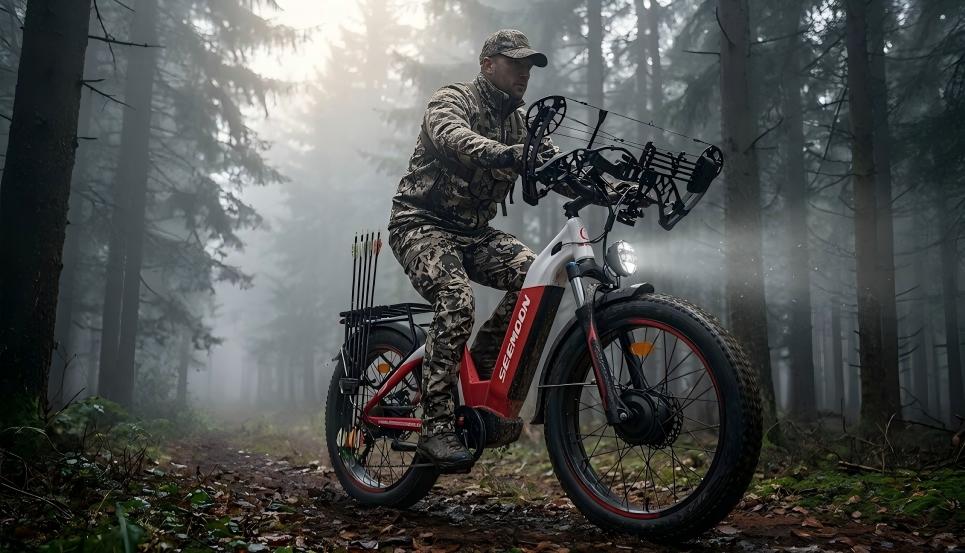
For decades, accessing deep backcountry hunting grounds meant a grueling hike or relying on loud, gas-guzzling ATVs that spook game miles away. The modern hunting ebike has completely disrupted this paradigm. Engineered for extreme payloads, rugged off-grid terrain, and absolute stealth, purpose-built electric hunting bikes are rapidly becoming the most critical piece of tactical gear for serious hunters across the United States.
But what separates a true hunting ebike from a standard fat-tire commuter? This guide breaks down the engineering, the tactical advantages, and exactly what specifications you need to evaluate before investing in your next overland rig.
1. What Exactly is a Hunting eBike?
A hunting ebike is not simply a standard electric bicycle slapped with a camouflage paint job. It is a high-performance utility vehicle engineered specifically for off-road extraction, steep gradients, and heavy payload transport.
Unlike urban e-bikes, hunting models prioritize structural integrity and maximum torque. They are built around reinforced chassis—typically utilizing aviation-grade 6061 aluminum alloy frames—to maximize torsional rigidity. This ensures the frame does not flex or suffer from harmonic resonance ("death wobble") when navigating rocky inclines while hauling an additional 100 pounds of gear or game. From heavy-duty suspension forks to puncture-resistant fat tires, every component is selected for backcountry survival.

2. Why Modern Hunters Need a Dedicated Hunting eBike
The transition from traditional off-road vehicles to hunting ebikes offers distinct tactical advantages in the field.
-
Absolute Acoustic and Olfactory Stealth: Internal combustion engines (ATVs and UTVs) generate noise that travels for miles and exhaust fumes that alert animals with keen senses of smell, like whitetail deer and elk. Electric motors operate in near silence and produce zero emissions, allowing you to slip into bedding areas completely undetected.
-
Unmatched Terrain Penetration: Standard ATVs are restricted by trail width. A hunting ebike can navigate narrow single-track trails, weave through dense timber, and access public land areas where wider motorized vehicles are prohibited.
-
Rapid Deployment and Logistics: Ebikes eliminate the need for heavy trailers. They can be easily loaded into the bed of a standard pickup truck or mounted to a hitch carrier, drastically reducing your setup time at the trailhead.
3. E-Bike Hunting Ethics and Regulations in the US
Navigating the legal landscape of e-bike usage on public lands is crucial for maintaining hunting privileges and respecting conservation efforts.
Federal agencies like the Bureau of Land Management (BLM) and the United States Forest Service (USFS) generally classify e-bikes as motorized vehicles. Therefore, they are typically restricted to trails approved for motorized use. However, regulations are rapidly evolving. Many local jurisdictions differentiate between:
-
Class 1: Pedal-assist only, top speed 20 mph.
-
Class 2: Throttle-actuated, top speed 20 mph.
-
Class 3: Pedal-assist only, top speed 28 mph.
Always consult local state wildlife agencies and specific Game Management Unit (GMU) regulations before your hunt. Furthermore, if your route crosses private land, securing written permission from the landowner is non-negotiable.
Using a silent, zero-emission vehicle often makes landowners more receptive, as it aligns with "Leave No Trace" principles and minimizes trail degradation.

4. What to Look for When Choosing the Best Hunting eBike
When choosing a hunting e-bike, focus on physics and engineering principles, not marketing jargon. Here are the key specifications to consider:
-
Drivetrain & Motor Architecture: Single rear-hub motors often struggle in deep mud or snow. For true off-road dominance, look for AWD (All-Wheel Drive) systems featuring front and rear dual hub motors. This setup provides superior traction, preventing the rear wheel from washing out on loose, steep inclines.
-
Battery Capacity & Voltage: Cold weather causes voltage sag, which depletes battery life rapidly. A robust power delivery system, such as a 52V architecture paired with a high-capacity (e.g., 20Ah) lithium-ion battery, is essential to maintain consistent output and achieve a long range when temperatures drop below freezing.
-
Payload and Extraction Capacity: The bike must support the rider, weapon systems, tree stands, and the harvested animal. Ensure the bike has a rated payload capacity exceeding 330 lbs and is compatible with heavy-duty game carts.
-
Braking Systems: Mechanical brakes will fail under the extreme heat and stress of descending a mountain with a heavy load. Hydraulic disc brakes are a mandatory safety requirement for reliable, fade-free stopping power.
-
Tires: 4-inch or wider fat tires allow you to run lower tire pressures, creating a larger contact patch for grip over rocks, snow, and loamy soil.

5. Tactical Riding Tips for Your Hunting eBike
Owning the gear is only half the battle; knowing how to deploy it maximizes your success rate.
-
Intelligent Power Management: If your bike features dual motors, use the single motor mode on flat, hard-packed fire roads to conserve battery. Engage the dual-motor AWD system only when approaching steep gradients, deep mud, or when hauling a heavy game cart.
-
The Stealth Approach: When you are within a few hundred yards of a known bedding area or your tree stand, disengage the throttle. Drop your Pedal Assist System (PAS) to level 0 or 1. Pedaling manually at low speeds minimizes the sound of tire tread crunching over dry leaves and gravel.
-
Strategic Route Planning: Cold weather and heavy payloads drain batteries faster. Map your routes using GPS topographic software to avoid unnecessary elevation gains.
6. Spotlight: Why the Seemoon SM1 is the Ultimate Hunting Rig
When we engineered the Seemoon SM1 Hunting Ebike, we analyzed the failure points of traditional e-bikes in hunting scenarios and built a machine that answers every tactical demand.
The SM1 is built on a rugged 6061 aluminum alloy frame, providing the structural rigidity required for heavy off-road use without adding unnecessary dead weight. Powering through the backcountry is effortless thanks to its front and rear dual hub motors, which deliver an astonishing 4000W of peak output power. This AWD system guarantees you have the raw torque needed to drag a 200-lb buck out of a deep ravine.
Energy is supplied by a massive 52V 20Ah lithium-ion battery pack, offering an extended range of up to 100 miles on optimal pedal assist—ensuring you never suffer from range anxiety deep in the woods. Crucially for center-of-gravity management and structural strength, the battery is engineered to be removed from the bottom of the downtube, rather than the top. This keeps the weight low, vastly improving handling and stability over technical terrain. Paired with all-terrain fat tires, the Seemoon SM1 is not just a bike; it is a premier backcountry extraction tool.

7. Conclusion
Investing in a high-quality hunting ebike is one of the most impactful upgrades you can make to your hunting arsenal. By prioritizing acoustic stealth, AWD capability, proper thermal management, and rugged frame construction, you can hunt deeper, stay longer, and extract your harvest with unprecedented ease.
Choose the best hunting e-bike-Seemoon SM1, respect the land regulations, and elevate your 2026 hunting season.
8. Frequently Asked Questions (FAQ)
Are hunting ebikes street legal? This depends heavily on local laws and the specific class of the ebike. Most high-powered hunting ebikes (like those with 4000W peak power) exceed standard street-legal Class 1, 2, or 3 definitions and are classified strictly for Off-Highway Vehicle (OHV) use on private land or designated OHV public trails. Always check your local Department of Motor Vehicles (DMV) and trail regulations.
Can a hunting ebike actually pull a loaded game cart? Yes, absolutely. Ebikes equipped with dual hub motors and high-voltage systems (like the Seemoon SM1) generate immense low-end torque, making them highly capable of towing game carts loaded with deer, elk quarters, or heavy camping gear over varied terrain.
How do I maintain my ebike battery during late-season winter hunts? Lithium-ion batteries lose efficiency in freezing temperatures. Keep your battery stored indoors at room temperature until you are ready to ride. If sitting in a tree stand for hours, consider removing the battery from the downtube and keeping it wrapped in an insulated sleeve or inside a warm pack to prevent voltage sag.
Share:
Where to Ride: The Ultimate Guide to US Trails and Laws for Electric Off Road Bikes
The Ultimate Guide to All-Terrain E-Bikes: Conquer Any Trail in 2026