
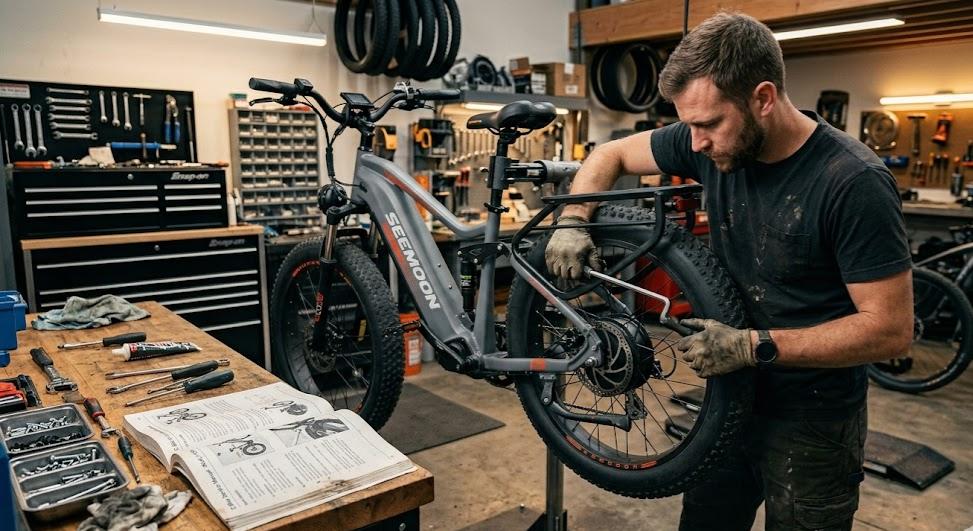
The DIY Revolution: Mastering High-Performance E-Bike Maintenance
If you own a high-performance electric bike, you already know the frustrating reality of the US bicycle industry: many Local Bike Shops (LBS) refuse to work on direct-to-consumer e-bikes. Even if they do, you are looking at labor rates of $100 to $150 an hour just to diagnose a loose cable.
At Seemoon, we engineer our bikes around a fundamental principle: the Right to Repair.
We know the Seemoon SM3 is a serious piece of machinery. Pushing 6,000W of peak power through a robust 60V architecture, it blurs the line between a bicycle and a lightweight electric motorcycle. But high voltage shouldn't equate to high maintenance barriers. That is why the SM3 is built on a strict modular, plug-and-play philosophy. You do not need a degree in electrical engineering to keep your drivetrain running at peak efficiency—you just need the right technical roadmap.
-
Critical Assembly Diagnostics: How to identify and avoid the most common (and potentially hazardous) out-of-the-box setup mistakes.
-
Decoding the Controller: A complete, technical breakdown of the SM3’s onboard diagnostic Error Codes and exactly how to clear them.
-
Advanced Battery Management: Actionable, chemistry-based strategies to optimize your massive 1,800Wh lithium-ion pack and effectively double its lifecycle.
1. Critical Assembly Warnings: Read Before You Ride
When your SM3 arrives, you will need to perform some basic assembly (attaching the front wheel, handlebars, and pedals). While the process takes less than 45 minutes, there are two catastrophic mistakes that new builders frequently make.
Fatal Mistake 1: The Reversed Front Fork
Because the bike is packed tightly in foam, the front suspension fork is often spun 180 degrees backwards during shipping. If you mount the front wheel without rotating the fork to the correct position, you compromise the entire geometry of the bike.
-
The Physics of "Trail": Bicycles stay upright because of a steering geometry measurement called "Trail." When the fork is facing forward, the wheel trails behind the steering axis, creating self-centering stability. If you reverse the fork, you create negative trail.
-
The Danger: At 5 mph, a reversed fork just feels "twitchy." At 45 mph, a reversed fork will instantly trigger a violent, unrecoverable "Death Wobble" (Tank Slapper), throwing you from the bike.
-
The Check: How do you know it’s right? Look at the front brake caliper. The brake caliper must be on the LEFT side of the bike, sitting BEHIND the suspension fork tube. The suspension arch (the bridge connecting the two lower tubes) should be facing forward.

Fatal Mistake 2: The Motor Cable Alignment
The rear dual-motor system connects to the controller via a thick, heavy-duty 9-pin high-current connector located on the lower chainstay.
-
The Mistake: Users try to force the two ends together without aligning the internal pins, or they twist the connector to make it fit.
-
The Result: Twisting this cable bends or snaps the fragile brass data pins inside. If a bent data pin touches a high-voltage power pin when you turn the bike on, you will short-circuit the system and instantly fry the controller (leading to a permanent Error 09).
-
The Fix: Look closely at both the male and female ends of the plug. You will see Embossed Arrows molded into the rubber. Align the arrows perfectly, and push straight in. Do not twist. You must push hard enough that the "Waterproof Line" (a colored ring on the plug) disappears completely.
2. The "Care Package": What’s In Your Box & Why
Unlike traditional brands that nickel-and-dime you for accessories, every Seemoon SM3 ships with a "Care Package" of spare parts worth over $200. This isn't a marketing gimmick; it is an anti-downtime strategy.
Here is exactly what we give you, and the engineering reason behind it:
-
26 x 4.0 Fat Tire Inner Tube: Have you ever tried to buy a 4.0-inch inner tube at a standard Trek or Specialized dealer? They don't handle them. If you suffer a blowout on a Saturday trail ride, we don't want you waiting two weeks for a shipping replacement. You have the part on Day 1.
-
Sintered/Ceramic Brake Pads: Stopping a 107 lb bike (plus rider weight) from 45 mph generates extreme kinetic heat. Standard organic/resin brake pads will glaze over and wear out in a few weeks of aggressive riding. We include high-temperature sintered pads so you can swap them out the moment your braking power fades.
-
Portable Hand Pump: Fat tires require dynamic tire pressure management. You need a pump to drop your pressure to 5 PSI for beach riding, and immediately pump it back to 20 PSI when you hit the pavement.

Want to learn exactly how to use tire pressure to conquer deep powder? Read our [Snow & Sand Riding Guide: Handling Heavy All-Terrain E-Bikes]
3. Troubleshooting: The Error Code Dictionary
Your SM3 is equipped with a smart controller and a color LCD display that acts as an onboard diagnostic tool. If the system detects a fault, it will flash an "E" code.
Instead of paying a mechanic to look at it, use this expert-level diagnostic table to fix it yourself in your garage.
| Error Code | Official Meaning | The Real-World Cause | The DIY Fix / Diagnostic Step |
| E06 | Undervoltage | The controller thinks the battery is dead. |
1. Charge battery. 2. Expert Check: Check your P-Setting (P15). If P15 is accidentally set to 72V instead of 60V, the bike will think a fully charged 60V battery is "dead." |
| E07 | Motor Hall Failure | The display lost communication with the motor's internal sensors. | 90% of the time, the motor isn't broken. The 9-pin motor cable connector on the chainstay has vibrated loose after hitting a bump. Unplug it, check for dirt, align the arrows, and shove it back together tightly. |
| E08 | Throttle Failure | The twist throttle is not returning to the "Zero" position. | 1. Did you push the rubber handlebar grip too far inward? If it rubs against the twist throttle, it causes friction, preventing the internal spring from snapping back. Pull the grip out by 2mm. |
| E09 | Controller Fault | Overheating or short circuit in the main controller. |
1. Turn off the bike and let it sit in the shade for 30 minutes to cool the MOSFETs. 2. Check all wiring harness connections for melted plastic. |
| E10 | Comm. Receive Fault | The display cannot "talk" to the controller. | The main wire running from the handlebars down into the frame has been pinched or disconnected. Unplug the green display connector and check for bent pins. |
The Hidden "No Code" Breakdown: Brake Motor Cutoffs
ou’ve got a full charge, the display is glowing, and there isn't a single error code in sight. Yet, when you twist the throttle or kick into pedal assist, the motor remains dead. It’s the ultimate "stealth" malfunction—your e-bike isn't broken; it’s just being too safe for its own good. On performance models like the SM3, the culprit is often the Electronic Brake Cut-off (EBC) system.
The Culprit: The SM3 features electronic brake cut-offs. Whenever you pull the brake lever, a sensor kills the motor power for safety. If your brake lever gets sticky from trail mud and fails to snap back that final 1 millimeter, the sensor stays engaged. The bike thinks you are braking, so it ignores the throttle.
The Fix: Manually push both brake levers outward (away from the handlebars). If the motor suddenly responds, you simply need to clean and lubricate the pivot hinges on your brake levers.
4. Advanced Battery Management: Safeguarding Your 1800Wh Investment
The 60V 30Ah Lithium-Ion battery is the heartbeat of your SM3—and its most significant financial component. While these high-density cells are robust, their lifespan is dictated by chemical discipline. Treat your battery with "set it and forget it" apathy, and you’ll see capacity fade within a year. Treat it like an engineer, and you’ll maintain peak performance for thousands of miles.
The "At-a-Glance" Status Check
Efficiency starts before you even mount the battery. The SM3 is equipped with an integrated LED State-of-Charge (SoC) indicator on the battery casing itself. By pressing the physical tactile button on the top housing, you can verify voltage levels without the 15 lb heavy lifting of a full installation. This is your primary tool for monitoring health during the off-season.
The 40–60% Storage Protocol: Avoiding Chemical Stress
Lithium-ion chemistry is most stable when it isn't at the extremes of its voltage range. If you plan to sideline your bike for more than three weeks, you must manage its "resting state" to avoid permanent degradation.
-
The 100% Trap (Oxidative Stress): Storing a battery at a "full" 100% charge keeps the cells at high voltage, accelerating the breakdown of the electrolyte and causing oxidative stress. This permanently "shrinks" your fuel tank, reducing your total range over time.
-
The 0% Trap (The Brick Risk): Storing a battery empty is a gamble. Because all lithium cells suffer from parasitic drain (self-discharge), a battery stored at 0% can drop below its critical voltage threshold. If this happens, the Battery Management System (BMS) will trigger a permanent "hard lock" to prevent a fire hazard during future charging. At that point, your battery is effectively a paperweight.
-
The Golden Zone: For long-term storage, aim for a 40% to 60% charge (approx. 58V–60V). Keep the unit in a climate-controlled, dry environment. Check the physical indicator once a month; if it drops below the 40% threshold, give it a brief "maintenance charge."

Thermal Safety: The "Lithium Plating" Danger
Temperature is the silent killer of lithium-ion performance. While you can discharge (ride) in cold weather, you must never charge a battery when its core temperature is below 32°F (0°C). Attempting to charge a frozen battery causes a destructive phenomenon known as Lithium Plating. Instead of the lithium ions smoothly intercalating into the anode, they crystallize into sharp, metallic "dendrites." These spikes can puncture the internal separator, leading to an internal short circuit and potential thermal runaway (fire).
Pro Tip: If you’ve just finished a winter ride, don't plug in immediately. Bring the battery indoors and allow it to reach an ambient room temperature (approx. 2 hours) before connecting the charger.
Conclusion: Mastering the Machine
When you purchase a generic department-store e-bike, you’re buying a disposable consumer product. When you invest in a Seemoon SM3, you are commissioning a high-voltage, high-torque performance vehicle.
True ownership of a machine this powerful goes beyond the saddle. It requires transitioning from a casual rider to a deliberate operator. By mastering the mechanical geometry of your front fork, learning to interpret on-board diagnostic (OBD) error codes, and managing lithium-ion battery chemistry with precision, you ensure the longevity and safety of your investment.
Don't hesitate to engage with the hardware. Grab your torque wrench, reference your schematics, and maintain your machine at its absolute peak. In the world of high-performance e-mobility, you don't just ride the SM3—you own it.
Ready to put this maintenance knowledge to the test? Get out and ride. If you need a refresher on the bike's raw specifications, check out the [Ultimate Guide to High-Performance Fat Tire Electric Bikes].
Share:
Folding vs. Solid Frame Fat Tire E-Bikes: Why We Chose Stability Over Portability
The Ultimate Guide to Off Road Ebikes in 2026: Conquer Any Terrain