
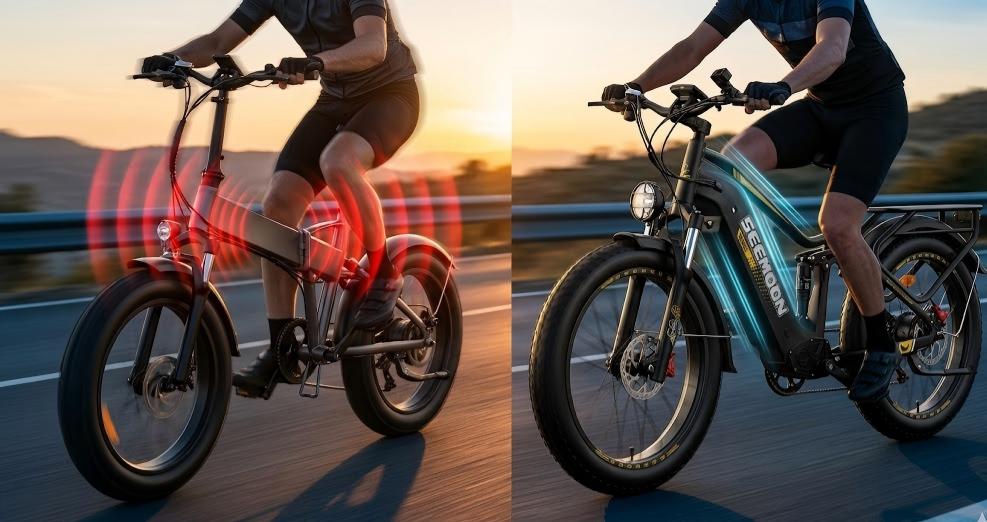
In the current US e-bike landscape, the "folding fat tire" segment is witnessing explosive growth. The value proposition is undeniably seductive: a rugged off-road machine capable of fitting neatly into the trunk of a Honda Civic. It is marketed as the ultimate "no-compromise" solution. However, at Seemoon, we engineer vehicles, not toys. When developing the Seemoon SM3, we made a conscious—and controversial—decision to reject the folding mechanism entirely.
Why? Because physics is unforgiving.
Convenience often comes at the cost of structural integrity. When you are pushing 6000W of peak power and approaching speeds of 45 mph, a folding hinge is not just a feature; it is a fulcrum for failure. Introducing a break in the frame's geometry creates a critical weak point susceptible to torsional flex, which can be catastrophic under high-velocity loads.
In this deep dive, we are stripping away the marketing hype to examine the engineering reality. We will analyze the critical distinctions between folding mechanisms and the SM3’s unibody 6061 Aluminum Alloy chassis. From the terrifying dynamics of "Speed Wobble" (shimmy) to the hidden maintenance nightmare of severed internal wiring, we are practicing Radical Transparency. If you want a bike that fits in a suitcase, buy a folder. If you want a machine built to handle 6000W safely. Please continue reading this article.
1. Why Torsional Rigidity Outweighs Wattage at High Speeds
When evaluating a high-speed e-bike, buyers often obsess over motor wattage and battery capacity. But the true differentiator for safe, predictable handling isn't raw power—it’s torsional rigidity. This is the frame’s ability to resist twisting forces under heavy load. While folding e-bikes offer unbeatable storage convenience, their inherent structural compromises quickly become a serious liability at highway speeds.
The Hinge: A Structural Chokepoint
Folding e-bikes rely on a central hinge and a locking clamp to hold the chassis together. At typical Class 1 or Class 2 speeds (under 20 mph), the mechanical stress on this joint is manageable. However, as you push into 45 mph territory, the physics shift radically.
Because the kinetic energy managed by the frame increases exponentially with velocity ($E_k = \frac{1}{2}mv^2$), hitting a pothole or leaning into a high-speed sweeper places immense lateral force on the bike. Under these conditions, a folding frame naturally flexes around its pivot point. This "micro-flex" might feel like a minor quirk at 15 mph, but at 45 mph, it’s the precursor to catastrophic instability.
Decoding the "Death Wobble" (Harmonic Resonance)
In the motorcycling world, riders dread the "tank slapper." On a high-speed e-bike, this terrifying phenomenon is caused by harmonic resonance. Here is how a compromised frame loses control:
-
The Trigger: A minor road imperfection or an abrupt steering input sends a sudden shockwave through the chassis.
-
The Oscillation: Because a hinged e-bike is not a continuous, solid structure, the front and rear halves of the frame begin oscillating at slightly different frequencies.
-
The Feedback Loop: Combined with the elongated, flexible steering stems typical of folding models, these vibrations amplify instead of dampening out. The result is a violent, escalating side-to-side handlebar shake that is nearly impossible to recover from at high velocity.
The Seemoon SM3 Approach: Solid-Frame Architecture
We engineered the Seemoon SM3 specifically to eliminate the vague, "noodle-like" handling that plagues high-powered folding bikes. We chose a rigid, non-folding 6061 Aluminum Alloy architecture for one non-negotiable reason: uncompromising rider safety.
By removing the hinge, we created a continuous triangular space-frame extending from the head tube all the way to the rear dropouts. In structural engineering, the triangle is the strongest geometric shape, providing a unified, uninterrupted path to safely dissipate kinetic energy.

Planted, Predictable Performance
The difference on the road is immediate. When you're descending a steep grade or holding 45 mph on a straightaway, the SM3 feels completely locked in. The front wheel tracks with surgical precision because the chassis behaves as a single, cohesive unit. You get a ride that is predictable and confidence-inspiring—delivering high-speed thrills completely free of the wandering, hinged-frame wobble.
Deep Dive: Curious about the raw power that requires such a robust chassis? Read our Technical Deep Dive: Safety at 45 MPH and the Physics of High-Voltage Systems.
2. The Hidden Cost of Folding: Wiring Harness Fatigue & Electrical Continuity
In the e-bike industry, there is a technical reality that few manufacturers address transparently: the most frequent failure point in folding designs isn't a structural frame snap—it is systemic electronic severance. While a folding frame offers undeniable portability, it introduces a critical engineering vulnerability known as the Dynamic Stress Point.
The Physics of the "Pinch Point"
In a folding architecture, the main wiring harness—the central nervous system connecting your battery, motor controller, and cockpit display—is forced to bridge the gap across a mechanical hinge. This creates a host of metallurgical and mechanical challenges:
-
Cyclic Fatigue & Work Hardening: Copper is naturally ductile, but it has a finite "flex life." Each fold-unfold cycle subjects the internal copper micro-strands to repetitive bending and torsional strain. In materials science, this is known as cyclic loading.
-
Internal Fracture: Over time, this motion triggers work hardening, where the copper molecules rearrange, becoming brittle and eventually snapping. Because the exterior casing often remains intact, these internal breaks are notoriously difficult to diagnose.
-
Abrasive Short-Circuiting: As the harness shifts within the hinge, the protective insulation can abrade against the metal frame. This leads to exposed conductors and catastrophic short circuits.
-
The Symptom Spectrum: This degradation usually begins with intermittent power flickers or "ghost" shutdowns. It eventually culminates in the dreaded Error 30 (Communication Fault)—a signal that the data stream between your display and controller has been physically severed.
The SM3 Advantage: Static Routing Architecture
The SM3 is engineered with a rigid, non-folding chassis, purposefully designed to implement Static Cable Routing. By removing the pivot point, we have solved the primary cause of e-bike electrical failure.
-
Zero-Stress Integration: Because the frame geometry is fixed, the wiring harness is housed internally through a reinforced downtube. The cables are never forced to stretch, pinch, or twist.
-
Preserved Signal Continuity: By eliminating the "bridge" across a moving hinge, the SM3 ensures that electrical resistance remains constant over the life of the vehicle. There is no mechanical interference to degrade the signal or wear down the insulation.
-
Industrial-Grade Reliability: This static architecture is a cornerstone of the SM3’s durability rating. While folding bikes treat their electronics as a consumable part that will eventually fail due to mechanical wear, the SM3 treats the electrical system as a permanent, protected asset.
The result? An electrical system that stays as robust on year five as it was on day one.

Pro Tip: Already seeing error codes on your current ride? Don't panic. Check out our comprehensive SM3 DIY Maintenance & Troubleshooting Guide to diagnose and fix common electrical faults.
3. Engineering for the Extremes: Defying the Hinge Vulnerability
In the e-bike industry, payload capacity is the ultimate barometer of structural integrity. It isn't merely a weight limit—it is a technical declaration of alloy quality, weld precision, and the fatigue resistance of the chassis. To understand why the SM3 stands apart, one must look at the physics of the "Folding Limit."
The "Folding Limit": A Structural Bottleneck
The vast majority of folding e-bikes are rated for a maximum payload of 220 to 250 lbs. While riders often blame the motor or battery for these limits, the true bottleneck is shear strength.
Standard folding mechanisms rely on a single locking pin to maintain the bike’s geometry. When a frame is overloaded, every pothole or curb-jump creates a massive moment arm of force centered directly on that hinge. At high speeds, the kinetic energy of an impact can exceed the yield strength of the latching mechanism. This leads to the ultimate nightmare for any rider: "mid-motion folding," where the frame begins to collapse under the stress of its own momentum.
The SM3 "Workhorse" Standard: A 330-lb Benchmark
We engineered the SM3 for a 330 lbs (150 kg) payload capacity, effectively moving it out of the "lifestyle" category and into the realm of true utility vehicles. We achieved this through three core engineering pillars:
-
The Factor of Safety (FoS) Principle: Even for a 180-lb rider, a 330-lb rating is critical. In mechanical engineering, this "over-spec" design provides a higher Factor of Safety, ensuring the alloy can withstand hundreds of thousands of vibration cycles without developing the microscopic stress fractures that plague lower-rated frames.
-
Monocoque-Inspired Subframe Logic: Most competitors use "bolt-on" rear racks that act as independent levers, wobbling under load and straining mounting points. The SM3 features a rack integrated directly into the subframe. This architecture distributes vertical load across the entire chassis, neutralizing localized stress.
-
Dynamic Tracking & Geometry: High capacity isn't just about weight; it’s about handling. An over-engineered frame eliminates the "frame-flex" and high-speed wobbles common in folding designs. Whether you’re hauling 80 lbs of backcountry gear or a week's worth of groceries, the SM3 maintains its steering geometry and tracking precision.

The Technical Takeaway: A higher payload capacity doesn't just mean you can carry more—it means the bike is inherently more stable, durable, and safer during every mile of your commute.
(Planning to haul gear through technical terrain? Discover how our reinforced chassis performs in our The Ultimate Guide to the SM3 High-Performance Electric Bike.)
4. Ergonomics: Engineering the "Cockpit" Experience
Stability on a high-speed E-bike isn't just a byproduct of the frame; it’s a direct result of rider geometry and control-point rigidity. In the industry, we call this the "Cockpit Feel." If the interface between the rider and the machine is vague, the ride becomes dangerous.
The Engineering Flaw of Folding Stems
Most folding E-bikes prioritize storage over structural integrity. To allow the handlebars to collapse, manufacturers typically employ a long, vertical telescoping stem. While convenient for a closet, this design introduces two critical failure points in performance:
-
The Lever Effect: Basic physics dictates that a longer lever multiplies force. In a high-speed braking event, a tall stem acts as a giant lever arm, creating significant fore-aft "flex." This instability can lead to speed wobbles or a loss of front-tire traction.
-
Aerodynamic Drag: These stems force an upright, "Dutch-style" posture. At speeds exceeding 28 mph, wind resistance becomes your primary opponent. An upright rider acts like a sail, draining the battery and destabilizing the bike in crosswinds.
The SM3 Solution: A Professional-Grade Adjustable Stem
The SM3 moves away from "commuter-grade" hinges and toward a Direct-Mount Adjustable Stem system. This is a design philosophy borrowed from downhill mountain bikes and performance motorcycles.
1. Zero-Flex Rigidity
By utilizing a shorter, high-gauge alloy stem bolted directly to the steerer tube, the SM3 eliminates the "hinge-point" weakness. When you engage the hydraulic brakes, the force is transferred directly into the suspension and tires rather than being lost in stem flex. The result is a planted, surgical steering feel.
2. Dynamic Geometry Tuning
The SM3 cockpit is fully customizable via high-torque side bolts, allowing you to tune your "Reach" and "Stack" height:
-
Performance Mode: Lower the stem angle for a tucked, aerodynamic "attack position." This is essential for maintaining stability and efficiency during 45 mph top-speed runs.
-
Comfort Mode: Rotate the stem upward for casual urban cruising, reducing strain on the lower back and wrists without sacrificing the structural solidness of the bike.

Pro Tip: For high-speed stability, a lower center of gravity is always superior. By adjusting the SM3 stem to a lower profile, you decrease the bike's aerodynamic profile and improve front-end "bite" during cornering.
5. Logistics & Storage: The Reality of a High-Performance Chassis
When selecting an e-bike, the "honest truth" often boils down to a fundamental trade-off: structural integrity versus portability. While the SM3 delivers a class-leading ride thanks to its rigid, solid-frame construction, that performance requires a specific logistical commitment.
The Portability Paradox: Folding vs. Solid Frame
In the e-bike ecosystem, weight is the tax you pay for power and stability. Folding e-bikes are excellent for "last-mile" commuters navigating tight urban spaces. However, those convenient hinges often introduce "frame flex"—a subtle instability that becomes increasingly noticeable under high torque or at top speeds.
The SM3 takes the opposite approach. With a 107 lb curb weight and an overall length of 78 inches, it is a full-sized machine engineered for high-speed tracking and vibration dampening. This footprint means it won't fit in a standard sedan trunk and is impractical for "walk-up" apartment living. If your daily routine involves three flights of stairs, the SM3’s heavy-duty build may outweigh its utility.
Technical Solution: Automotive Integration
Transporting the SM3 requires a shift in mindset: treat it less like a traditional bicycle and more like a light motorcycle or trail bike. Never attempt to use traditional strap-on or trunk-mounted racks. Most consumer-grade racks are rated for 35–50 lbs. Attempting to mount a 100+ lb e-bike on these systems risks catastrophic structural failure, vehicle damage, and highway hazards.
The Hitch-Mounted Requirement
To safely move the SM3, your vehicle must be equipped with a Class II or Class III 2-inch hitch receiver paired with a heavy-duty, platform-style rack.
-
Load Rating: Ensure the rack is rated for a minimum per-bike capacity of 120 lbs to account for dynamic loading (the extra force generated when hitting bumps at speed).
-
Specialized Hardware: Look for "RV-rated" or "Moto-style" carriers from reputable manufacturers like 1UP, Kuat, or Hollywood Racks. These brands offer the reinforced steel or thick-gauge aluminum trays necessary to support the SM3's wheelbase and weight.
-
Pro Tip (Weight Management): To simplify loading and protect your electronics, always remove the 15 lb lithium-ion battery before lifting. This drops your "lift weight" to approximately 92 lbs, significantly reducing the strain on both your back and the vehicle’s tongue weight capacity.
The Final Verdict on Storage
The SM3 is a "Garage-First" vehicle. If you have ground-floor access and a hitch-equipped SUV or truck, the solid-frame design offers a level of durability and ride quality that folding bikes simply cannot match. It is a machine built for the open road, provided you have the infrastructure to support it.
6. Comparative Engineering Analysis: Solid vs. Folding Frames
When evaluating high-performance e-bikes, the "folding vs. solid" debate extends far beyond storage convenience. It is fundamentally an engineering trade-off between structural rigidity and spatial flexibility. For riders prioritizing high-speed stability and long-term durability, the "raw numbers" reveal a clear technical victor. The following table benchmarks the Seemoon SM3—a flagship solid-frame fat tire e-bike—against industry averages for popular folding models.
Solid vs. Folding Frame Technical Comparison
| Feature | Average Folding Fat Tire E-Bike | Seemoon SM3 (Solid-State Frame) | The Engineering Advantage |
| Max Safe Speed | ~20 – 28 mph | 38+ mph | Stability: Rigid frames eliminate "speed wobble" caused by hinge flex. |
| Payload Capacity | ~250 lbs (113 kg) | 330 lbs (150 kg) | Strength: Uninterrupted 6061 Aluminum tubes distribute stress more efficiently. |
| Wiring Harness | Exposed / Pinched in hinge | Internal / Protected | Reliability: No moving parts means zero risk of wire fatigue or short circuits. |
| Frame Resonance | Develops creaks over time | Silent / Monocoque feel | Quality: Absence of mechanical joints prevents structural "play" and noise. |
| Maintenance | High (Hinge/Latch tuning) | Low (Standard hardware) | Simplicity: Fewer failure points mean more time on the road. |
| Portability | Fits in a standard trunk | Requires Hitch Rack | Trade-off: Mobility is sacrificed for superior ride dynamics. |
7. FAQ: Comparison Guide
Q: Does the SM3 frame rust?
A: No. The frame is precision-engineered from 6061 Aluminum Alloy, which is naturally resistant to oxidation. However, while the chassis is rust-proof, the high-strength steel bolts can corrode if exposed to road salt or ocean air.
Q: Can I remove the battery for transport?
A: Yes. The high-density 60V 30Ah battery is fully detachable. Removing the pack sheds approximately 15 lbs, significantly lowering the bike's curb weight. This makes it much easier to lift onto vehicle racks or carry indoors for climate-controlled charging—which also helps extend the battery’s long-term cycle life.
Q: Is the SM3 frame too large for me?
A: The SM3 is built with a long-wheelbase geometry to maximize high-speed stability.
-
Rider Fit: We recommend a minimum height of 5'4" (165 cm).
-
The Feel: If you are shorter than 5'4", the "reach" (distance to the bars) may feel overly extended. For taller riders, this design provides a planted, "locked-in" feel that excels on open roads and rougher terrain.
Final Verdict: Why Structural Integrity Outperforms Portability
Deciding between a folding e-bike and a rigid-frame powerhouse ultimately forces a choice between two conflicting priorities: convenience versus kinetic stability.
Folding bikes are the quintessential "last-mile" solution. If your primary goal is tucking a commuter tool under a workstation or into a studio apartment closet, the utility of a hinge is undeniable. However, for riders pushing the limits of speed and terrain, every joint is a compromise. In the world of high-performance e-bikes, a hinge isn't just a feature—it’s a potential point of mechanical flex and structural fatigue.
Why the Seemoon SM3 Dominates on Performance
The Seemoon SM3 is precision-engineered for riders who refuse to sacrifice chassis rigidity for a smaller footprint. By utilizing a unified, solid-unit frame architecture rather than a segmented folding design, the SM3 delivers a superior riding dynamic across three critical pillars:
-
High-Velocity Tracking & Stability: At speeds of 45 mph, even minor tolerances in a folding mechanism can translate into "speed wobbles" or unsettling handlebar play. The SM3’s rigid geometry eliminates these oscillations, providing a planted, "on-rails" sensation that is vital for high-speed confidence.
-
Long-Term Mechanical Integrity: Hinges are subject to constant shear stress and vibration. Over time, these moving parts inevitably develop squeaks, rattles, and material wallowing. The SM3’s fixed frame has zero moving junctions, ensuring the bike remains as silent and tight after 2,000 miles as it was on day one.
-
Superior Off-Road Dampening: When navigating gravel fire roads or uneven trails, a frame needs to manage torsional forces. The SM3’s 6061-T6 aluminum chassis acts as a singular harmonic unit, absorbing impacts and distributing stress evenly—forces that would otherwise overstress the locking pins of a folding bike.
The Bottom Line
The Seemoon deliberately trades "trunk-friendliness" for uncompromising power delivery. While it may require a dedicated rack rather than a backseat, that’s a small price to pay for safety. When you’re pinning the throttle on a steep descent or carving through a high-speed corner, you’ll be thankful for the absolute security of a solid frame.
Ready to upgrade to a high-performance fat tire ebike?
Share:
Mastering the Beast: The Ultimate Guide to Riding a 107-lb Fat Tire E-Bike in Snow & Sand
The Ultimate SM3 DIY Manual: Assembly Mistakes to Avoid, Error Codes & Maintenance