
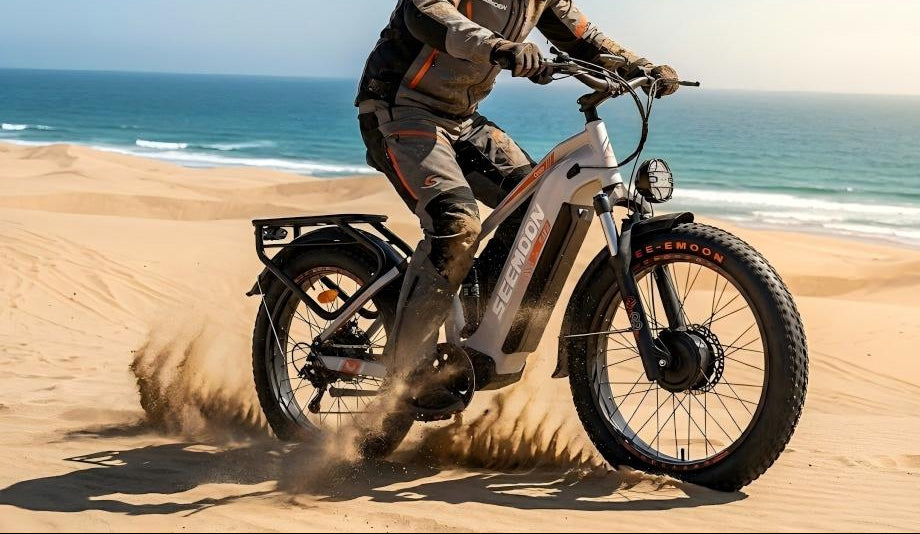
For many overlanding enthusiasts across the United States, the ultimate weekend escape isn't deep in an alpine forest—it’s on the coast. Whether you are hauling a shortboard to a hidden, uncrowded break in Southern California, surf-casting for striped bass on the rugged shores of the Atlantic, or simply cruising the Gulf Coast at sunset, the beach offers a unique breed of off-road freedom.
However, any seasoned local knows that coastal terrain is incredibly deceptive. What looks like a flat, pristine playground is actually a mechanical nightmare for standard bicycles. Deep, dry "sugar sand" will swallow narrow tires whole, coastal headwinds create massive aerodynamic drag, and the highly corrosive mixture of saltwater spray and abrasive quartz sand will rapidly destroy exposed drivetrains and cheap electrical components.
To truly conquer the coastline, you need a heavy-duty machine specifically engineered to float over soft terrain while aggressively resisting the elements. Enter the Seemoon SM3 heavy-duty all-terrain electric bike. Equipped with an All-Wheel Drive (AWD) dual-motor system, a 330 lb payload capacity, and extreme programmable customization, it is the ultimate tactical beach cruiser.
Here is the professional overlander's guide to mastering deep sand, hauling heavy surf gear, and protecting your investment from coastal corrosion.
The Physics of Sand: Overcoming Rolling Resistance
Riding an electric bike on the beach isn't just about raw motor power; Unlike hard-packed dirt or asphalt, loose, dry sand creates massive rolling resistance that actively robs your momentum. If you take a standard rear-wheel-drive commuter bike into soft sand, the torque quickly overwhelms the grip. The rear wheel experiences "trenching"—spinning out and acting like a rotary tiller until the bike is hopelessly bogged down to the axles.
The Flotation Strategy: Maximizing the Contact Patch
To conquer coastal terrain, you need flotation. This is the primary advantage of the SM3’s massive 24x4.0-inch fat tires. However, tire width alone won't get you through the deep dunes; air pressure is the critical variable.
Before hitting the soft sand above the high tide line, experienced coastal riders "air down." Dropping your tire pressure to a radically low 5 to 8 PSI fundamentally changes how the bike interacts with the ground:
-
Expanded Contact Patch: The low pressure allows the thick rubber casing to deform and flatten out against the ground.
-
Weight Distribution: This creates a wide, track-like footprint that distributes the SM3's 107 lb (48.5 kg) weight over a much larger surface area.
-
The "Snowshoe" Effect: Instead of a rigid edge cutting down into the terrain, the flattened tire effectively snowshoes over the top of the soft surface.

When you pair this maximized flotation with the SM3’s All-Wheel Drive (AWD) system—which balances traction by simultaneously pulling from the front and pushing from the rear—you eliminate wheel spin and maintain steady, forward momentum across the beach.
2. Dialing in the Software: Advanced P-Settings for Sand
Hardware is only half the equation when taking a heavy-duty e-bike onto the beach. To get the most out of the SM3 in coastal environments, you need to tune the software. Accessing the advanced engineering parameters—commonly known as P-Settings—via the LCD display lets you tailor the bike's power delivery and metrics to extreme, high-resistance conditions.
P06: Speedometer Calibration for Deflated Tires
Here is a field-tuning trick that most casual riders miss. When you air down your fat tires to 5 PSI for better floatation, the tire flattens out, effectively reducing its rolling diameter. Because the e-bike's controller calculates speed and mileage based on a fully inflated 24-inch wheel, running at low pressure may throws off your dashboard metrics.
To fix this, access the dashboard and adjust Parameter P06 (Wheel Diameter Calibration). By stepping down the wheel diameter value in the system to match the squashed profile of the deflated tire, you recalibrate the computer. This ensures your speedometer stays GPS-accurate and prevents you from miscalculating your remaining battery range on long, remote stretches of coastline.
P14: Controller Thermal Management in Deep Sand
Powering heavy gear through dry "sugar sand" demands sustained, high-amperage draw. This constant resistance creates massive heat buildup inside the motor controller. If you're running fully loaded, pushing the system to its absolute max is a recipe for a thermal shutdown.
To protect the 60V system, the SM3 allows you to throttle the controller via Parameter P14 (Current Limit). Before hitting soft sand, experienced riders will drop the maximum amperage limit slightly—for example, dialing it back from 20A to 16A. While this shaves a tiny margin off your peak burst power, it drastically reduces the heat generated within the controller housing. It's a simple, preventative software tweak that ensures reliable, sustained torque during long, heavy-duty crawls down the beach.
3. Payload Dynamics: Rigging for Surf and Surfcasting
A beach cruiser is only as good as the gear it can haul. Whether you're chasing the early morning swell or lugging a heavy tackle setup down to the jetty, moving unwieldy equipment on two wheels comes down to one critical factor: strategic weight distribution.
Stabilizing Surfboard Racks
Any coastal rider knows that trying to tuck a 7-foot funboard under your arm while riding is a fast track to a wipeout—especially when unpredictable crosswinds kick up off the water. The SM3 is specifically engineered to handle aftermarket side-mounted surfboard racks, largely due to its rigid 6061 aluminum frame and purposeful geometry.
At a substantial 107 lbs, the bike’s curb weight acts as an anchor. More importantly, because the bulk of that mass (the battery and motors) sits low on the frame, the resulting low center of gravity prevents the bike from being destabilized when a strong ocean gust catches the broad side of your board like a sail.
Maximizing the 330 lb Capacity for Anglers
For surfcasters, the SM3 is a legitimate pack mule. It utilizes a structurally integrated, heavy-duty rear rack that pushes the maximum payload capacity to an impressive 330 lbs (150 kg).
A quick rigging tip: When loading a fully stocked Yeti cooler or heavy bait tanks, strap them directly on the rear rack of an electric bicycle rather than hanging that kind of dead weight off one side in a pannier. Keeping a heavy load centered directly over the rear hub presses the tire into the ground, maximizing your traction on loose sand.

Because the SM3's dual-motor setup delivers a massive 200 Nm of torque, loading it down with rods, an umbrella, and a weekend’s worth of ice won't bog down the powertrain. You get the heavy-duty payload of a cargo bike, but you retain total command of your momentum on the beach.
4. Hitting the Surf Zone: Tides, Hardpack, and Water Limits
Riding right on the shoreline—where the receding tide leaves that perfect, concrete-like hardpack—is arguably the best part of taking an e-bike to the coast. The wet sand dramatically drops your rolling resistance, letting you easily hit top speeds while the ocean breeze keeps the motor cool. However, surfing is also completely affected by the ebb and flow of the tide, and any misjudgment of whether the tide is rising or not can lead to serious mechanical failure of electric bicycles.
The Battery Drain of the High Tide
Never launch a long beach run without checking local tide tables. A common rookie mistake is cruising 10 miles down the shoreline on hardpack during low tide, only to get trapped by the incoming high tide on the return trip. The rising water will force you higher up the beach into the deep, powdery dry sand (often called "sugar sand" in the off-road community).
Pushing through soft sand demands massive torque. Your motor will have to continuously draw peak amps just to maintain forward momentum, which generates excess heat and will absolutely cannibalize your battery range—not to mention exhausting you physically. Always time your ride so both legs happen on an outgoing or low tide.
The Axle-Level Water Limit
When it comes to saltwater exposure, the Seemoon SM3 is built to heavy-duty standards. It carries an IP54 water resistance rating and utilizes aviation-grade sealed connectors, meaning it easily shrugs off heavy sea mist, wet sand kick-up, and coastal showers. But a beach cruiser is not a submarine.
If you are crossing a tidal pool or a shallow inlet to reach a fishing jetty, strictly follow this engineering rule: Never let the water level reach the center axle of the hub motors. While the SM3's electrical cables are hermetically sealed, the mechanical wheel bearings located at the axle are vulnerable to hydrostatic pressure. If fully submerged, standing water can force its way past the exterior bearing seals. Once saltwater breaches the stator housing, it strips the mechanical grease and triggers rapid internal corrosion.

Bottom line: If you aren't completely sure how deep a water crossing is, dismount and walk it first.
5. Post-Ride Coastal Maintenance: Beating Saltwater and Rust
Riding your e-bike on the beach is an incredible experience, but the coastal environment is ruthlessly efficient at destroying bicycle components. Saltwater is a highly conductive electrolyte that rapidly accelerates galvanic corrosion between dissimilar metals, while fine quartz beach sand essentially acts as a liquid grinding paste on your moving parts. How you treat your SM3 after rolling off the sand dictates whether it lasts for years or seizes up in a single season.
The Golden Rule of E-Bike Cleaning: Low-Pressure Only
When you get home with a bike caked in wet, salty grime, it’s tempting to blast it pristine with a pressure washer or a trip to the local car wash. Don’t do it.
High-pressure water forcefully injects microscopic silica and saltwater right past the rubber contact seals of your bottom bracket and wheel bearings. Once that slurry gets inside, it displaces the factory grease and destroys the internal bearing races.
Instead, grab a standard garden hose set to a gentle "shower" spray. Let the sheer volume of water naturally flood the heavy sand off the frame. Thankfully, the SM3’s heavy-duty, full-coverage fenders will have already deflected the worst of the corrosive muck from hitting the vital battery casing and motor housing during your ride.

Drivetrain Triage: The Critical Final Step
Once the bike is rinsed and thoroughly dried (a clean microfiber towel is your best friend here), you need to immediately address the drivetrain. Coastal air can flash-rust an unprotected steel chain in a matter of hours.
After every single beach session, you must re-treat your Shimano cassette and chain to seal out the elements.
-
Apply a Marine-Grade Rust Inhibitor: We highly recommend products like Boeshield T-9 (originally developed for aerospace applications). It excels at displacing hidden moisture inside the chain rollers and leaves a waxy, waterproof film behind.
-
Stick to "Wet" Chain Lubes: If you don't have a specific rust inhibitor on hand, a high-quality wet chain lube is mandatory. Wet lubes are formulated with higher viscosity oils and hydrophobic additives that cling to the metal.
By taking five minutes to apply this heavy, water-resistant barrier, you are physically sealing the metal against the corrosive coastal atmosphere and ensuring your shifting stays crisp for your next ride.
The Bottom Line: Taking the Seemoon SM3 to the Sand
Riding deep sand usually means burnt-out controllers and bogged-down wheels, but the Seemoon legitimately changes the math on coastal overlanding. It isn't just about throwing a massive 6000W all-wheel-drive system at the problem—it's about how that power actually translates to the ground. When you drop the tire pressure on those 4.0-inch fat tires to maximize your contact patch and dial in the controller’s P-settings for smooth torque delivery, the AWD setup actively pulls you over soft, powdery dunes instead of trenching into them.
Add in a reinforced rear rack rated for a 330-pound payload, and the SM3 shifts from a fun beach cruiser to a serious utility rig. Whether you're hauling coolers and heavy tackle for a remote surfcasting session or strapping down a board to hit a swell miles away from the crowded public lots, the SM3 opens up vast stretches of coastline that used to be totally off-limits.
[Explore The SM3 All Terrain E-bike Product Page Now]
-
👉 : If your coastal adventures require you to load your heavy-duty bike onto a vehicle hitch rack, discover how to manage weight limits in our guide to detachable battery e-bikes for RVs and Vanlife .
-
👉 : Curious about how to manage motor temperatures when the environment changes from cool coastal breezes to blistering, dry heat? Read our deep dive into preventing motor overheat in deep desert sand.
-
👉 : To understand the full 60V, AWD architecture that powers this beach cruiser, return to our Comprehensive Guide to All-Terrain Electric Bikes.
FAQ: Riding Electric Bikes on the Beach
Can you ride an electric bike on soft beach sand?
Yes, provided it is a purpose-built electric fat bike. Standard commuter e-bikes will instantly sink and get stuck. To ride on soft "sugar sand," you need massive tires (like 24x4.0 inches) and you must intentionally deflate them to a very low pressure (around 5-8 PSI). This creates a wide "snowshoe" effect, allowing the bike to float over the sand. An All-Wheel Drive (AWD) dual-motor setup like the SM3 is highly recommended to push through the immense rolling resistance.
Will saltwater ruin my electric bike?
Saltwater is highly corrosive and conductive, making it extremely dangerous for electronics and bare metal. High-quality coastal e-bikes feature IP54-rated sealed wiring and full-coverage fenders to block sea spray. However, you should never submerge the motors or battery in ocean water. Always ride above the tide line, and strictly adhere to washing the bike with a low-pressure freshwater hose immediately after every beach ride to remove salt residue.
Why is my e-bike speedometer wrong after I let air out of my tires?
When you dramatically lower your tire pressure (PSI) for beach riding, the tire flattens out, which physically reduces the overall standing diameter of the wheel. Since your e-bike computer calculates speed based on the original fully-inflated wheel size, it will display an inaccurate, slower speed. Advanced e-bikes allow you to access the hidden engineering menus (like Parameter P06 on the SM3) to recalibrate the wheel diameter and restore GPS-accurate speed tracking.
Share:
The Ultimate All-Terrain E-Bike for Steep Hills and Mountain Off-Roading
The Ultimate Rugged E-Bike for RV and Vanlife Exploration