
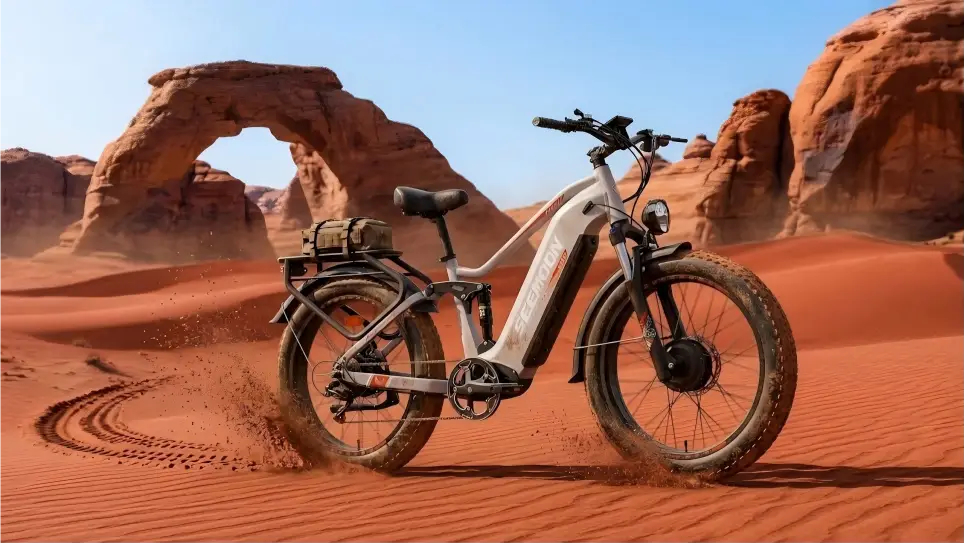
Desert overlanding is heavily romanticized in the off-road community—and for good reason. The sprawling expanses of the Mojave, the Sonoran, and the red rock canyons of Utah offer breathtaking, uninterrupted freedom. But beneath that sunset-soaked veneer lies an environment engineered to destroy mechanical and electrical drivetrains.
For an ordinary off-road e-bike, the desert presents a brutal double threat: deep, unconsolidated sand acts as the ultimate traction killer, while triple-digit ambient heat pushes components past their thermal limits. Take a standard, single-motor commuter e-bike into a dry wash, The rear wheel trenches into the sand, the motor spikes its amp draw to overcome the immense rolling resistance, and the controller inevitably succumbs to thermal shutdown. The result? You’re left pushing an 80-pound deadweight miles from the nearest paved BLM road.
To legitimately conquer dune fields and blistering temperatures, you need a rig purpose-built for extreme physical loads and superior thermal dynamics. Enter the Seemoon SM3. Built around a high-capacity 60V 30Ah (1800Wh) energy architecture and a staggering 6000W All-Wheel Drive (AWD) dual-motor powertrain, the SM3 isn't just surviving the desert—it’s dominating it. Here is the technical breakdown of how this machine's tactical payload capacity and heat-shedding drivetrain tame the wasteland.
1. The Physics of Sand Traction: Why AWD is Non-Negotiable
Traversing deep, soft sand is fundamentally different from riding on packed dirt or asphalt. On hard surfaces, tires rely on friction with a stable top layer. In sand, however, the medium is fluid. Your tires inevitably sink, meaning you are perpetually riding "uphill" to escape the rut your own weight is creating.
Dual Hub Motors: The "Push-Pull" Extraction Advantage
Most e-bikes rely on Rear-Wheel Drive (RWD), which is inherently flawed in soft-soil environments. In a RWD setup, the front wheel acts as a dead weight—a plow that creates immense drag. As the rear wheel fights to overcome this resistance, it quickly exceeds the sand's shear strength. The result? The tire excavates the loose material beneath it, digging a hole until the frame bottoms out.

The Seemoon SM3 solves this mechanical bottleneck through its Dual High-Speed Hub Motor configuration. By engaging AWD via the handlebar display, you fundamentally alter your momentum dynamics:
-
The Lead-Edge Pull: The front motor generates active "climb," pulling the front tire out of the rut and neutralizing the plowing effect.
-
The Trailing-Edge Push: Simultaneously, the rear motor drives the heavy-duty chassis forward.
This synchronized Push-Pull Dynamic distributes torque across two distinct contact patches. Instead of digging vertically, the SM3 "claws" horizontally, maintaining floatation over deep dunes that would instantly swallow a conventional e-bike. For an in-depth analysis of the SM3 All-Wheel Drive system, please read the article [The Ultimate Guide to All-Terrain E-Bikes: Conquer Any Trail in 2026]
Defeating Rolling Resistance with 200 Nm of Peak Torque
In the desert, extracting yourself from a rut is only the first step; maintaining kinetic energy is the real challenge. Sand produces extreme rolling resistance that saps your speed the millisecond you ease off the throttle.
To keep a dedicated overlanding rig moving through a dry riverbed, you need massive rotational force. The SM3 delivers a staggering 200 Nm of combined maximum torque and a 6000W peak power output. When the terrain attempts to bog you down, this "instant-on" torque provides the surge necessary to "plane" over the sand. Furthermore, the SM3’s 107 lbs (48.5 kg) of mass works in your favor here; once the dual motors overcome the initial friction, the bike’s inertia acts as a battering ram, punching through washboards and soft patches with relentless stability.
2. Mastering "The Float": The Physics of Fat Tires and Precision PSI
Even with the SM3’s massive 6,000W AWD output, a high-torque machine carrying a 200 lb rider exerts significant ground pressure. If you attack loose dunes with high-pressure tires, the physics are unforgiving: your tires will act like "pizza cutters," slicing through the crust and burying the motor in the sand. The definitive secret to desert dominance isn't just power—it’s flotation.
Maximizing the 24x4.0 Fat Tire Contact Patch
The SM3 is equipped with 24 x 4.0-inch high-volume fat tires, engineered for a wide range of terrain. While factory-spec pressure offers excellent stability on hardpack trails, unlocking true "sand-surfing" capabilities requires active Tire Pressure Management.
To navigate extreme soft-cell sand, seasoned overlanders utilize a tactical "airing down" technique. We recommend dropping your pressure to a range of 5 to 8 PSI. This reduction allows the tire carcass to deform slightly, dramatically expanding the contact patch—the total surface area in direct contact with the ground. By distributing the combined weight of the bike and rider over a larger surface area, the SM3 achieves physical flotation. Instead of struggling through the sand, you glide over it, reducing motor strain and maximizing battery efficiency.

The Integrated Ecosystem: Why the Included Pump is Critical
In the backcountry, your PSI requirements change as fast as the terrain. While 5 PSI is your best friend in the dunes, it’s a liability on hard-packed gravel or asphalt. Riding at ultra-low pressures on hard surfaces risks pinch flats, rim damage, and compromised handling.
Seemoon bridges this gap by including a professional-grade portable tire pump and multi-tool as standard equipment. This allows for real-time adjustments:
-
Airing Down: Drop to sub-10 PSI for technical sand sections.
-
Resurfacing: Quickly return to a stable 20–25 PSI for the high-speed transit back to camp.
By integrating these tools into the SM3’s out-of-the-box experience, Seemoon ensures you aren't just buying a bike—you’re deploying a fully-capable wilderness exploration system.
3. Surviving the Furnace: The Critical Role of 60V Thermal Management
While AWD traction is what gets you moving, robust thermal management is what keeps your ride alive. Desert riding is the ultimate torture test for an e-bike's electrical architecture. Combining ambient temperatures over 100°F (38°C) with the extreme, sustained motor load required to churn through deep sand demands a highly specialized power delivery system. Without it, the results are entirely predictable: controllers fry, phase wires melt, and motors suffer irreversible thermal degradation—commonly known as heat soak.
Defeating Joule Heating with High-Voltage Architecture
To understand why the SM3 thrives in these brutal environments, we have to look at the hard physics behind its true 60V high-voltage platform.
Generating the SM3’s massive 6000W peak output efficiently comes down to the fundamental electrical power formula: P = V×I (Power = Voltage × Current). By utilizing a high-voltage 60V architecture, the SM3 achieves its maximum 6000W output while limiting the current draw to an incredibly manageable 100 amps.
Keeping amperage low is the ultimate secret to thermal survival, and the reason lies in Joule’s First Law of heating: P_{loss} = I²×R (Heat Loss = Current²× Resistance). Because internal heat generation increases exponentially with the square of the current, minimizing amperage is the most effective way to prevent thermal breakdown. The SM3's 60V system is purpose-built to deliver massive wattage at a lower current threshold. This engineered efficiency drastically reduces Joule heating across the entire powertrain—protecting the wiring harness, the heavy-duty controller, and the dual hub motors from self-destruction.

By attacking heat generation at the physics level, the SM3’s 60V 30Ah lithium-ion system actively fights off heat soak. It bypasses the thermal throttling that plagues lesser fat-tire e-bikes, ensuring that your 6000W of AWD power remains sustainable, repeatable, and safe—even in the dead of summer in Death Valley.
4. The Desert Overlander’s Command Center: True Off-Grid Self-Reliance
Desert overlanding is a massive logistical challenge. When you are pushing deep into BLM (Bureau of Land Management) lands or remote backcountry trails, you are miles beyond the reach of cellular networks. In these environments, your e-bike isn't just a vehicle; it has to function as a fully self-reliant mobile basecamp.
Integrated Type-C Power Delivery: Uninterrupted GPS Navigation
Getting disoriented in a featureless, sun-baked desert is a high-risk scenario. When exploring off-grid, you are entirely dependent on offline GPS mapping apps (like Gaia GPS or onX Offroad). However, running navigation software with your smartphone’s screen at maximum brightness under glaring desert UV will cause rapid thermal throttling and drain a standard phone battery in mere hours.
The SM3 solves this by turning its color LCD dashboard into an overlander's command center, complete with an integrated Type-C charging port. Paired with the heavy-duty, vibration-dampening phone mount included in the accessory package, you can hardwire your device directly into the bike.
Technically speaking, you are tapping into the bike's massive 60V 30Ah (1,800Wh) power plant, effectively utilizing it as a high-capacity power bank. The parasitic draw of a smartphone is negligible against a battery of this size. Even on grueling expeditions pushing the absolute upper limits of the SM3's 50 to 120-mile range, your critical navigation devices will remain at a 100% charge, ensuring you always have a digital breadcrumb trail back to camp.
330-lb Payload Capacity & High-Torque Hauling
The non-negotiable golden rule of desert survival is hydration. Water is incredibly dense—weighing roughly 8.3 lbs per gallon—and carrying enough for a multi-day expedition on your back will drastically shift your center of gravity and cause severe rider fatigue.
The SM3’s aerospace-grade 6061 aluminum alloy frame isn't just engineered for torsional rigidity; it is specifically fabricated for extreme hauling. Boasting a massive 330 lbs (150 kg) maximum payload capacity, this e-bike operates as a tactical pack mule. Utilizing the factory-installed heavy-duty rear cargo rack, riders can seamlessly strap down RotopaX water containers, dry bags, sleeping gear, and emergency tool kits to the chassis rather than their bodies. Because the motor pushes a massive 200 Nm of peak torque, the added payload doesn't compromise the bike's performance. Even when fully weighed down with expedition gear, the SM3 retains the explosive acceleration necessary to keep your tires floating over deep sand and wash washes without bogging down.
Conclusion: Taming the Wasteland and Desert
The desert is a relentless proving ground. It ruthlessly exploits engineering oversights and punishes those ill-equipped for its volatility. However, the Seemoon SM3 shifts the paradigm, transforming an uncompromising environment into an expansive high-performance playground.
Through a sophisticated integration of on-demand AWD traction and a staggering 200 Nm of peak torque, the SM3 overcomes the high rolling resistance of deep silt and shifting dunes—terrains where traditional mid-drive or RWD ebikes often bog down. Its 60V architecture is the backbone of its thermal efficiency, ensuring consistent power delivery without the voltage sag or overheating typically triggered by triple-digit temperatures and heavy workloads.
Beyond raw power, the SM3 is a comprehensive all terrain overlanding platform. With a purpose-built wilderness accessory ecosystem, it addresses the logistical rigors of off-grid exploration, effectively neutralizing "range anxiety" and mechanical dread. With the Seemoon SM3, you aren't just surviving the heat—you are mastering the elements through superior engineering.
Explore the full specifications and secure your own off-road powerhouse on the [Seemoon SM3 Series Product Page].
-
👉 Want to know how the SM3 all-terrain electric bicycle performs in extreme mountain and forest environments? Read our comprehensive overview in the [Conquering Technical Forest Trails with the SM3 All-Terrain Electric Bikes].
-
👉 The same "push-pull" AWD traction principles that conquer soft sand are exactly what you need to survive freezing temperatures. Learn how it works in our guide to [riding through deep snow and winter ice].
FAQ: Riding E-Bikes in Sand and Deserts
Do I need a dual motor ebike for beach riding?
While you can ride a single-motor (RWD) e-bike on hard-packed, wet sand near the water line, a dual-motor AWD system is practically mandatory for soft, dry beach sand or desert dunes. A single rear motor will often dig a hole and get stuck in soft sand due to the high rolling resistance. Dual motors (like the SM3) allow the front wheel to pull the bike up and out of ruts, providing the necessary traction to keep you moving forward.
How low should I drop my ebike tire PSI for soft sand?
For extremely soft sand or dunes, you should significantly reduce your tire pressure to increase the "contact patch" (the amount of rubber touching the ground). On a 4.0-inch fat tire, many experienced riders drop their pressure to between 5 and 8 PSI. This allows the tire to deform and "float" on top of the sand. Always carry a portable pump (like the one included with the SM3) to reinflate the tires to normal pressure (usually around 20-25 PSI) before returning to hard-packed trails or pavement to avoid pinch flats and rim damage.
Why does my ebike motor overheat in the desert?
E-bike motors overheat in the desert due to a combination of high ambient temperatures and the extreme physical load required to push through sand. Sand creates massive resistance, forcing the motor to draw maximum current (amps) for sustained periods. In standard 48V systems, drawing high current generates a massive amount of internal heat (Joule heating), which quickly leads to thermal throttling or motor failure. Upgrading to a 60V system (like the SM3) reduces the current required to produce the same power, drastically lowering the heat generated by the electronics.
Share:
Conquering Technical Forest Trails with the SM3 All-Terrain Electric Bike
The Ultimate Snow Electric Bicycle Guide: Conquering Winter Ice with the SM3