
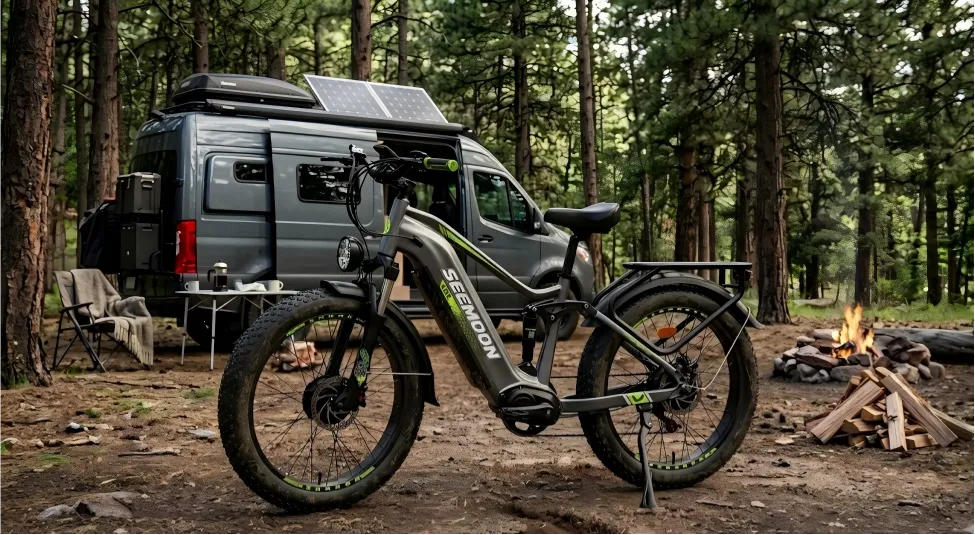
For modern American outdoor adventurers, driving a towering Class A motorhome through remote forests represents the ultimate in freedom. However, experienced RV travelers are well aware of the inherent logistical limitations: once you drive into and park your RV in a vast national park or a remote Bureau of Land Management (BLM) campsite, your mobility instantly drops to zero.
The ultimate solution is to carry a heavy-duty all-terrain electric bicycle for exploring surrounding trails, groceries in town, or visiting campsite supervisors on the other side of the park. To adapt to a nomadic lifestyle, you need a machine that combines tactical practicality, intelligent power management, and powerful load-bearing capacity. The Seemoon SM3 all-terrain electric bicycle was born to meet this need.
The SM3 is not a recreational toy, but an industrial-grade off-road adventure tool. Here's a technical analysis of how the SM3's unique 60V architecture, modular battery system, and LCD programming technology make it the undisputed king of the RV and campervan lifestyle.
1. The Physics of the Hitch Rack: Solving the Weight Dilemma
Hauling a high-performance e-bike on the rear of a large vehicle introduces complex mechanical stresses that many riders overlook. A purpose-built machine like the SM3 is engineered for rugged versatility, featuring a reinforced 6061 aluminum alloy frame, dual high-torque hub motors for All-Wheel Drive (AWD) capability, and high-volume 4.0" fat tires. This robust build results in a total curb weight of 107 lbs (48.5 kg)—a significant mass for any mounting system.
The Impact of Dynamic Loading
The challenge isn't just the static weight; it’s the dynamic force. When a 15,000 lb RV hits a pothole or a bridge expansion joint at highway speeds, the vertical acceleration creates a "whip effect." This multiplies the downward force on your hitch receiver exponentially.
Most standard RV-rated hitch racks are engineered with a strict weight ceiling, often capping out at 60 to 65 lbs per tray. Loading a fully assembled 107 lb e-bike onto these racks isn't just a risk—it's a mechanical gamble. Overloading can lead to metal fatigue, snapped welds, or extreme "rack sway" that compromises your vehicle's handling and safety.
The Modular Solution: The Detachable Battery Advantage
The SM3 engineering team addressed this structural dilemma through strategic modularity. By decoupling the weight, we’ve made high-performance AWD biking compatible with standard transport solutions.
The heart of the SM3’s energy system is a high-capacity 60V 30Ah lithium-ion battery, secured to the downtube with a heavy-duty mechanical locking mechanism. By simply turning the key and removing the pack before transit, you achieve two critical goals:
-
Weight Reduction: The battery accounts for approximately 20 lbs of the bike’s total mass. Removing it immediately sheds nearly 20% of the weight, bringing the frame within the safety margins of heavy-duty, tray-style RV racks.
-
Structural Integrity: Reducing the "unsprung" weight on the rack minimizes the leverage exerted on the hitch pin. This significantly mitigates lateral sway and vertical bounce during long-haul interstate travel.

Beyond protecting your equipment, this modular design is a win for ergonomics. Hoisting an 87 lb frame is a much more manageable task for your lower back than lifting a full 107 lb rig. It’s a simple step that ensures your AWD powerhouse arrives at the trailhead—and stays on your vehicle—exactly as intended.
2. Boondocking Power: Master Your Off-Grid Energy Economy
For the dedicated boondocker, energy is the ultimate currency. Camping off-grid—far from the luxury of shore power hookups—transforms electrical management from a background task into a strategic discipline. When your lifestyle depends on rooftop solar arrays and a finite LiFePO4 (Lithium Iron Phosphate) house bank, every watt of electricity is crucial at this point. Because in a remote campsite far from town, you simply cannot afford to run out of stored power.
The Seemoon SM3 is engineered specifically for this high-stakes energy environment, offering sophisticated features that protect your rig’s electrical integrity while keeping your mobility intact.
The "At-a-Glance" Power Audit
If your SM3 battery is tucked away in a dark RV "basement" or cargo bay, hauling that heavy frame out and booting up the full LCD interface just to check your range is a friction point you don’t need.
Seemoon solved this with a dedicated Independent LED Status Button integrated directly into the battery casing. Even when the battery is completely detached from the bike and sitting in cold storage, a tactile press of the physical button activates an instant LED readout (one red, three green). This provides a zero-latency capacity check, allowing you to make data-driven decisions on whether to allocate your precious peak-sun solar hours to the bike or save them for your fridge and lighting.
High-Voltage Efficiency: The 60V Advantage
Charging a massive 1,800Wh power cell might sound like a nightmare for a modest van-life electrical system, but the SM3’s architecture is built for the nuances of off-grid living.
While much of the industry languishes at 48V, the SM3 utilizes a high-voltage 60V system. From a physics standpoint, this is a game-changer: higher voltage allows for lower current (amperage) to deliver the same power, resulting in decreased thermal buildup and significantly less resistance throughout the circuitry.
Optimized Low-Amp Charging for Inverters
To protect your RV’s delicate ecosystem, the SM3 factory charger is tuned for a steady, low-amperage draw—typically between 2 to 3 Amps. This "slow and steady" approach is a deliberate engineering choice for the off-grid traveler:
-
Inverter Friendly: It won’t "spike" your pure sine wave inverter or trigger a low-voltage disconnect on your house batteries.
-
Solar Synergy: The low draw allows the battery to "sip" power throughout the day, syncing perfectly with the steady output of a solar charge controller.
-
Thermal Longevity: By avoiding high-amperage "fast charging" in unventilated storage bays, you preserve the chemical lifecycle of the LiFePO4 cells.
This synergy makes the SM3 more than just an e-bike; it’s a responsible extension of your mobile power grid.
3. Campground Etiquette: Mastering the Art of Silent Compliance
Navigating the social ecosystem of a crowded RV park or a serene National Forest requires more than just a set of wheels—it requires situational awareness. Most managed campgrounds strictly enforce "Quiet Hours," typically between 10:00 PM and 7:00 AM.
In these environments, sound carries. Attempting to fire up a traditional gas-powered ATV or a high-decibel 2-stroke dirt bike for a 6:00 AM run to the shower block is a fast track to a confrontation with a camp host or, worse, an immediate eviction notice.
The Stealth Advantage of Acoustic Engineering
This is where the SM3’s dual brushless hub motor system becomes a definitive logistical asset. Unlike internal combustion engines (ICE) that rely on mechanical explosions and exhaust cycles, the SM3’s propulsion system operates through electromagnetic induction, functioning in near-total silence.
The technical superiority of the SM3 lies in its acoustic footprint:
-
Zero Decibel Idle: There is no "warm-up" noise. You simply power on and roll.
-
Low-Frequency Output: The brushless motors eliminate the high-pitched whine common in lower-end ebikes.
-
Natural Sound Profile: The only audible output is the "organic crunch" of the 24x4.0-inch fat tires compressing the gravel. To a sleeping neighbor, this sound is indistinguishable from natural ambient noise.
By leveraging this "Acoustic Stealth," you maintain the high-torque pulling power of a utility vehicle without the social friction of noise pollution. Whether you are heading out for a pre-dawn fishing session or returning to your site after stargazing, the SM3 ensures you remain fully compliant with campground etiquette while upholding a professional, respectful presence in the outdoor community.

4. Mastering Backcountry Navigation: The "Point of No Return" Strategy
Once your RV is leveled and the stabilizers are down, the SM3 shifts from cargo to your primary reconnaissance vessel. Whether you’re weaving through the labyrinthine washouts of Quartzsite or carving through dense logging tracks in the Pacific Northwest, the wilderness is unforgiving.
Because a high-torque, AWD e-bike allows you to push 30 miles into the backcountry in under an hour, manual distance tracking isn't just a convenience—it’s a survival requirement.
Parameter P16: Precision Trip Management
While every e-bike tracks cumulative mileage via the ODO (Odometer), relying on mental subtraction to calculate your distance from basecamp is a dangerous gamble when battery levels are at stake. The SM3’s LCD interface includes a professional-grade override known as Parameter P16 (Trip Odometer Reset).
Experienced overlanders use P16 as their primary navigational "anchor." By entering the P-settings menu and executing the P16 command at your RV steps, you calibrate your TRIP display to 0.0. This allows for real-time, zero-latency distance tracking without purging your bike’s lifetime mileage data.
Calculating Your "Point of No Return"
In technical terms, off-road range isn't static; it's a variable influenced by terrain density and elevation gain. If your SM3 provides a reliable 40-mile range under aggressive throttle use in heavy dirt, P16 becomes your fuel gauge:
-
The 50% Rule: Reset P16 before departure. The moment your TRIP display hits 20 miles, you have reached your absolute Point of No Return.
-
The Safety Margin: Turning back at the halfway mark of your known battery capacity ensures you have the necessary voltage to navigate unexpected detours or steep climbs on the return leg.
By utilizing P16, you replace guesswork with telemetry, ensuring you make it back to the rig under power rather than pedaling a heavy AWD frame through the dark.
5. The "Snowbird" Protocol: Managing Seasonal Battery Dormancy
For many RVers, the "Snowbird" lifestyle is the dream—migrating south to outrun the frost or storing the rig during the peak summer swelter. However, long-term dormancy is the silent killer of lithium-ion performance. Leaving your e-bike battery in a sweltering garage or a sub-zero storage lot for six months is a guaranteed way to accelerate chemical degradation and compromise your investment.
The 50% Equilibrium Rule
Unlike lead-acid batteries, lithium-ion chemistry is highly volatile at its "voltage extremes." Storing a battery at 100% SoC (State of Charge) creates internal oxidation and thermal stress, while leaving it at 0% can cause the cells to "brick" as the voltage drops below a recoverable threshold.
To preserve the lifespan of the 60V high-performance system, the SM3 engineering guidelines dictate a strict 50% Storage Rule:
-
Target the Sweet Spot: Before winterizing your RV, discharge or top off your battery until the display indicates between 50% and 60% capacity. This balanced state minimizes the "solid electrolyte interphase" (SEI) layer buildup, preserving the battery's health.
-
Climate-Controlled Storage: Never leave the battery inside the bike frame or the RV's external storage bays. Remove it and store it in a dry, indoor environment (ideally between 10°C and 25°C or 50°F and 77°F).
-
Avoid Voltage Sag: Storing your battery in temperature-controlled environments prevents the "cold-soak" effect, which can lead to permanent capacity loss.
By following this professional maintenance protocol, you ensure that when the next season rolls around, your 60V powertrain delivers its full rated torque and range without the "phantom" degradation typical of neglected batteries.
The Ultimate Mobile Basecamp: Why the SM3 is the Definitve RV Companion
Embracing the nomadic lifestyle is an exercise in balancing boundless freedom with logistical precision. You want to push further into the backcountry, but you’re often tethered by the physical and technical constraints of a heavy motorhome. The Seemoon SM3 isn't just an e-bike; it’s a tactical extension of your living space—a "land dinghy" designed to solve the specific pain points of life on the road.
Engineering for Portability and Payload
One of the most overlooked hurdles in RV life is the hitch rack weight limit. Traditional high-capacity e-bikes often exceed the tongue weight ratings of standard carriers once you factor in the leverage of a rack.
The SM3 addresses this through a mechanically detachable battery system. By removing the power cell during transit, you significantly reduce the "dead weight" on your rack, ensuring your setup remains within safe structural tolerances while protecting the battery from road vibration and thermal shifts.

Off-Grid Autonomy and Technical Mastery
For the dedicated boondocker, power management is a zero-sum game. The SM3 integrates seamlessly into your energy ecosystem:
-
Independent Power Diagnostics: Unlike consumer-grade bikes that offer vague battery bars, the SM3 provides granular data. This allows you to audit your energy consumption against your RV’s solar gain, ensuring you never overdraw your house batteries.
-
Acoustic Stealth: Whether you’re navigating a sensitive BLM trailhead or a quiet National Park campground, the SM3’s refined motor controller ensures near-silent operation.
-
The P16 Parameter Advantage: For the tech-savvy rider, access to the P16 parameter—the odometer and system reset configuration—allows for precise trip tracking and maintenance scheduling.
The Verdict: The SM3 serves as a force multiplier for your mobile basecamp. It allows you to drop anchor in the perfect spot and deploy a high-torque, long-range scout to handle the "last mile" of rugged exploration.
Ready to expand your riding season and conquer the fourth dimension of off-roading?
【Explore the SM3 AWD Product Page Now】
-
👉 Expand Your Off-Grid Skills: If you plan on leaving the RV behind for a few nights to camp under the stars, master our wilderness diagnostic guide for off-grid bikepacking and surviva.
-
👉 Hit the Coast: Taking your RV down to the Florida Keys or the California coast? Learn how to drop your tire pressure and avoid saltwater corrosion in our beach and deep sand fat tire guide.
-
👉 Cross-Country Relocation: If you frequently ride on paved roads connecting different state parks, understand how this heavy frame resists semi-truck crosswinds in our high-speed highway touring breakdown.
FAQ: E-Bikes for RVs and Camper Vans
Are heavy electric bikes safe for RV hitch racks? Putting a fully assembled, 100+ lb heavy-duty electric bike on a standard RV hitch rack is extremely dangerous due to weight limits (often 60 lbs per tray) and the violent dynamic bouncing that occurs on the rear of long motorhomes. The safest method is to use a heavy-duty, RV-rated hitch rack specifically built for e-bikes, and to always remove the battery before mounting it. Removing the battery on models like the SM3 drops the overall weight by roughly 20 lbs, significantly reducing the mechanical stress on your rack and receiver.
How do I store my e-bike battery during the RV off-season? If you are putting your camper in storage for the winter, never leave your lithium-ion e-bike battery sitting at a 100% full charge or completely dead (0%). This will permanently damage the cell chemistry. The golden rule for long-term storage is the "50% Rule." Drain or charge the battery until it is sitting between 50% and 60% capacity, remove it from the bike, and store it indoors in a dry, room-temperature environment to preserve its lifespan.
Can I charge an electric bike using my RV's solar panels? Yes, but you must monitor your inverter load. A high-capacity 60V e-bike battery stores a massive amount of energy. However, the standard wall chargers provided with these bikes typically draw a low, steady current (around 2 to 3 Amps). As long as your RV is equipped with a pure sine wave inverter capable of handling a continuous 200W to 300W load, you can safely plug the charger into a standard outlet and charge the detached e-bike battery using your rooftop solar panels and house battery bank without overloading the system.
Share:
The Ultimate Fat Tire Electric Bicycle for Beach and Surf Cruising
The Ultimate Tactical Electric Bike for Search & Rescue and Off-Road Patrol