
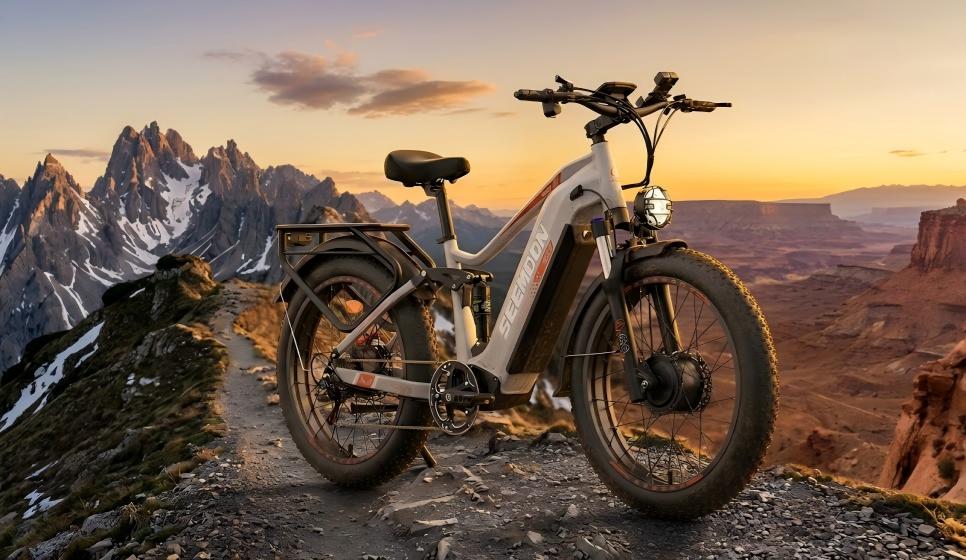
If you are browsing the electric bike market in 2026, you have likely noticed a trend: almost every manufacturer with a fat tire model slaps the "All-Terrain" label on their product. But as veteran off-road riders and engineers know, throwing 4-inch tires on a standard commuter frame does not make it an all-terrain vehicle. It simply makes it a heavy commuter bike that will inevitably fail when pushed beyond the pavement.
A true all-terrain e-bike is a purpose-built machine. It requires foundational redundancies in electrical architecture, structural rigidity, thermal management, and rider failsafes. When you are twenty miles deep into a backcountry trail, a mechanical failure isn't just an inconvenience; it is a survival liability.
In this comprehensive guide, we are stripping away the marketing fluff. We will dive deep into the real-world physics of off-road riding, navigate the complex landscape of US e-bike trail regulations, and break down the engineering benchmarks set by the Seemoon SM3 series—a 6000W, 60V dual-motor powerhouse designed for the absolute extremes.
Whether you are a big and tall rider looking for unyielding frame stability, a hunter needing a silent tactical hauler, or an adrenaline junkie chasing 45 mph thrills, this guide will teach you exactly what to look for in a high-performance all-terrain e-bike.
1. The Physics of True All-Terrain Dominance
Engineering an e-bike for a smooth asphalt commute is a solved problem. However, building the all terrain electric bike that survives jagged rock gardens, energy-sapping deep sand, sub-zero alpine snow, and sustained 30-degree mountain ascents requires a radical departure from consumer-grade cycling. It requires a deep dive into power electronics and structural rigidity.
The 60V vs. 48V Divide: Mastering Thermal Management
The most critical—yet frequently misunderstood—metric in high-performance all-terrain electric bicycle design is operating voltage. While the mass market relies on standard 48V systems, the Seemoon SM3 utilizes a dedicated 60V high-voltage platform.
This isn't just about speed; it’s about the fundamental laws of electrical physics. To understand why, we look at the formula for electrical power:
(Where P is Power, V is Voltage, and Iis Current/Amperage)
To achieve the SM3’s 6000W peak output, an engineer must increase either voltage or current. If a manufacturer attempts to push 6000W through a 48V system, they are forced to drastically spike the amperage. This triggers Joule’s First Law, which dictates how much energy is wasted as heat:
(Where P_{loss} is heat generated, I is current, and R is resistance)
Notice that heat generation increases with the square of the current. By opting for a 60V architecture paired with a high-capacity 30Ah lithium-ion battery, the SM3 delivers massive torque while keeping the current (I) significantly lower than a 48V counterpart.

Why this matters in the wild: When you are grinding up a steep, sun-baked incline, lower current translates to exponentially less heat in the controller, wiring harnesses, and motor phase wires. This eliminates "thermal throttling"—the frustrating safety feature where a bike cuts power to prevent its own components from melting. A 60V system doesn't just offer more power; it offers sustainable power that protects the long-term integrity of your motor. Gain a deeper understanding of why higher voltage results in less Joule heating loss[Conquering Desert Heat: The SM3 AWD All Terrain E-Bike ]
The Reinforced 6061 Alloy Chassis: The Case Against Folding Frames
In the world of high-speed off-roading, we must be candid: a folding hinge is a structural liability. While folding bikes offer convenience for "last-mile" commuters, they introduce a catastrophic weak point under high torsional stress. At speeds exceeding 30 mph or when navigating rutted forest trails, a folding frame is prone to lateral flex. This oscillation is the primary catalyst for the "death wobble"—a terrifying loss of steering control that often results in high-speed crashes.

To ensure rider safety and vehicle longevity, the Seemoon SM3 is built on an integrated, non-folding 6061 Aluminum Alloy frame.
-
Mass as an Asset: This industrial-grade construction brings the net vehicle weight to 107 lbs (48.5 kg).
-
Planted Inertia: While "lightweight" is a buzzword in road cycling, serious off-roaders value mass and rigidity. That 107-lb footprint provides motorcycle-grade inertia, absorbing trail chatter and maintaining a "planted" feel at the SM3’s 45 mph top speed.
-
Tactical Payload: This rigid architecture supports an astonishing 330 lbs (150 kg) payload capacity.
The SM3 isn't something you casually toss into the trunk of a sedan; it is an overbuilt, tactical pack mule engineered for the most demanding environments on earth.
2. Power Delivery & Failsafe Traction: Mastering the SM3’s AWD System
Having massive raw power on an e-bike is useless if you can’t efficiently—and safely—transfer that power to the dirt. True off-road capability demands advanced traction solutions that standard, single-motor commuter setups simply can't deliver. Let’s look under the hood of the Seemoon SM3 to understand how its powertrain translates high voltage into relentless forward momentum.
The AWD Advantage: 6000W Dual Hub Motors
The foundation of the SM3’s drivetrain is its Dual High-Speed Hub Motors (front and rear). While the system outputs a highly respectable 2000W nominal rating for sustained cruising, the real magic happens when the terrain pushes back. When you hit severe resistance—like bogging down in soft beach sand or tackling a loose, rocky scree slope—the controller unleashes a massive 6000W Peak Performance.
Activating the Dual Motor mode transforms the SM3 into a true All-Wheel Drive (AWD) e-bike. This creates a vital "push-pull" dynamic: the front motor pulls the bike up and out of ruts, while the rear motor pushes the chassis forward. If you want to navigate deep snow or thick mud without digging a trench, this dual-traction approach is the only mathematically sound way to do it.

Decoding the 12 magnets behind 200 Nm torque with PAS precision
While watts determine your top speed, torque determines what you can conquer. The SM3 generates a staggering 200 Nm of maximum torque. To put that into perspective, 200 Nm is enough rotational force to accelerate a 300 lb payload up a 30-degree incline without a single pedal stroke. However, managing this level of brute force requires absolute precision. If 200 Nm engages too abruptly on a steep, loose trail, the bike will either loop out (flip backward) or instantly break traction and spin the tires.
To tame the power delivery, Seemoon integrated a high-resolution 12-Magnet Pedal Assist Sensor (PAS) paired with a 7-Speed Shimano mechanical drivetrain.
-
Low Latency: The high sampling rate of the 12-magnet system ensures the motor responds smoothly and instantly to your crank revolutions.
-
Custom Torque Curves: Through the bike’s advanced P-Settings (specifically P12 for start strength), riders can dial in the throttle response. This allows for highly technical, slow-speed rock crawling without the fear of sudden surges or rollback.
Failsafe Engineering: Torque Arms and Motor Cut-Offs
When 200 Nm of rotational force is applied instantaneously, the axle of the motor naturally wants to violently twist out of the frame dropouts. To prevent catastrophic frame damage, the SM3 is equipped from the factory with industrial-grade torque arms. These heavy-duty metal brackets lock the motor axle directly to the solid aluminum frame, ensuring structural integrity under maximum load.
Furthermore, safely stopping a 107 lb e-bike traveling at 45 mph requires immense braking authority. The SM3 handles this using heavy-duty Hydraulic Disc Brakes equipped with integrated Motor Cut-Off Sensors. The exact millisecond you pull the brake levers, the controller completely kills the 6000W motor output. This failsafe ensures you are never fighting the motor's torque while trying to stop, which drastically reduces braking distances and virtually eliminates the risk of brake fade during long, aggressive mountain descents.
3. Navigating U.S. Trail Laws: The "Street-Legal" Chameleon
For the American rider, the appeal of a high-output e-bike is often tempered by a complex web of federal and state regulations. Out of the box, the Seemoon SM3 is a powerhouse. With a native top speed of 45 mph, it technically transcends the standard e-bike definition, entering the territory of Mopeds or Off-Highway Vehicles (OHV).
Therefore, to ride a high-performance all-terrain electric bicycle with peace of mind, understanding the U.S. Three-Class System is essential:
-
Class 1: Pedal-assist only; motor ceases support at 20 mph.
-
Class 2: Throttle-actuated or pedal-assist; motor ceases support at 20 mph.
-
Class 3: Pedal-assist only; motor ceases support at 28 mph.
In many jurisdictions—including municipal bike paths, State Parks, and Bureau of Land Management (BLM) non-motorized trails—Class 2 compliance is the "gold standard" for access. Showing up to a restricted trailhead with a visible 6000W profile can lead to heavy fines or impoundment. This is where the SM3’s engineering shines.
The Compliance Failsafe: Mastering the P08 Speed Parameter
Seemoon engineers recognized that riders need a bridge between "track performance" and "street legality." Rather than forcing a permanent hardware handicap, they integrated a firmware-level governor directly into the motor controller's logic. Accessible via the LCD dashboard’s advanced telemetry menu, Setting P08 serves as your digital "legal toggle." Here is how the technical synergy works:
-
The Digital Hard-Lock: By navigating to the P08 parameter and inputting a value of "32", you instruct the controller to truncate the power curve once the vehicle hits 32 km/h (approx. 20 mph).
-
Instant Classification: This adjustment effectively re-profiles the SM3 as a Class 2-compliant vehicle. Even with its massive peak power potential, the functional output is capped, allowing you to commute through urban traffic or pass park rangers with total peace of mind.
-
The Weekend Transformation: Once you transition to private property or designated OHV parks, a simple reversion of the P08 setting restores the controller's full duty cycle.
This dual-identity capability ensures that the SM3 isn't just a all-terrain electric bicycle—it’s a sophisticated, adaptable platform that respects local land-use laws without sacrificing the raw adrenaline of 45 mph off-road performance. It is, quite literally, two elite vehicles housed within a single chassis.
4. The Wilderness Ecosystem: Field Maintenance & Survival Engineering
A purpose-built all-terrain vehicle is only as good as its reliability. In the backcountry, "cool features" matter less than mechanical uptime and field-serviceability. While the industry standard often involves selling a "stripped-back" frame and upselling you on essentials, the Seemoon SM3 arrives as a fully integrated ecosystem. It is engineered not just for the ride, but for the realities of ownership.
Integrated OBD Diagnostics: Eliminating "Trailside Anxiety"
High-performance electric powertrains shouldn’t be a "black box." When you’re miles from the nearest trailhead, a technical glitch can be the difference between a ride and a hike. The SM3 mitigates this with its EB300 On-Board Diagnostics (OBD) system.
By translating complex electrical signals into actionable data on the color LCD dashboard, the SM3 allows for instant trailside triage. If the system detects an irregularity, it identifies the root cause via standardized error codes:
-
Code 06 (Battery Undervoltage): Critical cell discharge or voltage sag.
-
Code 07 (Phase Wire/Motor Fault): Connection integrity issues or motor timing errors.
-
Code 08 (Throttle Sensor): Signal interference or hall sensor failure.
-
Code 09 (Controller Damage): Internal MOSFET failure or thermal shutdown.
This transparency removes the "repair blind box" frustration. When you contact Seemoon’s US-based technical support, you provide a specific diagnostic code, ensuring the correct warranty parts are shipped the first time.
Thermal Management & Modular Power Logistics
Lithium-ion chemistry is notoriously sensitive to thermal extremes. Storing a battery in sub-freezing temperatures can lead to irreversible lithium plating, permanently nerfing your range and cycle life.
The SM3 addresses this with a keyed modular battery architecture. While the 107 lb (48.5 kg) chassis stays in the garage, however, the bike's core component—the detachable battery—can be brought indoors where the temperature is suitable. The manual recommends a charging and storage "sweet spot" of 50°F–77°F (10°C–25°C) to ensure longevity.
Beyond propulsion, this 60V 30Ah (1.8 kWh) power plant acts as your backcountry lifeline. The integrated USB-C Power Delivery (PD) port on the dashboard, paired with the included heavy-duty vibration-dampened phone mount, ensures your GPS and emergency comms stay topped off regardless of how deep you venture.
The "Full-Spec" Arsenal: Out-of-the-Box Readiness
Most "off-road" e-bikes require another $500 in upgrades before they are truly trail-ready. The SM3 disrupts this trend by shipping with a professional-grade accessory suite designed for the long haul:
-
Utility & Hauling: Full-coverage high-impact fenders and a heavy-duty 330 lb (150 kg) rated rear cargo rack for overlanding gear.
-
Automotive-Grade Safety: A high-lumen LED headlight, brake-actuated tail lighting, and dedicated front/rear turn signals for legal transit between trails.
-
Security & Maintenance: A physical heavy-duty shackle lock (to supplement the keyed ignition) and a comprehensive Field Repair Kit featuring spare inner tubes, replacement brake pads, a high-pressure tire pump, and a precision multi-tool.
5. Master Your Environment: Engineered for Every Terrain
The Seemoon SM3 isn't just an e-bike; it’s a high-performance all-terrain platform. Thanks to its raw hardware output, granular P-setting customization, and reinforced physical shielding, the SM3 thrives in punishing environments that would cause structural or thermal failure in "big-box" e-bikes.
We’ve engineered the SM3 to be modular in its performance. Explore our technical deep dives below to see how the SM3 dominates your all terrain landscape:
⛰️ Vertical Dominance: Steep Grade & Rock Crawling
Don't just climb—conquer. With a peak 200 Nm of torque, the SM3 provides the low-end grunt necessary for technical rock gardens.
-
The Tech: Learn how to sync mechanical gearing with motor cadence to prevent "looping out" on 30% grades.
🌲 Forest Flow: Roots, Ruts, and Technical Singletrack
Tight trails require precision, not just power.
-
The Tech: A deep dive into tuning the adjustable inverted fork suspension for high-speed damping and rebound. Learn how to dial in your "small-bump sensitivity" to maintain traction over slick roots.
🏜️ Desert Overlanding: Sand Physics & Thermal Management
Sand is the ultimate energy-thief. Floating over it requires a specific mathematical balance of surface area and power.
-
The Tech: Master the physics of AWD traction, optimal tire PSI for a wider "contact patch," and how our controller prevents thermal throttling in high-ambient desert heat.
❄️ The Winter Warrior: Snow, Ice, and Sub-Zero Volts
Cold weather kills batteries and kills grip. We’ve solved for both.
-
The Tech: Explore the benefits of Dual-Motor AWD for lateral stability on black ice and our advanced BMS (Battery Management System) thermal protocols that maintain voltage discharge even when the mercury drops.
🐊 Utility in the Wild: Muck, Swamps, and Heavy Hauling
Designed for hunters and backcountry explorers who can’t afford a mechanical failure in the bush.
-
The Tech: An overview of the IP54-rated ingress protection, the fail-safe "Walk Mode" for self-recovery in deep mud, and how the SM3’s high-tensile frame handles 400lb+ payloads without frame flex.
🌾 The Prairie Cruiser: Stability Over the Long Haul
On the open plains, speed and range are king.
-
The Tech: Why our solid-mold rigid frames provide superior high-speed tracking at 45mph compared to the "speed wobble" common in folding bikes. Learn the aerodynamics of long-range touring.
6. Frequently Asked Questions (FAQ)
To wrap up our ultimate guide, let's address some of the most common questions we receive regarding high-performance, heavy-duty e-bikes.
Is a 60V e-bike really better than a 48V e-bike?
Absolutely, especially for heavy bikes designed for off-road use. To produce the same amount of power, a 60V system requires significantly less current (amps) than a 48V system. Lower current means less heat generated in the motor and wires, reducing the risk of overheating on steep hills and extending the overall lifespan of the electrical components.
How do I make a 6000W e-bike street legal?
While a 6000W e-bike with a 45mph top speed is inherently an off-road vehicle, the Seemoon SM3 includes a digital failsafe. By entering the display's advanced P-settings and changing parameter "P08" to "32", you hard-lock the top speed to 20mph (32km/h). This aligns the bike's performance with US Class 2 e-bike regulations, making it compliant for city bike lanes and restricted trails.
Why is a solid frame safer than a folding frame for off-road riding?
Folding hinges introduce a structural weak point. When navigating bumpy off-road trails or riding at high speeds (30mph+), the intense torsional stress can cause a folding frame to flex laterally. This flex leads to high-speed wobbles and potential hinge failure. A solid 6061 aluminum frame, like the SM3, provides the rigid, motorcycle-like stability necessary for safe, aggressive riding.
How do I charge an e-bike battery in the freezing winter?
You should never charge a lithium-ion e-bike battery in freezing temperatures, as it can cause irreversible chemical damage. The SM3 features a removable battery with a physical key lock. You should leave the bike in your garage, remove the battery, and bring it indoors to charge. The SM3 manual strictly recommends charging the battery in environments between 50°F-77°F (10°C-25°C) to maximize cycle life.
How do I prevent an e-bike from rolling backward on a steep hill?
Rolling backward on a technical climb usually happens due to a delay in the motor kicking in. The SM3 prevents this by using a high-resolution 12-magnet Pedal Assist Sensor (PAS). This high sampling rate detects your pedal movement instantly, delivering the 200Nm of torque exactly when you need it without any dangerous lag.
Ready to stop compromising and start conquering?
Explore the full specifications and secure your own off-road powerhouse on the [Seemoon SM3 Series Product Page].
Share:
What is a Hunting Ebike and Why Every Hunter Needs One in 2026
Conquering Technical Forest Trails with the SM3 All-Terrain Electric Bike