
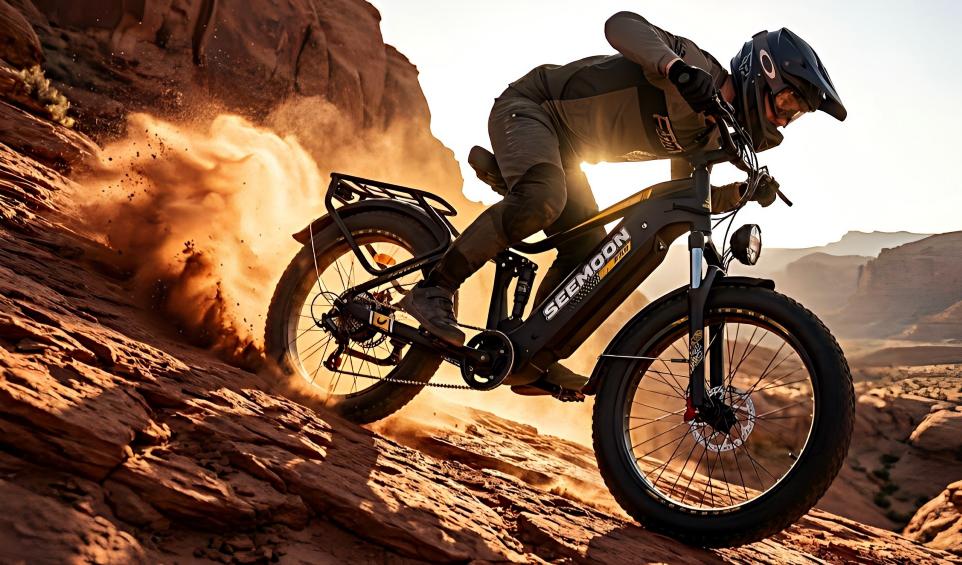
A steep mountain trail will ruthlessly expose every mechanical and electrical weakness a rig possesses. Push a budget commuter e-bike up a true mountain grade, and you’re asking for catastrophic failure. Under sustained high-torque demand, undersized hub motors will rapidly trigger thermal throttling to prevent a stator meltdown. Standard alloy frames will flex under severe torsional stress, and undersized rotors will succumb to terrifying hydraulic brake fade on the descent.
To tackle severe elevation changes—whether it's the loose shale of the Colorado Rockies or the unforgiving slickrock of Moab, Utah—you can't rely on a standard bicycle with a bolt-on battery. You need a purpose-built, heavy-duty climbing machine.
Therefore, Seemoon proudly launches the SM3 high-performance all-terrain electric bicycle. Engineered as an uncompromising all-terrain electric mountain bike (eMTB), it defies gravity through a combination of raw power and intelligent design, featuring:
-
Mechanical Gear Synergy: Optimizing the drivetrain for high-torque, low-RPM rock crawling without grinding gears.
-
Intelligent Suspension Lockouts: Eliminating pedal bob and maximizing rear-wheel traction on aggressive ascents.
-
Industrial-Grade Structural Integrity: A reinforced chassis specifically engineered to withstand massive rotational and torsional loads.
-
Advanced Battery Management System (BMS): Delivering precise, consistent power output without voltage sag during prolonged, heavy-draw climbs.
Here is a professional rider’s engineering breakdown of how a heavy-duty e-bike dominates the steepest hills and most treacherous mountain descents in the backcountry.
1. The Physics of the Climb: Maximizing 200 Nm of Torque with Mechanical Gearing
When tackling steep, backcountry inclines, novice riders often make a critical error: relying entirely on the electric motor to drag them up the hill. While pinning the throttle might work on moderate city streets, leaning solely on raw electrical output on a 30-degree pitch forces the motor into an inefficient RPM range. This rapidly drains your battery and risks overheating the controller. True technical climbing requires a seamless blend of electrical brute force and mechanical leverage.
Synergizing Dual-Motor Power with the Shimano Drivetrain
A top-tier all-terrain e-bike like the SM3 is an undisputed powerhouse. It features dual high-speed hub motors that deliver a combined 6,000W of peak power and a staggering 200 Nm of maximum torque. However, the real secret to unlocking its climbing capability lies in how that power interacts with the 7-speed Shimano mechanical transmission.

When approaching a steep technical section, veteran riders don't just mash the throttle. They drop the derailleur into the lowest mechanical gear (the "granny gear," or the largest cog on the cassette) to maximize mechanical advantage. As you pedal at a higher cadence, the 200 Nm of electrical torque merges effortlessly with your kinetic output. This synergy allows the SM3 to crawl up jagged, loose terrain with the calculated traction of a 4x4 rock crawler, significantly reducing the thermal load on the 60V electrical system.
Preventing E-Bike "Rollback" with High-Resolution PAS
One of the most nerve-wracking experiences on a trail is "rollback"—stalling halfway up a steep pitch, trying to pedal forward, but experiencing a motor lag that causes you and a 107 lb (48.5 kg) e-bike to drift backward toward the drop-off.
To eliminate this latency, the SM3 utilizes a highly responsive 12-magnet Pedal Assist Sensor (PAS). The millisecond your crank arm rotates, this high-resolution sensor signals the controller to deliver immediate power to the drivetrain.
Pro Tip for Technical Climbs: Advanced riders can dive into the SM3’s LCD dashboard and adjust Parameter P12 (Start Intensity). Dialing up this setting guarantees an aggressive, zero-lag power delivery that bites into the dirt before gravity can pull you backward, making mid-hill restarts safer and highly predictable
2. Kinematics and CoG Management: The Art of Dynamic Stability
While robust hardware specifications are foundational, conquering extreme gradients requires proactive management of the vehicle's Center of Gravity (CoG). This is where rider input becomes the critical variable in the physics equation.
When applying 200Nm of mechanical torque to the rear wheel on gradients exceeding 25 degrees, the immediate result is massive upward rotational force. If the rider maintains a passive, upright seated position, the front wheel's contact patch is compromised instantly. This leads to a total loss of steering traction and the high probability of a "loop-out"—a catastrophic event where the bike flips backward under power.
To maximize climbing efficiency and maintain control, you must adopt the "Attack Posture." Unseat immediately, aggressively driving your thoracic mass forward and dropping your chest toward the handlebars. By radically shifting your weight over the front axle, you pin the wide, high-volume fat tire to the terrain. This technique is imperative for AWD systems, as it ensures the front motor—the crucial "pulling" component—retains absolute traction on loose scree and rock, ensuring dynamic stability and preventing uncontrolled ascent.
3. Battery Thermal Management and Mitigating E-Bike Voltage Sag
Going wide-open throttle on a steep incline isn't just a test of raw motor torque; it’s the ultimate stress test for your lithium-ion battery chemistry.
Understanding the "Voltage Sag" Phenomenon
When you tackle a heavy climb using pure throttle, the motor controller demands a massive, sustained amperage draw from the battery pack. This high-discharge rate interacts with the battery cells' internal resistance, causing a temporary but significant drop in output voltage—a dynamic known as voltage sag.
If this extreme load is sustained for too long, the excess energy converts into heat. To prevent premature cell degradation or the risk of thermal runaway, the intelligent Battery Management System (BMS) acts as a digital failsafe, potentially triggering a forced thermal shutdown that will leave you stranded mid-hill.
How to Defeat the Voltage Sag Trap
The SM3’s engineering-grade color LCD dashboard provides a telemetry-level solution for this exact scenario. Rather than relying on traditional, easily skewed battery percentage bars (State of Charge graphics), riders can toggle to the Real-Time Voltage Reading.
During a grueling ascent, monitor this real-time metric closely. If you observe the voltage sagging dangerously close to the system's Low-Voltage Cutoff (LVC) threshold—such as the 52V safety limit—you must intervene immediately to relieve the amp draw on the controller.
Here is the exact technique to recover your voltage:
-
Downshift into a lower mechanical gear.
-
Increase your pedaling cadence to inject human power into the drivetrain.
Mastering this proactive battery management technique prevents the BMS from triggering a shutdown, ensuring you conquer the summit efficiently while actively extending the lifespan of your e-bike's battery.
4. Climbing Efficiency: Mastering the Suspension Lockout Strategy
A plush, long-travel suspension system is essential for soaking up harsh impacts when bombing down chunky descents. However, that exact same active suspension can work against you during steep, sustained climbs on hard-packed fire roads.
Defeating "Suspension Bob" for Maximum Power Transfer
When you stand out of the saddle to power up a hill, your downward pedal strokes generate significant vertical force. On an active suspension setup, this kinetic energy compresses the fork rather than propelling the rear wheel forward. This parasitic energy loss—commonly known in the mountain biking world as "suspension bob"—can sap a substantial amount of your pedaling efficiency, translating your hard work into useless vertical bouncing.

To eliminate this inefficiency, the SM3 is equipped with a highly responsive hydraulic lockout dial on its heavy-duty front fork.
-
For the Ascent: Before tackling a long, sustained climb, a quick clockwise turn of the dial restricts the hydraulic compression damping. This mechanically locks the fork's travel, transforming the SM3 into a rigid, highly efficient climbing machine. By eliminating suspension dive, every ounce of torque generated by your legs—and the e-bike’s dual motors—is routed directly into the dirt.
-
For the Descent: Once you crest the summit, simply flip the lockout dial open to re-engage the active travel. This instantly restores the plush, responsive feel of the fork and 4.0-inch fat tires, leaving you fully prepared to tackle the punishing terrain on the way back down.
5. Downhill Domination: Defeating Thermal Brake Fade on Heavy-Duty E-Bikes
Summiting the peak is only half the battle. What goes up must eventually come down, and arresting the momentum of a heavy-duty e-bike—combined with a rider and a full payload of gear—down a sustained 20-minute backcountry descent requires industrial-grade stopping power.
If you attempt a steep, prolonged downhill run relying on entry-level mechanical disc brakes, you are flirting with disaster. The intense, continuous friction quickly leads to pad glazing and extreme heat buildup. In mechanical systems, this translates to stretched cables and terrifying thermal brake fade—a scenario where your brake levers pull softly to the handlebar, and your 80-pound rig essentially becomes an unguided missile.

The Solution: High-Performance Hydraulic Systems
To safely navigate steep, technical terrain, a heavy-duty all-terrain e-bike must be armed with uncompromising 4-piston hydraulic disc brakes.
-
Oversized Rotors: Look for massive, heat-dissipating rotors (ideally 203mm or 220mm in diameter, with a heavy-duty 2.3mm thickness) on both the front and rear wheels to act as heat sinks.
-
Vapor-Lock Resistance: The hydraulic fluid creates a closed, pressurized system that resists boiling and vapor lock. This advanced hydro-dynamics setup translates a light, one-finger pull into massive, fade-resistant clamping force at the caliper.
Electronic Motor Cut-Off Switches: The Ultimate Failsafe
Raw stopping power is useless if your motors are fighting your brakes. That is why premium hydraulic brakes must be integrated with electronic motor cut-off sensors.
In the chaos of a steep, rocky washboard descent, the absolute last thing you want is for a massive 6000W dual-motor drivetrain to accidentally surge while you are trying to modulate your speed. The millisecond you feather the brake lever, the electronic sensor instantly severs all power to the drivetrain. The motors never fight the brake calipers, guaranteeing you total, predictable downhill authority.
6. Structural Integrity: The Physics of E-Bike Torque Arms
When a high-performance, dual-motor e-bike pushes 200 Nm of torque against the resistance of a steep incline, the resulting mechanical stress is immense. Due to the physics of electric hub motors, as the motor drives the wheel forward, an equal and opposite rotational shear force aggressively attempts to spin the motor axle backward.
The Danger of "Axle Spinout"
On entry-level or poorly engineered electric bikes, this massive torsional load is a recipe for disaster. The raw rotational force can easily overwhelm standard aluminum dropouts (the slotted frame mounts that secure the wheel). Without proper reinforcement, the axle acts like a wrench, literally twisting inside the dropout and tearing the softer aluminum wide open. This phenomenon—known in the industry as "axle spinout"—destroys the frame and often results in a catastrophic crash at high speeds.

Industrial-Grade Reinforcement on the SM3
Top-tier machines are engineered to withstand extreme mechanical violence. To neutralize axle spinout, the SM3 utilizes heavy-duty torque arms as a non-negotiable safety standard.
Here is how this critical component protects the bike:
-
Hardened Steel Anchoring: These thick, precision-cut steel plates physically lock the flat sides of the motor axle directly to the solid 6061 aluminum frame, completely immobilizing the axle.
-
Torsional Stress Dispersion: Instead of concentrating 200 Nm of rotational violence directly onto the fragile dropouts, the torque arm acts as a mechanical lever. It safely absorbs and distributes the shear force across the heavier chassis tubing.
Torque arms are the unsung heroes of high-wattage e-bikes. By neutralizing rotational stress, they protect the structural integrity of your core investment and, more importantly, ensure your physical safety on extreme terrains.
Conclusion: Precision Engineering for Extreme Gradients
The backcountry is an unforgiving environment, but purpose-built, all-terrain e-bikes like the SM3 are explicitly engineered to dominate high-angle alpine terrain. By pairing a class-leading 200Nm of dual-motor torque with a robust 7-speed Shimano drivetrain, the SM3 ensures optimal power transfer and prevents motor stall on aggressive climbs. Furthermore, integrating smart suspension lockouts maximizes uphill pedaling efficiency, while heavy-duty steel torque arms safeguard the frame against the immense rotational forces generated by the dual hub motors.
When you are miles off-grid staring down a technical, high-grade ascent, top speed becomes secondary to uncompromising mechanical reliability and raw traction. The SM3 is designed to be that relentless climbing machine, guaranteeing you conquer the summit with confidence. Just as importantly, its high-performance hydraulic braking systems provide the necessary modulation and stopping power to ensure you navigate the descent safely back to basecamp.
[Explore The SM3 All Terrain E-bike Product Page Now]
-
👉 Continue Your Journey: Once you conquer the mountain and enter the deep woods, learn how the SM3’s built-in tire armor handles sharp debris in our guide to navigating root-heavy technical forest trails.
-
👉 Weather the Storm: Mountain weather is unpredictable. Discover how the vehicle's electrical system withstands heavy rain and mud in our waterproof engineering and muddy trails guide.
-
👉 The Full Picture: To understand the complete 60V, 6000W heavy-duty architecture that makes these climbs possible, dive into our Comprehensive Guide to All-Terrain Electric Bikes.
FAQ: The Hardcore Guide to Conquering Mountain Inclines
Q1: Can an electric bike really climb a 30-degree steep incline?
Your standard commuter e-bike won't cut it—it will likely stall out or hit a thermal shutdown. To conquer a true 30-degree pitch, you need a purpose-built heavy-duty all-terrain e-bike (for example, the SM3 all-terrain electric bicycle equipped with a 6000W four-wheel drive kit.). More importantly, you can't just rely on the throttle. You have to use mechanical leverage by dropping the Shimano derailleur into the "granny gear" (the lowest gear) and adopt an aggressive "attack posture" to pin the front wheel down. It’s all about human-machine synergy.
Q2: Why does my e-bike battery die so fast or suddenly shut off on long climbs?
Welcome to the physics of "Voltage Sag." When you're going wide-open throttle on a brutal climb, the controller pulls massive amperage from the battery. Under extreme electrical load, the intelligent Battery Management System (BMS) will force a shutdown to keep the cells from frying. Pro riders don't rely on generic battery bar graphics; they monitor the real-time exact voltage reading on the LCD. If you're dipping dangerously close to the low-voltage cutoff, immediately downshift and pedal harder to take the electrical load off the controller.
Q3: Why are "Torque Arms" mandatory on heavy-duty electric mountain bikes?
When a massive hub motor unleashes 200Nm of torque to fight gravity, the motor axle wants to violently spin backward. Without heavy-duty hardened steel torque arms to safely distribute that rotational shear force across the frame, that torque will literally snap and tear open your aluminum dropouts, causing your rear wheel to fall off mid-ride. They are a non-negotiable structural safety feature.
Q4: How do I keep my heavy e-bike from rolling backward during a mid-hill start?
"Rollback" usually happens because of motor latency. High-end all-terrain e-bikes eliminate this by using a high-resolution 12-magnet Pedal Assist Sensor (PAS). Plus, advanced riders can dive into the LCD settings to dial up the "Start Intensity" (Parameter P12). This ensures that the microsecond you crank the pedals, the motor delivers zero-lag, explosive power to bite into the dirt before gravity can pull you backward down the trail.
Q5: Why should I "lock out" my front suspension when climbing a steep hill?
A plush, long-travel suspension fork is a lifesaver on the descent, but it's your worst enemy on a hard-packed climb. When you stand up to mash the pedals, your body weight shifts down, compressing the fork and causing "suspension bob." You end up wasting 20% of your physical energy just bouncing the bike up and down. By turning the physical lockout dial, you turn the front end into a rigid, highly efficient climbing platform, ensuring 100% of your effort and motor torque goes straight into forward momentum.
Share:
The Ultimate All-Terrain Electric Bike for Hunting: Conquering Mud and Swamps
The Ultimate Fat Tire Electric Bicycle for Beach and Surf Cruising