
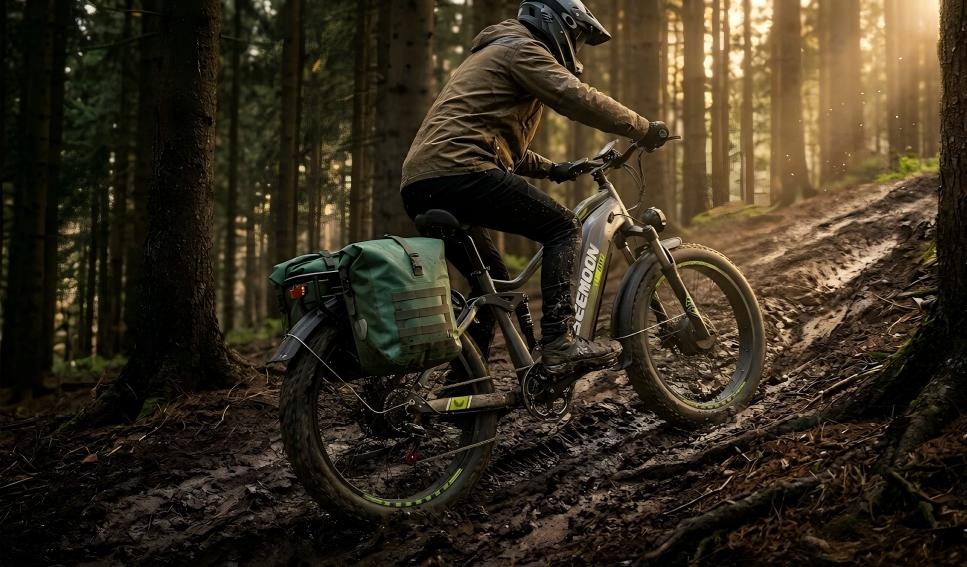
Imagine you are twenty miles into a remote Bureau of Land Management (BLM) trail, the sun is dipping below the horizon, and you shift gears under a heavy load to clear a steep ridge. Suddenly, a sickening snap echoes through the canyon. Your chain has failed. This was followed by the screeching sound of metal rubbing against the spokes. The gearbox was also bent and deformed beyond repair.
In this moment, the engineering debate of hub motor vs mid drive ceases to be academic. It becomes a matter of survival. For the modern American overlander, understanding how these two powertrain architectures handle the rigors of the wild is the difference between an epic adventure and a dangerous walk back to camp.
1. E-Bike Motor Mechanics: How Power Actually Hits the Dirt
To figure out which motor setup truly performs best off-road, you have to look past the marketing spec sheets and examine how they actually put power to the ground. It comes down to the basic mechanics of power delivery.
Mid-Drive Motors: Leveraging the Gearing
A mid-drive motor is mounted at the bottom bracket, right between your pedals. Instead of spinning the wheel directly, it drives the front chainring.
This means every watt of electric assist runs through your chain, cassette, and derailleur before it ever touches the trail.
-
The Mechanical Advantage: Because a mid-drive utilizes the bike's existing transmission, it excels at low-speed, highly technical climbing. Drop into your granny gear, and the motor can spin at its most efficient RPM while you crawl up a steep, rocky grade. It functions exactly like shifting a 4x4 truck into low range.
-
The Catch: Accelerated drivetrain wear. You are forcing the combined torque of a high-output motor (often pushing 85 to 90 Nm) plus your own leg power through a standard bicycle chain originally engineered for human watts alone. If you shift poorly under load or snap a chain deep in the backcountry, you lose motor power entirely.
Hub Motors: Direct and Independent Power
Housed inside a sealed casing at the center of the wheel itself, an electric hub motor completely bypasses the bike's drivetrain. It acts as an independent, direct-drive power source.
-
The Mechanical Advantage: It delivers instantaneous torque straight to the tire’s contact patch. Whether you are in the wrong gear, missing a shift, or your chain is completely broken, a hub motor keeps pulling. The power delivery is consistent and linear.
-
The Real-World Application: For off-road bikepacking or hauling heavy cargo on logging roads—particularly with geared brushless hub motors—this setup is incredibly forgiving. You get reliable, heavy-duty thrust without the constant downshifting required to keep a mid-drive from bogging down on steep hills.
(Want to learn more about hub motors and their unique advantages? Read our deep dive: Why the E-Bike Hub Motor Rules Off-Grid Overlanding).
2. Drivetrain Redundancy: The Ultimate Backcountry Backup
When it comes to the mid-drive vs hub motor debate for serious off-grid overlanding, drivetrain redundancy is usually the deciding factor. Out in the backcountry, having a mechanical fail-safe isn't just a nice feature—it's essential for getting home.
The Mid-Drive Vulnerability
Mid-drive e-bikes are fantastic for climbing torque, but they rely entirely on your bike's standard drivetrain.
That creates a major single point of failure. If you snap a chain, strip a cassette, or smash your rear derailleur on a stray rock, your electric motor is instantly rendered useless. You’re no longer riding; you’re doing a brutal "hike-a-bike" with a 75-pound rig loaded down with heavy camping gear over uneven terrain.
The Hub Motor Advantage
The rear hub motor or dual-motor , on the other hand, gives you true drivetrain redundancy. Because the motor spins the wheel directly, it operates completely independently of your pedals, chain, and gears. If your drivetrain explodes 20 miles from the trailhead, the fix is easy:
-
Zip-tie the broken chain and derailleur out of the way.
-
Hit your thumb throttle.
-
Let the raw motor power drive you safely back to the truck.
For high-stakes e-bike overlanding, knowing your motor will still work even if your pedals won't gives you a level of peace of mind that a mid-drive system simply can't match.

3. First-Hand Testing: Payload & Thermal Realities
At Seemoon, we don't just read spec sheets; we test them in real-world scenarios. The core argument against hub motors has historically been that they overheat on long climbs compared to mid-drives. While true for cheap commuting motors 5 years ago, modern engineering has changed the landscape.
During our recent payload testing, we loaded the test e-bike with 250 lbs (rider plus overlanding gear). We ran it up a sustained 15% grade for 20 minutes using two different setups: a standard 1500W mid-drive and the SM3 all terrain series with modern 60V geared brushless dual hub motor.
-
The Mid-Drive Result: The rider had to frantically downshift to keep the motor in its optimal RPM range. The immense tension stretched the chain significantly, and we observed a high risk of "cassette gouging" (where the chain digs into the softer metal of the gears under extreme load).
-
The Hub Motor Result: The 60V architecture allowed the SM3 hub motor to draw fewer amps to achieve the necessary wattage, drastically reducing heat buildup. The sealed casing's thermal dissipation strategies kept the motor well within safe operating temperatures, all without putting a single ounce of stress on the bicycle chain.
(To understand the exact physics behind motor cooling, read our engineering deep dive: Inside the Brushless Electric Bicycle Wheel Hub Motor for Off-Road).
4. Terrain-Specific Match-Up: Sand, Mud, and Rocks
Different trails demand different torque characteristics. Let's break down where each motor thrives.
Deep Sand and Coastal Riding: The Hub Motor Domain
On loose, "soupy" terrain like the dunes of Moab or the coastal beaches of the Carolinas, momentum is everything. Shifting gears in deep sand with a mid-drive often causes a momentary loss of power, leading the tires to dig in and sink.
The hub motor provides a constant, uninterrupted wave of torque that keeps the fat tires "floating" on the surface.

Technical Rock Crawling: The Mid-Drive Edge
If your riding consists primarily of extreme eMTB singletrack—where you must hop over large logs or crawl up near-vertical rock steps at 2 mph—the mid-drive’s ability to leverage the lowest gear is superior.
However, for 90% of traditional overlanding trails, fire roads, and hunting tracks, this extreme low-speed advantage is unnecessary.
Data Table: Off-Road Terrain Dominance
| Terrain / Scenario | Hub Motor Performance | Mid-Drive Performance | The Verdict |
| Deep Sand & Snow | Constant torque, prevents sinking during shifts. | High risk of bogging down when changing gears. | Hub Motor |
| Loaded Overlanding | Direct power delivery, zero drivetrain wear. | Extreme stress on chain; high snapping risk. | Hub Motor |
| Technical Rock Hops | Challenging to modulate at sub-3 mph speeds. | Exceptional torque multiplication via low gears. | Mid-Drive |
| Mud & Swampy Ground | Sealed IP67 unit; highly resistant to muck. | High wear rate on exposed cassette and derailleur. | Hub Motor |
5. The Financial Reality of US Bike Shops
For American riders, the long-term cost of ownership cannot be ignored. Traditional mid-drive e-bikes are notorious for devouring drivetrains. The combined force of the motor and rider can stretch a high-end e-bike specific chain and wear out a cassette in as little as 500 to 800 miles of off-road use.
Currently, professional US bike shop labor rates average between $80 to $150 per hour. When you factor in the cost of a reinforced chain, a new cassette, and an hour of labor, a routine mid-drive drivetrain replacement can easily exceed $200.
However the hub motor puts zero electrical stress on the chain, your maintenance intervals are identical to a regular, unpowered bicycle. You will spend more time exploring the backcountry and drastically less money at the repair stand.
6. Which E-Bike Motor is Quietest for Hunting? (Hub vs. Mid-Drive)
For hunters, anglers, and wildlife photographers requiring absolute acoustic stealth, a high-quality brushless hub motor is significantly quieter than a mid-drive system.
While mid-drives are highly capable, they present a major liability for covert backcountry navigation. Here is exactly why hub motors provide a superior tactical advantage for off-grid operations:
-
Elimination of Drivetrain Clatter: Mid-drive motors force power directly through the bicycle's chain and cassette. When climbing steep, wooded terrain under heavy load, this inherently produces mechanical "clacking" and heavy derailleur "thunks"—unnatural, metallic sounds that easily spook game.
-
Direct-to-Wheel Silence: A brushless rear hub motor is completely sealed within the wheel itself, bypassing the bike's mechanical transmission entirely. This eliminates chain tension noise and shifting slap, resulting in a near-zero acoustic footprint.
-
Tactical Momentum: Without the need to constantly drop gears under tension in unpredictable terrain, riders can maintain silent, consistent momentum right up to the blind or patrol checkpoint.
The Bottom Line: If your success relies on navigating the woods undetected, bypassing the mechanical noise of a traditional drivetrain in favor of a stealth hub motor is a non-negotiable requirement.

7. Conclusion: Matching the Motor to the Mission
The hub motor vs mid drive choice isn't about which technology is objectively "perfect"—it's about which tool guarantees you make it back to civilization.
If you are a technical eMTB purist who lives for jumping rock gardens, buy a mid-drive.
But if you are an overlander, a boondocker, or a rugged explorer who prioritizes survival redundancy, zero-maintenance reliability, and the raw power to conquer loose terrain, the electric bike hub motor remains the undisputed king of the wild.
At Seemoon Dual-Motor (AWD) All Terrain Series, we engineer our all-terrain systems around this philosophy of "uninterrupted exploration." Because the best adventure is the one that brings you home.
Frequently Asked Questions (FAQ)
Does a hub motor make it harder to change a flat tire on the trail?
It requires slightly more effort than a standard quick-release wheel, but it is easily manageable. Modern hub motors feature quick-disconnect waterproof cables. You simply unplug the cable, use a wrench to loosen the axle nuts, and drop the wheel out. With practice, fixing a rear flat takes less than 15 minutes in the field.
Are hub motors heavier than mid-drive motors?
Yes, direct-drive and high-torque geared hub motors generally weigh more than mid-drives (often ranging from 8 to 12 lbs). However, because this weight is concentrated at the very center of the rear wheel, it actually lowers the bike's center of gravity and increases rear-wheel traction on loose dirt and gravel.
Can I ride a hub motor e-bike if the battery completely dies?
Yes. Geared hub motors contain an internal freewheel mechanism. If your battery dies 10 miles from camp, the motor disengages internally, allowing you to pedal the bike like a traditional (albeit heavy) bicycle without fighting magnetic resistance from the motor core.
Share:
Surviving the Wild: Why the E-Bike Hub Motor Rules Off-Grid Overlanding
Rugged Tech: How the SM3 Brushless Electric Bicycle Wheel Hub Motor Survives the Wild