
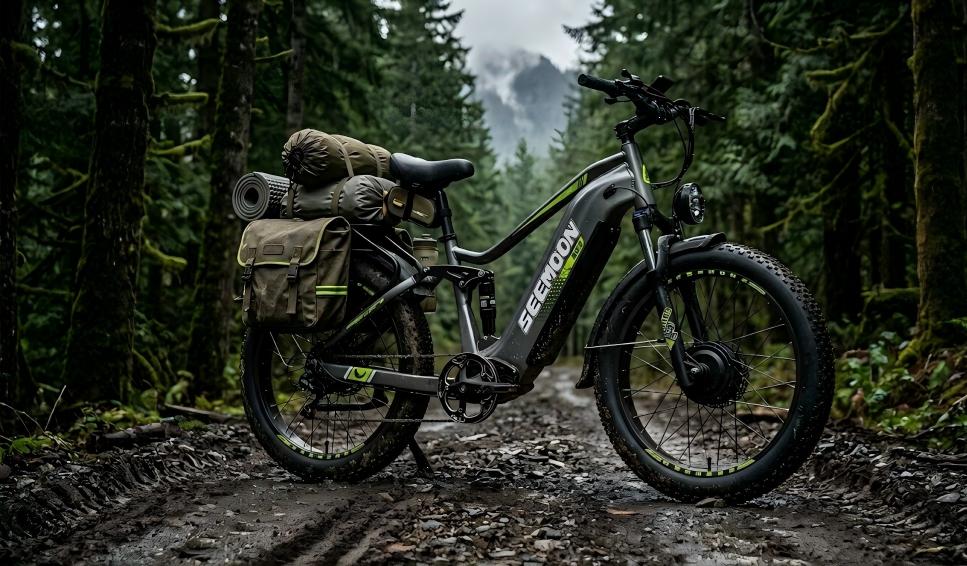
Key Takeaways for the Outdoor Off-road Enthusiasts:
-
The Hub Advantage: The hub motor of an electric bicycle can directly transmit power to the wheel, and even if the chain breaks, it can bypass the bicycle's transmission system to achieve direct power output.
-
Tech Standard: Brushless Geared Hub Motors (BLDC) offer the highest torque-to-weight ratio for easily handling terrains such as muddy swamps and steep mountain slopes.
-
Safety First: In cities like New York, opting for systems strictly compliant with UL 2849 and UL 2271 is no longer optional; it is a legal and safety necessity.
-
Power Architecture: For heavy payloads (250+ lbs), a 60V system runs significantly cooler than a standard 48V system.
The American wilderness demands respect. Whether you are navigating the deep coastal sands of the Outer Banks, managing a heavy boondocking setup in the Pacific Northwest, your equipment cannot fail. While the e-bike industry has spent years arguing over motor types, the conversation around e-bike hub motors has drastically shifted.
No longer just for urban commuting, high-torque brushless hub motors have become the powertrain of choice for serious overlanders. This ultimate guide breaks down the engineering, physics, and real-world off-road capabilities of the modern electric bicycle wheel hub motor.
The Mechanics of Off-Road Hub Motors: Power at the Core
Unlike the traditional mid-drive layouts that mirror a standard bicycle’s crankset, an e-bike hub motor is housed entirely within the wheel’s center. When you engage the Pedal Assist System (PAS) or thumb throttle, the motor draws current from the battery to rotate the wheel directly at the axle.
For off-road enthusiasts, this direct-drive mechanism is a strategic advantage. Because the motor operates independently of the drivetrain, your power delivery doesn't rely on the bike’s chain, cassette, or derailleur. If you snap a chain miles into a backcountry trail, a hub motor can still throttle you back to the trailhead—a level of redundancy that mid-drive systems simply can't offer.
Hub motor type: Front, Rear, and AWD Configurations
Choosing the right motor placement is critical for maintaining traction on unpredictable surfaces like loose shale, deep mud, or coastal sand.
Rear Hub Motors: The Traction Powerhouse
The rear hub is the gold standard for off-grid hauling and steep ascents. Pushing from the rear mimics the natural dynamics of a rear-wheel-drive vehicle; as you climb, your weight shifts over the drive wheel, pinning the tire to the dirt and maximizing "bite." It’s the go-to setup for riders who prioritize stability and torque on technical climbs.
Front Hub Motors: Niche Utility
Single-motor front setups are rare in serious off-roading. Without weight directly over the fork, the front wheel is prone to "washing out"—losing traction and sliding—on loose gravel or slick mud during a turn. While simpler to maintain, they lack the grit required for aggressive trail riding.
Dual-Motor (AWD): Dominating Soft Surfaces
For the "un-stoppable" experience in deep snow or soft sand, All-Wheel Drive (AWD) is the ultimate solution. By distributing power to both wheels simultaneously, the front tire pulls through the muck instead of plowing into it. AWD hub systems offer a balanced "pull-and-push" effect that keeps the bike afloat on terrain where single-drive bikes would simply sink.

Pro Tip: When choosing a hub motor for off-roading, look for a "geared" hub rather than "direct-drive." Geared hubs are lighter and provide significantly more low-end torque, which is essential for punching up short, punchy hills.
Direct-Drive vs. Geared Hub Motors on the Trail
Not all hub motors are built the same. When planning a backcountry excursion, understanding what is inside the motor casing is critical for performance under load.
Geared Hub Motors: The Torque Multiplier
Geared hub motors contain an internal planetary gear system. The motor itself spins at a much higher RPM than the wheel, and the gears reduce this speed to multiply the torque output (often exceeding 80 Nm).
-
The Off-Road Advantage: This mechanical advantage is vital for low-speed, high-incline climbs over roots and rocks. Furthermore, they feature a freewheel clutch; if the battery dies, the motor disengages, allowing you to pedal without magnetic resistance.
Direct-Drive Hub Motors: Raw Durability
Direct-drive motors have no internal gears—the outer shell of the motor is the wheel hub. They are larger, heavier, and generally more suited for high-speed highway commuting.
-
The Off-Road Verdict: While they offer regenerative braking (useful for long mountain descents), their lack of low-end torque makes them less ideal for dragging a 250 lb payload up a steep muddy embankment compared to a geared hub.
How BLDC Hub Motors Survive Extreme Off-Road Conditions
To withstand extreme environments, premium off-road e-bikes rely exclusively on Brushless DC (BLDC) hub motors. By replacing mechanical brushes with a frictionless system of copper-wound electromagnets (the stator) and rare-earth neodymium magnets (the rotor), BLDC technology delivers three critical advantages for backcountry riding:
-
IP67-Rated Weatherproofing: The absence of physical brushes enables a fully sealed, marine-grade architecture. This protects sensitive internal components—specifically the copper windings and Hall effect sensors—from water ingress, mud, and corrosive salt spray.

-
Zero Mechanical Wear: Eliminating internal friction not only provides near-instantaneous torque but drastically extends the motor's lifespan beyond traditional brushed designs.
-
Dynamic Thermal Throttling: Heat is the unavoidable byproduct of sustained torque. Under heavy loads (e.g., climbing steep 15% grades with gear), advanced BLDC systems utilize integrated diagnostics to monitor thermal limits, strategically rolling back power to prevent the rotor's magnets from demagnetizing.
(Want to understand the exact physics behind motor cooling and stator engineering? Read our deep dive: Inside the Brushless Electric Bicycle Wheel Hub Motor for Off-Road).
Hub Motor vs. Mid-Drive for Overlanding: The Case for Drivetrain Redundancy
While mid-drive motors are universally favored for technical eMTB singletrack, rear hub motors offer a critical, often-overlooked advantage for off-road overlanding and bikepacking: mechanical redundancy. When riding deep in the backcountry, this distinction can be the difference between riding back to camp or walking.
The Mid-Drive Vulnerability Under Load
A mid-drive motor channels its entire output—often exceeding 100 Nm of torque—directly through a standard bicycle chain. This creates a significant point of failure for overlanders. When you load an e-bike with 50+ pounds of expedition gear and shift gears while grinding up a steep fire road, the drivetrain endures immense stress.
-
The Risk: Shifting under heavy load frequently results in snapped chains or mangled derailleurs.
-
The Consequence: Because a mid-drive relies on the pedal drivetrain to transfer power, a broken chain 15 miles into the wilderness means your ride is instantly over. You are left pushing a heavy rig back to civilization.
The Hub Motor’s "Get Home" Guarantee
Conversely, a rear hub motor operates entirely independent of your bike's pedal drivetrain. This separation provides a built-in fail-safe that is invaluable for remote exploration.
-
Independent Power: If a rock smashes your derailleur or you completely shred your chain, a hub motor remains unaffected.
-
Throttle Override: You can simply engage the thumb throttle, allowing the raw electrical power to drive the rear wheel directly.
For expedition riding where reliability outweighs low-speed agility, the hub motor acts as an ultimate insurance policy, ensuring you can limp back to civilization even after a catastrophic mechanical failure.

(For a complete breakdown of terrain matching and maintenance costs, check out our guide: Hub Motor vs Mid Drive: Which is Best for All-Terrain & Overlanding?).
Beyond the Cycling Enthusiasts: Search & Rescue and Backcountry Stealth
It's not just outdoor off-road enthusiasts who rely on brushless hub motors. Across the US, park rangers, land management agencies, and backcountry Search and Rescue (SAR) teams are increasingly deploying hub-driven e-bikes for rigorous off-grid work. Here is why the hub motor makes sense out in the field:
-
Whisper-Quiet Patrols: Anyone who has pushed a traditional drivetrain to its limits knows that chains and cassettes can make a racket under heavy tension. Direct-drive and well-lubricated geared hub motors bypass that drivetrain clatter entirely, running virtually silent. For wildlife officers managing protected lands—or bowhunters trying to slip into a blind before dawn—this near-zero acoustic footprint is a massive tactical advantage.
-
Predictable, Heavy-Duty Towing: In emergency scenarios, SAR crews frequently pull single-wheel cargo trailers loaded with heavy medical gear over unpredictable terrain. Rear hub motors are uniquely suited for this job. Because the motor sits at the very back of the bike, it delivers a smooth, linear torque curve directly to the ground. This predictable power delivery keeps the bike planted, actively preventing heavy trailers from unexpectedly jackknifing on steep, loose-gravel descents.
The Bottom Line for US Riders
Choosing the right motor is about matching the tool to the terrain. If your goal is to hit extreme downhill jumps, look at mid-drives. But if your mission is to load up your gear, explore forgotten BLM (Bureau of Land Management) roads, ride the coastal surf lines, and have the ultimate peace of mind that your powertrain won't leave you stranded—a robust, heavily engineered e-bike hub motor is your ultimate off-grid companion.
Frequently Asked Questions (FAQ)
Can an e-bike hub motor handle deep coastal sand riding?
Yes, but technique and hardware matter. A rear hub motor, paired with 4-inch fat tires aired down to a low PSI (around 8-10 PSI), provides excellent "float" and traction. Because the motor pulls directly at the wheel, it prevents the jerky drivetrain shifts that usually cause riders to dig into the sand and get stuck.
Do I need a dual hub motor (AWD) for snow?
While a single rear hub motor with studded fat tires is sufficient for packed snow, an AWD (All-Wheel Drive) setup featuring both front and rear hub motors is highly recommended for deep, fresh powder. AWD prevents the front wheel from acting as a plow, actively pulling the bike over the top of the snowpack.
How do I maintain my hub motor after a muddy overlanding trip?
Brushless hub motors are remarkably low-maintenance. After riding through mud or saltwater, use a low-pressure hose (never a high-pressure power washer) to rinse the casing. Ensure the axle nuts remain torqued to the manufacturer's spec, and periodically check the motor cable entry point for any signs of seal degradation.
Share:
Do You Really Need Electric Bike Insurance? Costs, Coverage, and Theft Protection Explained
Hub Motor vs Mid Drive: The Overlander’s Guide to All-Terrain Dominance