
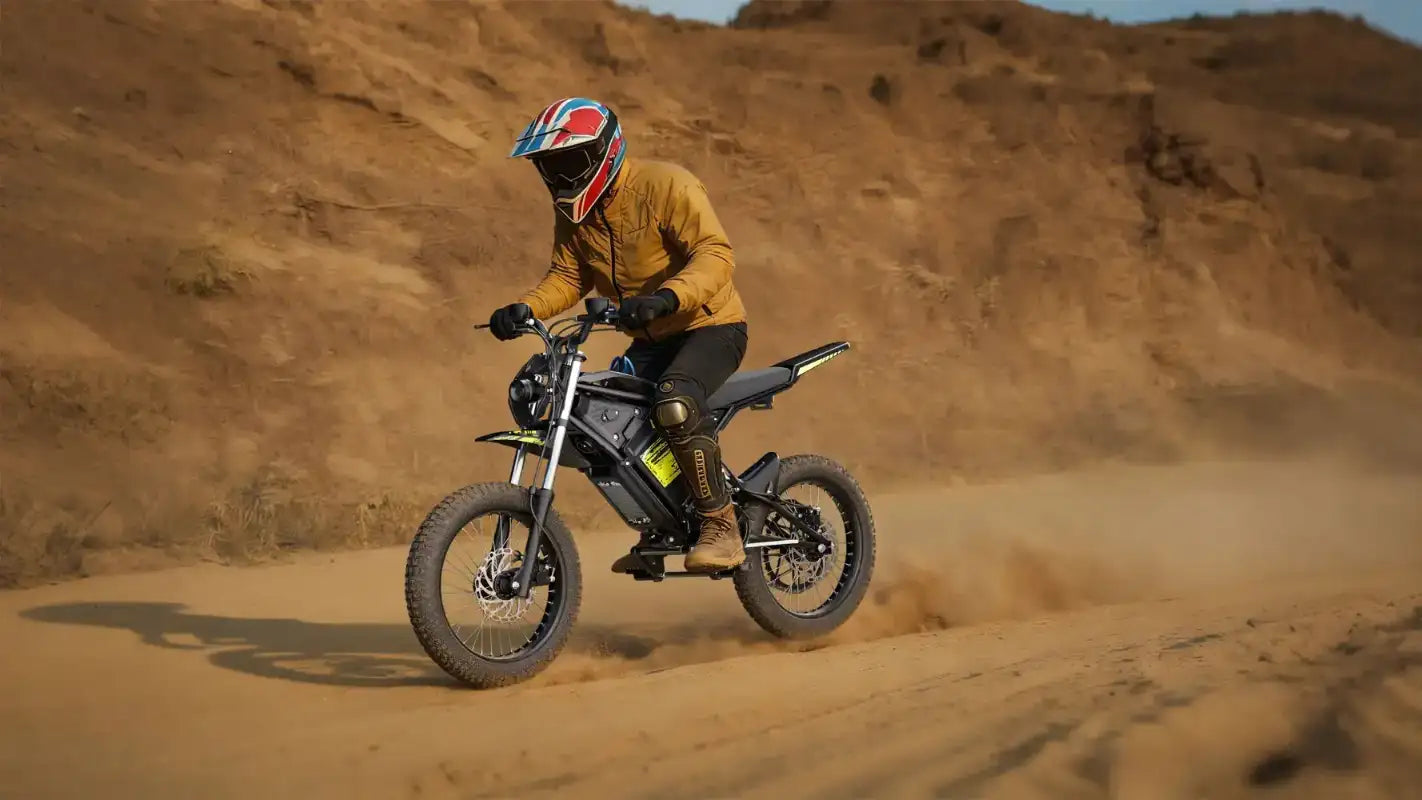
Turn off the engine. Listen.
No ringing ears. No smelling like 2-stroke oil. Just the sound of your tires crunching over gravel and the wind in the trees. For decades, riding dirt bikes meant noise complaints, angry hikers, and constant engine rebuilds. But in 2026, the game has changed.
We aren't all looking to hit 50-foot jumps at the motocross track. Most of us just want to explore fire roads, conquer technical trails, and get lost in the woods without waking up the entire county.
For a long time, your only options were a heavy gas bike or a $4,500+ Sur-Ron. But there is a new contender in town. A machine that bridges the gap between a commuter and a trail weapon. If you are looking to take your adventure off the pavement, here is everything you need to know about the modern electric enduro motorcycle landscape—and why you might not need to spend five grand to have fun in the dirt.
The "Soft Enduro" Revolution: What Are We Riding?
Before diving into specifications, let's define the different endurance racing missions. Hard endurance racing involves leaping over logs and climbing vertical rock walls, which can easily result in fractures and vehicle damage. Soft endurance racing, on the other hand, focuses more on exploration, such as riding 40 miles of gravel firebreaks or venturing into single-track tracks to find secluded campsites and then riding home.
Therefore, if you're aiming for a soft endurance racing mission, you don't need a powerful racing car. What you need is an electric motorcycle that excels in torque, range, and reliability.

The Market Problem
If you search for electric dirt bike motorcycles, you usually find two extremes:
- The "Hyper-Expensive" Toys: Bikes like the Sur-Ron Light Bee or Talaria Sting. They are incredible, but they cost as much as a used car ($4,500 - $6,000) and have tiny batteries that limit your range.
- The "Pretenders": Fat-tire e-bikes that look rugged but rattle apart on the first washboard road because they use bicycle components.
The Solution: Electric motorcycles represented by the SM4
Enter the SM4. It occupies a sweet spot we call the "Crossover Scrambler." It has the geometry and wheels of a small motorcycle but the accessibility of an e-bike. It is designed for the rider who wants to commute on Friday and hit the trails on Saturday.
Curious about how these bikes handle the street? Check out our comparison here.
Trail Ready: Why "Bicycle Parts" Don't Belong in the Dirt
I’ve seen it a hundred times on the trail. A guy brings a "fat tire e-bike" to an OHV area. Five miles in, he has a pinch flat, his brakes are overheating, and his battery is dead. So if you want to ride off-road, you need hardware that can take a beating.
1. The Suspension: Soaking Up the Gnar
Roots, rocks, and washboards will destroy your wrists if you don't have damping. Rigid forks are a non-starter. The SM4 comes equipped with a full suspension system.
- Front Suspension: Telescopic forks that handle the initial impact of rocks and ruts.
- Rear Shock Absorber: A coil-over rear shock that keeps your rear wheel planted for traction.
This isn't just about comfort; it's about control. When your suspension absorbs a bump, your tire stays on the ground. Tire on the ground = Traction.

2. The Rubber: 17" Moto Wheels vs. 20" Bicycle Tires
This is the hill I will die on. 20-inch fat tires are terrible for off-roading. They bounce unpredictably (we call it the "basketball effect") and have thin sidewalls that tear easily on sharp rocks.
The SM4 uses authentic 17-inch motorcycle rims.
- Stability: The larger diameter rolls over obstacles rather than getting hung up on them.
- Durability: Motorcycle tires have thicker sidewalls. You can run lower pressures for grip without immediately getting a flat.
- Service: If you tear a tire in a rural town, the local moto shop has a 17-inch tube. They definitely don't have a proprietary 20x4.0 bicycle tube.

Range Anxiety in the Woods? Not Anymore.
On city streets, a dead bike battery is just an annoyance, but you can call an Uber. However, in the woods, a dead bike battery becomes a matter of life and death, forcing you to push a 134-pound bike back to civilization. Therefore, for electric off-road motorcycles, battery capacity is your lifeline.
Most "off-road e-bikes" are equipped with small batteries (typically around 19-20Ah) to reduce weight. They're suitable for short 30-minute sprints, but not for exploration. The SM4, however, comes with a massive 48V 28Ah (1344Wh) battery.
The Math of Adventure
That extra 40% capacity is the difference between turning back early and seeing what's over the next ridge.
This extra 40% capacity means you can choose to turn back early or continue exploring the next ridge. The manual states a range of 50-100 miles. Even if you ride aggressively on muddy roads (which will consume more power), the 1344Wh capacity provides a level of safety that a lightweight motocross bike can't match.

Want to know the tech behind these batteries? Read our detailed guide here.
Torque for the Trails: The "Climb Factor"
Riding off-road isn't about top speed. Who cares if you can go 50mph if you can't climb the steep hill out of the creek bed? Off-road riding is all about Torque.
Most hub-motor scramblers produce around 80-90Nm of torque. The SM4 delivers 170 Nm via a Mid-Drive Motor. This allows you to start from a dead stop on a steep fire road.
This torque allows you to start from a standstill on steep firebreaks, with the mid-mounted motor transmitting power through a chain and amplifying it using mechanical gears. On challenging terrain, smaller electric motorcycles might get stuck in the mud, while the SM's 2000W peak power motor gives you the "burst" of power needed to traverse sand pits or muddy sections.

🔧 Unlocking SM4 Off-Road Performance & Core Maintenance Guide
I always tell new riders: "The factory build is just the foundation; adaptation is key." The SM4 is a machine with immense potential, but if you plan to take it off-road, relying solely on the factory settings isn't enough.
Based on the SM4 Official Maintenance Manual and community field data, here are four core preparation tips tailored for off-road scenarios:
1. Drivetrain: Chain Tension is the Lifeline of Power Delivery
High-frequency vibrations on off-road trails are the "invisible killer" of mechanical components. A loose chain not only causes power loss but can also lead to severe mechanical failures, such as slapping the swingarm or derailment.
-
Check Frequency: Mandatory Pre-Ride Check (Every Ride).
-
Technical Specs: Strictly maintain chain slack between 2-6 mm.
-
Field Experience: The manual suggests calibrating every 65 miles (approx. 105 km) initially. However, in high-intensity off-road environments, we recommend adopting a "Check Before You Load" habit. Always carry a portable wrench kit—this is the baseline for self-rescue in the wild.
2. Thermal Management: Protecting the Controller's "Heart"
While the SM4 controller is equipped with 35A Over-Current Protection and Under-Voltage Protection, physical heat dissipation remains critical during extreme climbing. Overheating causes performance throttling or can trigger a system shutdown.
-
Core Risk: Heat accumulation.
-
Field Operations: After long-distance, low-speed climbing (high-load scenarios), ride on flat ground to utilize airflow for cooling, or let the bike rest for 1 minute.
-
Avoidance Guide: Never park the bike in direct sunlight immediately after an intense ride. You must ensure sufficient air circulation around the controller casing to facilitate passive cooling.
3. Ingress Protection: Understanding the Reality of IP54
An IP54 rating means the SM4 handles dust and water splashes effectively, but it does not make it an amphibious vehicle.
-
Operational Boundaries: You can confidently tackle wet trails, light mud, and shallow puddles.
-
Absolute No-Go Zone: Do not wade through rivers or ride in torrential rain. The manual explicitly warns against deep water immersion and extreme weather to protect precision electronic components (like the controller and battery contacts).
4. Tire Dynamics: Balancing Pressure and Grip
Traction begins with the contact patch. The manual specifies a standard pressure of 230 kPa (approx. 33 PSI), which balances range and support.
-
Benchmark: 33 PSI.
-
Advanced Strategy: Maintain 33 PSI on paved roads while heading to the trail to maximize range.
-
Descent Tip: Re-check your tire pressure before beginning a downhill rush. You need enough pressure to protect the rims from rock strikes, but avoid pressure so high that the tires feel "rock hard" and lose grip.
The Verdict
The Weekend Warrior's Weapon.
You don't need a factory sponsorship to own the dirt. The SM4 isn't just about the 17-inch wheels or the massive battery—it's about the silence between the trees and the freedom to go where the map ends.
It’s not a motocross bike. It’s a ticket out of the city.
Check the full off-road specifications
Share:
Best Electric Motorcycles for Adults : The "Torque" Ranking
The Electric Motorcycle Buyer’s Guide: Street Legal Dirt Bikes & Scramblers