
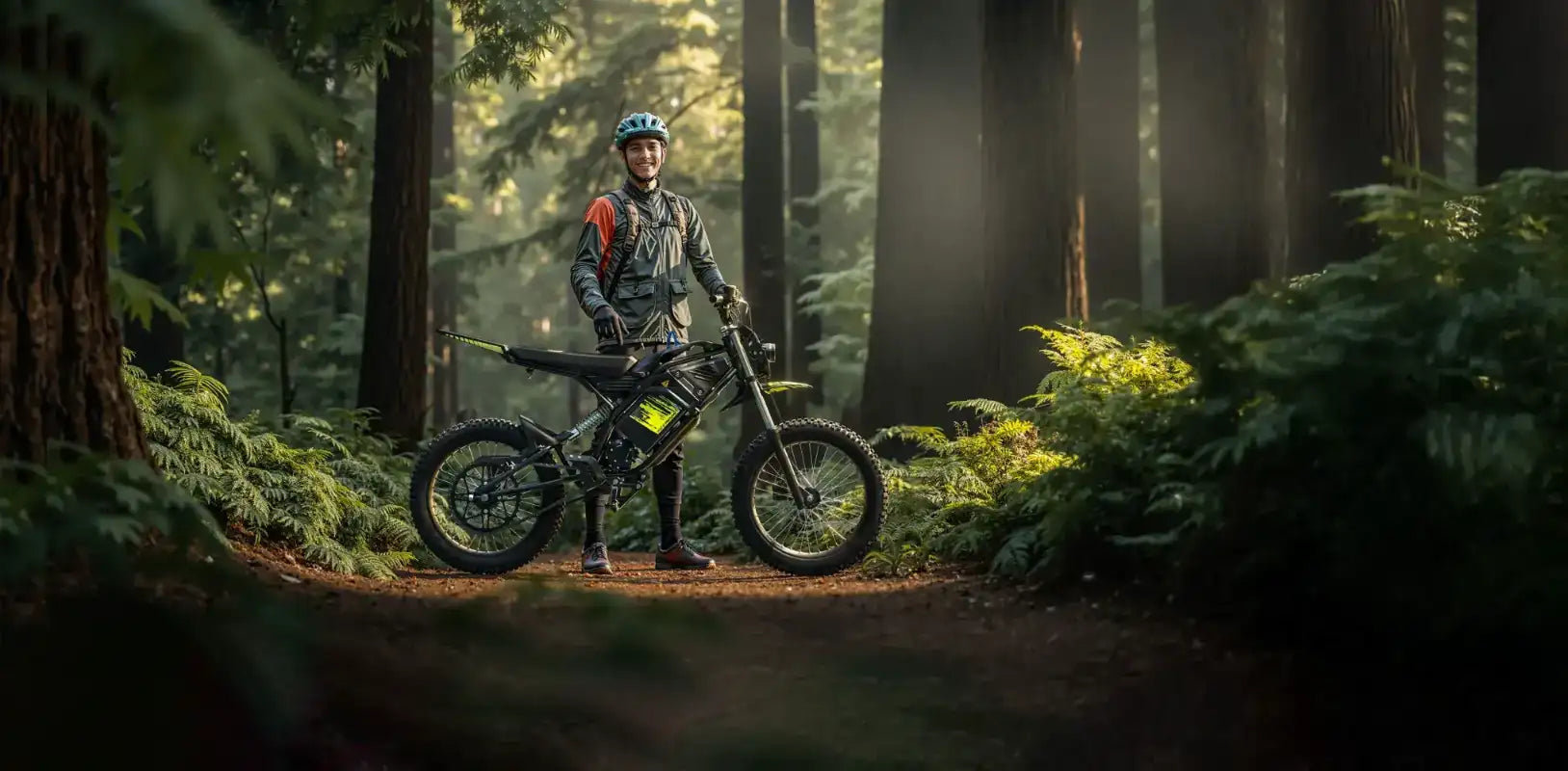
The roar of engines is being replaced by the hum of future electric motors. By 2026, the line between a bicycle and a motorcycle has not just blurred—it has vanished. We are witnessing the rise of the "Crossover Electric Motorcycle": machines that look like dirt bikes, handle like motorcycles, but possess the practical flexibility of mopeds.
For the modern rider, the question is no longer "Should I go electric moped?" It is "Which electric motorcycle gives me the power to climb hills without the hassle of a full motorcycle endorsement?"
If you are navigating the chaotic market of 2026—flooded with cheap toys and overpriced prototypes—this guide is your roadmap. We will break down the critical specs that actually matter: Torque (Nm), Voltage (V), Wheel Size, and Street Legality. Introducing the breakout contender redefining the category: the Seemoon SM4, a street-legal scrambler boasting a massive 170Nm of torque and automotive-grade engineering.

The New Era: Understanding the "Crossover" Electric Motorcycle
The Crossover Revolution: Defining a New Species of E-MotoFor years. For years,the two-wheeled electric market suffered from a polarizing gap: you were forced to choose between low-powered, pedal-assisted e-bikes or heavy, prohibitively expensive electric motorcycles. That era is over. Enter the Electric Crossover—a high-performance hybrid often categorized as the "lightweight e-moto." these vehicles maximize power-to-weight ratios, offering the agility required for technical off-road riding with the acceleration needed to assert dominance in urban traffic.
Why the Market is Shifting ? Riders are evolving. The modern commuter refuses to compromise on range anxiety or gradeability (climbing power). They demand a machine with the DNA of a climber—characterized by exposed trellis frames, extended seats, and dual-sport tires—that remains practical for urban environments. It raises the question: Is it a bicycle? Is it a motorcycle? It is neither. It is an entirely new species designed for the modern era.
Street Legal vs. Off-Road: The "Electric Moped" Advantage
A common pitfall for new buyers is purchasing a $3,000 bike only to realize it is illegal to ride in their neighborhood. Many electric dirt bikes are classified as "off-road only," meaning they lack the safety equipment required by the Department of Transportation (DOT). The Seemoon SM4 offers a "best of both worlds" solution: the durability of a dirt bike with the street-legal features of a moped.
The SM4 Compliance Strategy: Engineering for the Real World
- Optimized Powertrain Calibration: With a governed top speed of 28 mph, the SM4 is tuned to align with specific urban mobility classifications, allowing it to flow seamlessly with city traffic while managing battery efficiency.
- DOT-Standard Visibility: Unlike competition-spec "toy" bikes, the SM4 prioritizes active safety. It comes factory-equipped with a full lighting suite—headlights, taillights, and comprehensive signaling—ensuring you are visible day or night.
- Responsible Lane Usage: Designed for versatility, this platform allows riders to navigate designated moped or motorcycle lanes confidently (subject to local state regulations), removing the legal ambiguity of riding a distinct dirt bike on the street.
Torque is King: Why Wattage is Just a Number
Let’s be clear: Watts measure energy consumption; Torque measures raw muscle. In the electric motorcycle world, high wattage figures look good on a spec sheet, but they don't help you launch off the line or conquer a 30° incline. To move a heavy frame and a rider against gravity, you need rotational force, not just energy potential. This is where the SM4 separates itself from generic electric scooters.
While standard hub motors often plateau at 80-100Nm, the SM4 delivers a crushing 170Nm of torque. This massive torque figure changes the ride dynamic entirely. It means instant throttle response without the "lag" typical of lower-tier electric motorbikes. Whether you are hauling cargo or navigating steep terrain, the SM4 prioritizes actual wheel-turning force over inflated marketing numbers.
The SM4 Performance Spec:
- Torque: 170Nm (Class-leading climbing power)
- Peak Power: 2000W (High-output acceleration)
- Rated Power: 48V 800W (Continuous reliability)

Battery Tech: The Reality of Range
When evaluating high-performance electric mobility, the spec sheet only tells half the story. The SM4 distinguishes itself not just by its motor, but by the massive energy reservoir that powers it. In this technical analysis, we break down the SM4’s battery architecture, its real-world range capabilities, and the critical maintenance protocols needed to maximize cycle life.
1. Technical Analysis: The 1,344Wh Advantage
At the core of the SM4 is a high-capacity 48V 28Ah lithium-ion battery pack. To understand the significance of this, we need to look at the total energy capacity calculation:
In a market where standard e-bikes typically rely on ~672Wh packs, the SM4 effectively doubles the energy density available to the rider. This 1.3 kWh capacity is the defining factor that transforms the SM4 from a simple recreational bike into a legitimate long-range utility vehicle.
2. Range Reality: Lab Data vs. The Road
Manufacturer lab data indicates a range variance of 50–100 miles. However, seasoned riders know that range is a dynamic variable influenced by payload, terrain, and throttle aggression. Here is what you can expect in real-world scenarios:
- The 100-Mile Ceiling: Achievable under "Eco" conditions—utilizing pedal assist on flat terrain at moderate cruising speeds.
- The 50-Mile Floor: Even under heavy load or continuous throttle usage, the 1,344Wh pack provides a robust safety net. This ensures you can handle lengthy urban commutes without the "range anxiety" common in lower-capacity models.
- Charging Workflow: The system features an 8–9 hour charge cycle. This is designed for an overnight "plug-in and forget" routine, ensuring a full "tank" every morning.
3. Engineering Battery Longevity
To protect your investment and maintain the pack's chemical health over years of service, treating the Battery Management System (BMS) correctly is key.
Managing the Voltage Floor
The SM4 is equipped with a hardware-level Low-Voltage Protection cutoff that engages at 42V (±1V).
Pro Tip: While this safety feature prevents immediate failure, frequently draining the battery to this absolute limit (0%) increases internal resistance. To maximize the battery's lifespan, aim to recharge before you hit the hard cutoff.
The Thermodynamics of Range
Lithium-ion efficiency is heavily dictated by ambient temperature.
- Cold Weather Impact: In freezing temperatures (<32°F / 0°C), expect a temporary capacity loss of 20–30% due to "voltage sag" and increased internal resistance.
- Best Practice: Always charge your battery indoors at room temperature. While riding in the cold is acceptable, charging a frozen battery can cause permanent lithium plating on the anode, irreversibly damaging the cells.
Winterization & Long-Term Storage
If storing the SM4 for the winter season, beware of parasitic drain—the small amount of power the BMS uses to monitor the cells.
- The Protocol: Unlike smaller electronics, this high-capacity pack requires vigilance. We recommend a top-up charge every 15 days. This prevents the voltage from dropping below the critical threshold where the BMS might permanently lock the battery for safety.

The Geometry of Performance: Why the SM4 Uses 17-Inch Motorcycle Rims
In the electric motorcycle industry, wheel architecture is often the hidden variable that dictates ride quality. While many manufacturers cut corners by using 20-inch bicycle "fat tires," the SM4 is engineered as a true vehicle, not a toy. We utilize 17-inch motorcycle-grade rims, a design choice that fundamentally changes the physics of the ride. This resulted in a frame geometry that far surpasses the 20-inch wide tire standard used in competing models.
Here is the technical breakdown of why this distinction matters:
- Gyroscopic Stability & Rotational Inertia: Bicycle tires lack the mass required for high-speed stability. The SM4’s motorcycle rims create a stronger gyroscopic effect. This increased rotational inertia naturally keeps the bike upright and tracks straight, eliminating the "speed wobble" often felt on lighter e-bikes.
- Improved Angle of Attack: The physics of obstacle clearance is determined by the angle of attack. A dedicated motorcycle wheel has a larger total diameter and stiffer sidewall construction than a bicycle tire. This allows the SM4 to roll over potholes, roots, and curbs with less resistance, rather than deflecting or bouncing off them.
- Integrated Suspension Dynamics: Tires are the first line of suspension. By using a DOT-standard motorcycle tire, we gain distinct sidewall rigidity that bicycle tires cannot offer. When paired with our inverted front forks and rear monoshock, the wheels act as a tuned component of the chassis, offering predictable traction on both tarmac and trail.

Safety & Build Quality: Beyond the Motor
Precision Control: The SM4 Hydraulic Braking System
The SM4 abandons traditional mechanical constraints in favor of a high-performance Hydraulic Disc Brake system. Unlike mechanical cable-actuated brakes—which are prone to cable stretch, friction fatigue, and reduced stopping power over time—the SM4’s hydraulic architecture ensures consistent caliper pressure and superior modulation.
Using DOT4 brake fluid, known for its high boiling point and resistance to moisture absorption, the system translates minimal lever input into massive clamping force at the rotors. This means riders experience less hand fatigue and more confidence, whether navigating technical trails or commuting in urban traffic.
Safety Feature: Electronic Motor Cut-Off
Critical for high-torque electric powertrains, the SM4 integrates an instantaneous Brake Power Cut sensor. The moment the brake lever is actuated, the system electronically overrides the throttle signal to cut motor power. This prevents the motor from "fighting" the brakes, significantly reducing stopping distances and enhancing rider safety during panic stops.

The Verdict: Is the SM4 Right for You?
The electric mobility market in 2026 is saturated with generic electric motorcycles, but the Seemoon SM4 stands out with its precise positioning as an urban electric motorcycle. It's not just about looks; it's a model built to meet specific needs, aiming to bridge the gap between high-performance electric bicycles and heavy motorcycles. Therefore, for enthusiasts seeking a perfect balance between specifications and actual riding dynamics, the SM4 is undoubtedly an excellent choice. Below is a detailed technical specifications analysis to help you make your decision.
You should buy the SM4 if:
- ✅ You need 170Nm Torque for hills.
- ✅ You want the safety of 17-inch wheels and hydraulic brakes.
- ✅ You need a massive 48V 28Ah battery.
- ✅ You want that rugged "Scrambler" style.
Ready to ride? Learn more about the SM4 model
Welcome to the future of the Crossover Electric Motorcycle.
Disclaimer: This guide is for informational purposes. Always consult local regulations regarding electric motorcycle and moped use on public streets.
Share:
Off-Road Dominance: Why the "Silent Scrambler" is Taking Over the Trails (2026)
The "Moped Loophole": Riding Street Legal Electric Dirt Bikes to Work