
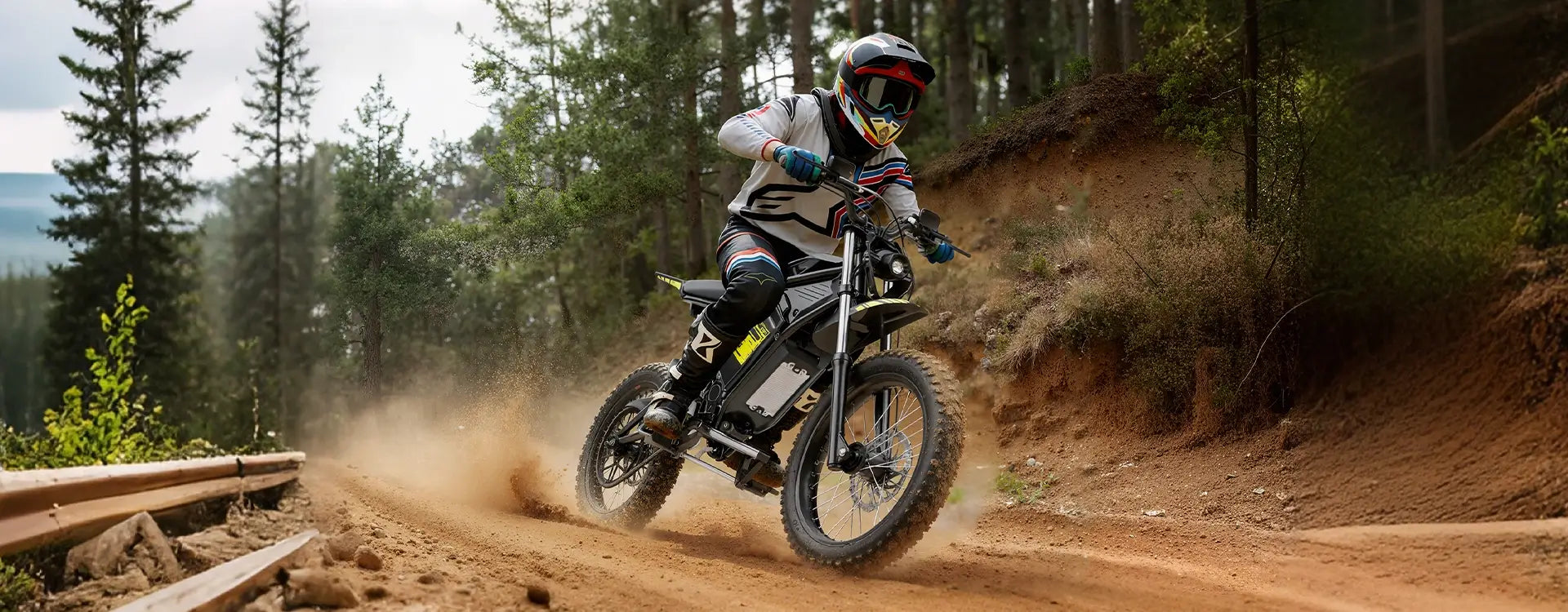
For decades, the American commuter was trapped in a frustrating binary: succumb to the gridlock of four-wheelers or don spandex to become a "cyclist." By 2025, that paradigm has shifted. A third category has hit the pavement, blending the aggressive geometry of a dirt bike with the nimble torque of a trials bike—all while bypassing the bureaucratic hurdles of a traditional Class M license in many jurisdictions.
Welcome to the Electric Moped Revolution. Leading this charge are high-performance platforms like the Seemoon SM4, engineered to blur the lines between recreational tech and legitimate utility. However, navigating the "gray zone" between CPSC-regulated Class 2 e-bikes and DOT-compliant motor vehicles requires more than just a quick glance at a manual.
In this in-depth technical analysis, we’ll deconstruct the federal and state frameworks—from nominal wattage limits to street-legal hardware requirements—and explain why the modern electric moped is the ultimate "cheat code" for the urban commute.
Redefining Versatility: Why "Categorical Utility" Trumps the "Loophole" Narrative
In the e-moto community, the term "loophole" is frequently tossed around in YouTube comment sections. However, to understand the true value of a machine, we must look past colloquialisms and focus on a much more precise technical concept: Categorical Utility.
The Limitation of Traditional Off-Road Platforms
Traditional dirt bikes are engineered with a singular focus—closed-course performance. By definition, these are "Off-Highway Vehicles" (OHVs). They lack integrated lighting systems, feature non-DOT-approved knobby tires, and operate without the speed governors required for urban integration. Attempting to operate a standard dirt bike on a public artery doesn't just make you a target for law enforcement; it highlights a fundamental lack of design versatility.
The SM4: Engineering for Multi-Modal Compliance
From its inception, the SM4 was purposefully classified as an "Electric Moped." This is a critical distinction in manufacturing. Rather than being an after-thought, the SM4’s street-legal DNA—including its lighting package, mirror mounts, and software-defined speed tiers—is baked into its factory configuration.
-
Regulatory Precision: By adhering to specific US state and federal classifications for mopeds, the SM4 provides riders with a legitimate pathway to registration and public road access.
-
Dual-Purpose Utility: It bridges the gap between a high-torque trail slayer and a reliable urban commuter.
By prioritizing Categorical Utility, the SM4 proves that true innovation isn’t about finding a "loophole"—it’s about utilizing sophisticated engineering to deliver high-performance freedom within the framework of local regulations.
The Speed Limit Factor: 20mph vs. 28mph
The key factor in the legality of electric mopeds lies in the speed of enforcement. For example, the SM4 has dual functions. This feature allows you to either travel at 28 mph with city traffic or slow down to 20 mph to safely enter a compliant lane.
-
Non-Motorized Lanes (Class 2 Rule): When riding in designated non-motorized lanes, the User Manual explicitly states that the motorcycle's "maximum speed must not exceed 20 mph"
-
Street performance (moped/Class 3): On major roads where higher speeds are permitted, the SM4's maximum design speed is 28 mph.
want to see the full spec sheet? Check out our [2025 Electric Motorcycle Buyer’s Guide]
Safety First: Why "Street Legal" Means More Than Just Speed
Powerful performance is only one part of navigating the complexities of modern transportation. To transform from an "off-road toy" into a reliable commuter vehicle, a vehicle must possess superior handling and safety. The SM4 is designed to bridge the gap between recreational riding and automotive-grade safety.
1. High-Fidelity Visibility: Seeing and Being Seen
In the realm of urban commuting, visibility is your primary line of defense. Unlike off-road-only models that treat lighting as an afterthought, the SM4 features a fully integrated OEM Lighting Suite designed for high-contrast signaling.
-
Integrated Illumination: The SM4 utilizes a high-lumen LED headlamp with a wide-angle beam pattern and a high-intensity rear positioning light. This ensures a consistent "visual footprint," making you identifiable to motorists from both the front and rear in low-light conditions.
-
Compliance & Customization: While the SM4 provides the essential lighting foundation, local DOT (Department of Transportation) regulations vary by state. Many jurisdictions require specific additions like turn signals or side-view mirrors for high-speed road classes. To address this, the SM4 cockpit features integrated mounting points on the handlebars, allowing for seamless, vibration-resistant installation of legal accessories without modifying the core wiring harness.
2. Hydraulic Braking Performance & Power Management
In a split-second emergency—like a vehicle merging blindly into your lane—mechanical cable brakes simply lack the modulation and thermal capacity required for a 2000W platform. The SM4 utilizes a Closed-Loop Hydraulic Disc Brake System to ensure professional-grade deceleration.
-
The Physics of Stopping Power: Unlike mechanical cables that suffer from "cable stretch" and friction loss, hydraulic systems provide a linear, consistent clamping force. This reduces hand fatigue and prevents brake fade during repeated high-speed stops.
-
Intelligent Motor Cut-off (Electronic Braking Integration): Power is nothing without control. The SM4 system is equipped with an integrated Brake-Power Cut-off Circuit. The moment the levers are engaged, a signal is sent to the controller to instantly de-energize the motor.
Technical Insight: This safety interlock ensures that even under wide-open throttle, your 2000W peak output isn't fighting against your mechanical brakes. This not only shortens your total stopping distance but also preserves the longevity of your brake pads and rotors.

The Reality of a 50–100 Mile Range: Engineering Beyond "Range Anxiety"
For the modern commuter, a vehicle’s utility isn't defined by how far it can go, but by the confidence that it can get you back home without a charger in your backpack. In the micromobility industry, "Range Anxiety" is often fueled by the gap between laboratory ratings and real-world performance.
Technical Depth: Why 28Ah Changes the Equation
Most standard Class 2 and Class 3 electric bicycles in the US market are equipped with a 48V 14Ah (672Wh) battery. While this is sufficient for short rides on electric bicycles, for more demanding electric motorcycles, especially with frequent acceleration, these vehicles often encounter a "range bottleneck" after traveling 20-25 miles.
The SM4 disrupts this standard by integrating a 48V 28Ah lithium-ion system, delivering a total energy capacity of 1,344Wh. By doubling the Amp-hour (Ah) rating, we aren't just increasing distance; we are increasing the battery's ability to maintain higher voltage under load, which translates to consistent torque even as the charge depletes.
Decoding the "50–100 Mile" Specification
While our technical data sheets list a range of 50–100 miles, we believe in radical transparency regarding range variables:
-
The Baseline: The 100-mile upper limit is calculated based on optimal conditions—specifically level terrain, a consistent 170lb payload, and minimal wind resistance.
-
The Variables: In practice, your actual range is dynamic. Factors such as aerodynamic drag (wind resistance), ambient temperature (which affects lithium-ion chemical activity), and rolling resistance (road surface) will influence total mileage.
-
The "Worry-Free" Radius: Even when accounting for aggressive inclines or stop-and-go urban traffic, the 1,344Wh capacity comfortably supports a 30+ mile round-trip commute on a single charge.
The Bottom Line: For the average American commuter, the SM4 transforms the electric motorcycle from a "last-mile solution" into a primary vehicle capable of handling full-day transit cycles without the need for midday charging.
Comparing budget options? See why battery size is the #1 value factor in our [Affordable Electric Motorcycles Guide]
Comfort Factors: Suspension and Ergonomics
If you are riding to work every day, comfort isn't a luxury—it's a necessity. Potholes, speed bumps, and cracks in the asphalt punish riders on rigid frames. The full suspension function lets you say goodbye to the discomfort of bumpy rides, making you feel like you're walking on flat ground even on mountainous or gravel roads.
Full Suspension vs. Rigid
The SM4 features a full suspension system, setting a new standard for all-terrain riding.
Front Suspension: High-performance inverted forks enhance unsprung mass response.
Rear Suspension: Central Rear Shock optimizes weight distribution.
Design Philosophy: This configuration is specifically designed for challenging road conditions, efficiently absorbing road energy and suppressing rebound, maximizing chassis shock isolation, effectively protecting spinal health, and ensuring comfort during long rides.

The "Moto" Wheel Advantage
While many commuters settle for 20-inch fat tires, the SM4 uses 17-inch motorcycle wheels (2.47*17). Larger wheels roll over obstacles more easily and provide better gyroscopic stability at 28mph.

Legal Compliance Checklist: Before You Ride
To fully utilize the "legal loopholes" of high-performance electric vehicles, strict adherence to regulatory standards is non-negotiable. Operating an SM4 is a privilege, provided that relevant regulations are followed. Failure to follow the manufacturer-approved guidelines in the user manual may result in legal liability or safety hazards.
1. Age and License Compliance
Riding a high-torque electric motorcycle requires a certain level of cognitive maturity and refined motor skills. The user manual clearly states: "Riders under the age of 16 are strictly prohibited from riding on public roads." In many parts of the United States, minors riding such vehicles may result in vehicle impoundment and finesse from their parents.
2. Lane Strategy and Right-of-Way
Safe city driving depends on predictable vehicle positions. According to technical guidelines: "Where there is no dedicated non-motorized vehicle lane, the rider must stay on the far right side of the main road." This practice minimizes traffic friction and ensures you are always visible to speeding motor vehicles, conforming to standard defensive driving practices.
3. Personal Protective Equipment: Key Protective Gear
From a biomechanical perspective, the most effective safety measure is high-quality personal protective equipment (PPE). We strongly recommend always wearing a helmet certified by the U.S. Department of Transportation (DOT). a certified helmet is your primary line of defense against traumatic brain injury (TBI) in the event of a kinetic impact.
4. Passenger Restrictions and Structural Restrictions The SM4's suspension and braking systems are calibrated for specific load parameters. Official directives clearly state: "Passenger riding is strictly prohibited unless otherwise specified by local municipal regulations." Unauthorized tandem riding alters the vehicle's center of gravity and braking distance, creating serious safety hazards.
The Verdict: The Ultimate Commuter Tool
The Seemoon SM4 represents the sweet spot of modern commuting. It offers the aggressive style and suspension of an electric dirt bike but retains the lighting, speed governance, and legal profile of a moped.
By choosing a street-legal electric moped, you aren't just saving money on gas; you are turning a boring commute into the best part of your day.
Ready to feel the difference of Electric moped?
[Explore the SM4 Series Electric moped],and find the model that fits your ride.
Want to know more about the tech under the hood? Read our deep dive: [SM4 Tech Analysis: Motor & Wheels]
Disclaimer: Traffic laws regarding electric mopeds, e-bikes, and motorcycles vary significantly by state and city. Always verify your local DMV regulations before riding on public roads.
Share:
The Electric Motorcycle Buyer’s Guide: Street Legal Dirt Bikes & Scramblers
The Ultimate Guide to Electric Dirt Bikes for Adults (2026 Edition)