
Executive Summary:
The fundamental difference between a cadence sensor vs torque sensor lies in telemetry. A cadence sensor acts as a switch, measuring if and how fast you are pedaling using magnets. A torque sensor acts as a dynamic throttle, using strain gauges to measure exactly how hard you are pedaling, delivering motor power proportionally. For precision handling and optimized battery efficiency, electric bicycles with torque sensors are the superior engineering choice.
1. Understanding the Core: Why Do Electric Bicycles Need a Pedal Assist System (PAS)?
Before dissecting the specific sensor technologies, it is critical to understand the engineering purpose of a Pedal Assist System (PAS).
The Mechanics of Human-Electric Hybrid Powertrains
The PAS acts as the communication bridge between human biological output and the electric powertrain. Without a properly calibrated PAS, an e-bike motor would operate via a rudimentary on/off throttle, leading to erratic power surges. A sophisticated PAS telemetry system reads the rider's input and instructs the motor controller to dispense precise amperage.
This intelligent current distribution is crucial for the 60V architecture unique to high-performance electric bicycles. By calculating exact motor intervention, the PAS mitigates sudden amperage spikes, thereby preventing extreme voltage sag under heavy loads and extending the overall cycle life of the lithium-ion cells.
Mechanical Safety: Preventing Drivetrain Wear
Beyond electrical efficiency, the PAS protects mechanical components. Immediate, uncalibrated motor torque can stretch chains, snap cassette teeth, and prematurely wear out derailleurs. A smooth PAS integration ensures that motor power ramps up in harmony with human pedaling, distributing the mechanical stress evenly across the drivetrain.
2. Core Technologies Explained: Cadence Sensor vs Torque Sensor
What is an E-Bike Cadence Sensor (Speed of Pedaling)?
Often colloquially referred to as a "speed sensor" (though technically distinct from the wheel speed sensor), the cadence sensor is the oldest and most widely adopted PAS technology in entry-level e-bikes.
Working Principle: Magnet Rings & The Hall Effect
A cadence sensor operates strictly on the Hall Effect. It consists of two main parts: a magnetic disc mounted directly to the bicycle's crank arm and a stationary sensor mounted to the bottom bracket frame.
As you pedal, the magnets pass the sensor. The system detects the movement and the RPM (Revolutions Per Minute) of the cranks. It essentially tells the motor controller: "The rider is pedaling at X RPM, engage the motor to the pre-set assist level."
Engineering Pros & Cons: Commuter-Friendly But Delayed Response
-
Pros: Cadence sensors are inexpensive to manufacture and maintain. They are ideal for riders who have joint issues or prefer "ghost pedaling"—simply rotating the pedals with zero physical resistance to keep the motor engaged at a high cruising speed.
-
Cons: The primary flaw is latency. Because the sensor must read the passing magnets, there is often a quarter-to-half pedal stroke delay before the motor engages, and a similar delay before it cuts off when you stop pedaling. This on/off, binary power delivery can feel abrupt, providing a sudden thrust that is undesirable in technical riding scenarios.
What is an E-Bike Torque Sensor (Force of Pedaling)?
A torque sensor is a premium, highly sensitive component that measures mechanical force rather than simple rotation.
Working Principle: Precision Strain Gauges & Torsional Measurements
Instead of magnets, a torque sensor utilizes precision strain gauges, typically housed internally within the bottom bracket or the rear dropout. When you push down on the pedals, the metal spindle micro-flexes. The strain gauges measure this exact torsional deformation and translate it into an electrical signal (measured in Newton-meters, Nm).
The motor controller reads this millisecond data and amplifies your exact physical effort. If you push lightly, the motor whispers; if you stand up and crank hard on a hill, the motor delivers maximum amperage.
Engineering Pros & Cons: Intuitive Control, High Efficiency, Higher Cost
-
Pros: The ride quality is inherently bionic. Electric bicycles with torque sensors provide linear, immediate power delivery with zero latency. Because the motor only outputs the exact power required to match your effort, it is highly energy-efficient, preserving battery range. Furthermore, it prevents wheel slip on loose terrain because the power doesn't surge unpredictably.
-
Cons: The integration of strain gauges requires complex controller algorithms and precise manufacturing, significantly increasing the cost of the e-bike.
3. Head-to-Head Comparison: Performance Data Matrix
To simplify the decision-making process, compare the objective telemetry metrics of both systems:
| Technical Specification | Cadence Sensor | Torque Sensor |
| Primary Metric | Crank Rotation (RPM) | Physical Force (Newton-meters) |
| Response Latency | 200ms - 500ms (High delay) | <10ms (Near instantaneous) |
| Power Delivery | Binary / Stepped (On/Off feel) | Linear / Proportional (Smooth) |
| Battery Efficiency | Moderate (Prone to excess output) | Excellent (Power is dynamically regulated) |
| Ideal Terrain | Flat pavement, dedicated bike lanes | Steep hills, off-road trails, varied urban environments |
4. The Legal Angle: Speed Sensors, PAS, and US E-Bike Class Regulations
When discussing e-bike sensors for the US market, it is vital to distinguish the PAS from the legally mandated wheel speed sensor.
Demystifying the Role of the Hub-Mounted Speed Sensor
While cadence and torque sensors manage how power is applied, the speed sensor (usually mounted on the rear chainstay reading a magnet on the wheel spokes, or integrated into the motor hub) dictates when power must legally cease.
Navigating Class 1, Class 2, and Class 3 Compliance in North America
The controller uses the wheel speed sensor data to comply with US Federal and State laws (such as the 3-Class system standardized by PeopleForBikes):
-
Class 1: Pedal-assist only, motor cuts off at 20 mph.
-
Class 2: Throttle and pedal-assist, motor cuts off at 20 mph.
-
Class 3: Pedal-assist only (usually), motor cuts off at 28 mph.
Regardless of whether you use a cadence sensor vs torque sensor, the speed sensor acts as the ultimate governor. When the wheel speed sensor detects you have reached the legal 28 mph limit of a Class 3 e-bike, it commands the controller to cut motor power, ensuring your vehicle remains a legally compliant bicycle rather than an unregistered moped.
Trail Access and Legal Liability for American Riders
Many local US jurisdictions—specifically National Parks and single-track mountain bike trails—strictly enforce Class 1 regulations. A highly responsive torque sensor is invaluable here, as off-road trail riding demands precision handling without the use of a throttle.
5. Buying Guide: How to Choose the Right Sensor for Your Riding Scenario?
Scenario A: Casual Cruising, Flat Commutes, and Minimal Effort
If your daily route consists of flat, paved roads from the suburbs to the office, and you want to arrive without breaking a sweat, a well-calibrated cadence sensor is perfectly adequate. It allows you to select a high assist level and simply rotate the pedals to cruise effortlessly at 20 mph.
Scenario B: Steep Inclines, Cargo Hauling, and Technical Off-Roading
If you tackle steep grades, carry heavy loads, or navigate unpredictable terrain (like gravel, mud, or snow), electric bicycles with torque sensors are an operational necessity.
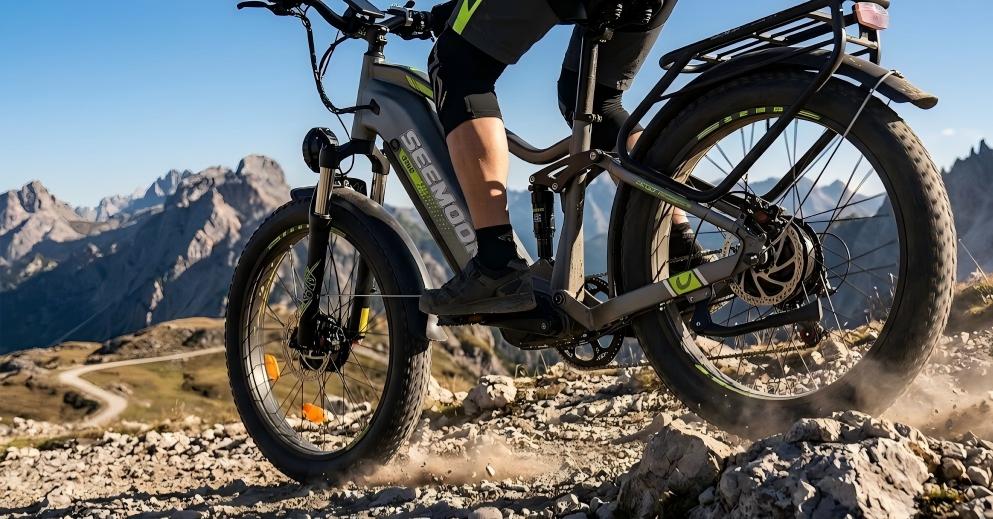
When navigating technical terrain, the latency of a cadence sensor can cause the rear wheel to lose traction or push you into an obstacle. A torque sensor paired with a high-voltage architecture—such as the advanced 60V systems utilized in models like the Seemoon SM3 —delivers aggressive, instant torque exactly when you need it to clear a rock, and backs off instantly when you ease up on the pedals. This high-resolution control, combined with a robust 6061 aluminum alloy frame, eliminates frame resonance and ensures ultimate control.

6. Conclusion: Choosing Technology Over Marketing Hype
When evaluating the drivetrain of your next e-bike, look beyond wattage and top speed. The pedal assist system is the brain of your ride. While cadence sensors offer an accessible, low-effort cruising experience, the nuanced, bionic feedback of a torque sensor represents the pinnacle of e-bike engineering.
By prioritizing electric bicycles with torque sensors—especially those engineered with high-capacity controllers and bottom-loaded battery architectures for lower center-of-gravity stability—you are investing in a superior, safer, and infinitely more responsive riding experience.
7. Frequently Asked Questions (FAQ)
Q1: Are electric bicycles with torque sensors worth the extra investment?
Yes. If you prioritize handling, immediate acceleration off the line, and riding trails or hills, the millisecond response time and natural riding feel of a torque sensor easily justify the higher manufacturing cost.
Q2: Can I upgrade my e-bike from a cadence sensor to a torque sensor?
Generally, no. Converting a cadence sensor vs torque sensor is not a simple plug-and-play parts swap. Torque sensors require specific bottom bracket geometries, distinct wiring harnesses, and entirely different controller firmware algorithms to process the strain gauge telemetry.
Q3: Does a torque sensor drain the battery faster than a cadence sensor?
No, a torque sensor actually improves battery efficiency. Because it dynamically allocates amperage based on your exact physical output—rather than continuously dumping pre-set power like a cadence sensor—it minimizes wasted electrical energy and reduces motor thermal accumulation, extending your overall range.
Share:
Rugged Tech: How the SM3 Brushless Electric Bicycle Wheel Hub Motor Survives the Wild
Electric Dirt Bike vs. Electric Bike: The Ultimate Guide to Off-Road Dominance