
Author: John Doe, Lead Battery Engineer at Seemoon
If the motor acts as the muscle of your electric bicycle, the ebike battery is undoubtedly its beating heart. It determines how fast you can accelerate, how effortlessly you can conquer that 15% gradient hill, and most importantly, how many miles of freedom you have before needing to plug in.
As an e-bike engineer for over a decade, I've seen firsthand how the battery is often the most misunderstood—and most expensive—component of the entire bike. Riders frequently ask: "How long will it last? Is it safe to charge in my living room? Why am I not getting the advertised range?"
In this comprehensive, data-backed 2026 guide, we are going completely under the hood. Whether you are researching your first e-bike purchase or looking to squeeze another 5,000 miles out of your current commuter, this guide provides the definitive answers.
Key Takeaways
Before we dive into the deep physics and maintenance protocols, here are the core facts every e-bike owner must know:
-
The Ultimate Metric: Ignore the marketing fluff; Watt-hours (Wh) is the only true measure of an ebike battery's total range capacity.
-
Expected Lifespan: A premium lithium-ion battery will last 3 to 5 years (or 500-1,000 charge cycles) before experiencing a noticeable 20% drop in capacity.
-
The Golden Charging Rule: Keeping your battery charged between 20% and 80% for daily use can double its functional lifespan.
-
Safety is Non-Negotiable: Never purchase a battery or an e-bike that lacks UL 2849 Certification. Uncertified batteries pose a severe thermal runaway (fire) risk.
-
Weather Matters: Extreme heat (above 90°F) degrades cell health rapidly, while extreme cold (below freezing) temporarily slashes your riding range.
- Premium Battery Cells: Seemoon e-bikes use premium, high-density lithium-ion batteries and are equipped with a smart battery management system (BMS) for ultimate safety and lifespan.
1. Decoding E-Bike Battery Specs: A Beginner’s Glossary
Walking into an e-bike shop or browsing online can feel like reading a physics textbook. Let's break down the technical jargon into entities that actually make sense for your daily ride.
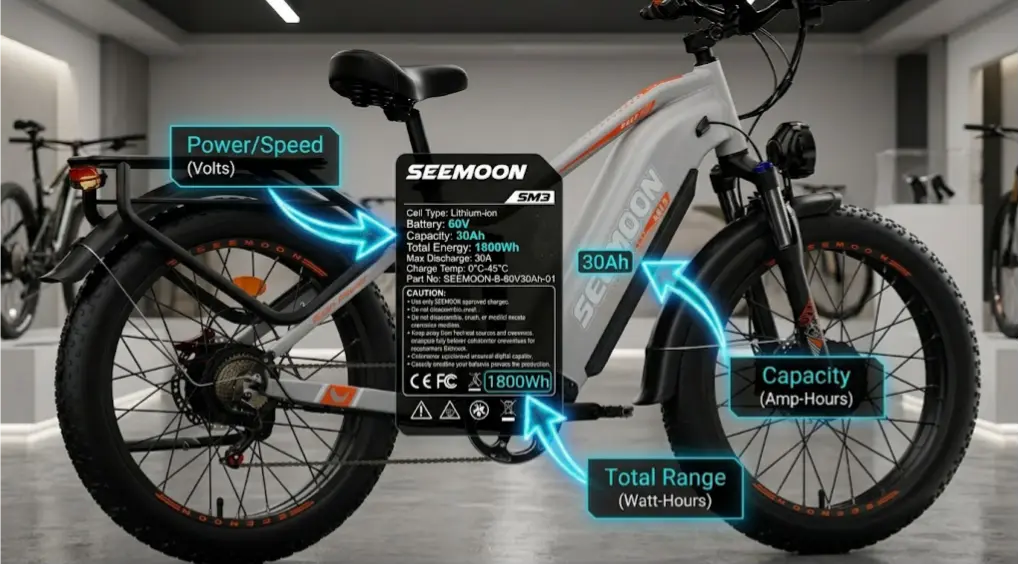
Volts (V): The "Horsepower"
Voltage is the measure of electrical pressure. For e-bikes, this means the raw pushing power your motor receives. A higher voltage battery (like 60V or 52V) delivers power more efficiently, meaning you can accelerate faster and conquer steep hills without the motor bogging down.
-
48V: Commonly found in entry-level or urban commuter electric bicycles. Suitable for flat roads.
-
52V: The industry standard for modern, high-quality electric bicycles. It perfectly balances efficiency and climbing torque.
-
62V: Commonly found in high-performance off-road e-bikes like the SM3 or heavy-duty cargo bikes, providing maximum power for climbing and heavy loads.
Amp-Hours (Ah): Your "Gas Tank" Capacity
Amp-Hours (Ah) is the measure of electric charge. For e-bikes, it determines the size of your "gas tank." If you have a 15Ah battery, it can deliver 15 amps of current for one hour. The higher the Ah, the longer you can ride before needing to plug in.
Watt-Hours (Wh): The Ultimate Range Indicator
If you only look at one number when buying an e-bike, make it the Watt-hours. It represents the total amount of energy stored in the battery. You calculate it using a simple formula:
Volts (V) × Amp-Hours (Ah) = Watt-Hours (Wh)
Example: A 48V 15Ah battery holds 720 Wh of total energy.
When comparing two bikes, the one with the higher Wh will almost always take you further on a single charge, assuming the motors are of similar efficiency.
2. Why Lithium-Ion is the Industry Standard
Almost every modern e bike battery uses Lithium-Ion (Li-ion) technology. Compared to old lead-acid batteries, Li-ion cells are incredibly lightweight, hold their charge longer when not in use, and do not suffer from the dreaded "memory effect" (meaning you don't have to drain them completely before recharging).
Two Types of Lithium-ion Batteries: NMC vs. LFP
Not all lithium-ion batteries are created equal. By 2026, lithium-ion battery packs for electric bicycles will mainly fall into two categories:
At Seemoon, We use high-quality battery cells in our electric bicycles and electric motorcycles, developed and manufactured in-house, to provide you with the best power output and safety protection.
while integrating advanced, multi-layer Battery Management Systems (BMS) to ensure you get comparable cycle life to lithium iron phosphate batteries and energy density like nickel-manganese-cobalt batteries.
3. How Far Can You Go? The Real-World Range Math
The most common question we get is: "How far will this ebike battery take me?" While manufacturers love to advertise "Up to 80 miles per charge," the real world is a bit more complicated.
The Realistic Consumption Rule
In real-world conditions, an average e-bike consumes about 30 Watt-hours (Wh) per mile if you are relying heavily on the motor or using a throttle. If you are pedaling hard on Pedal Assist Level 1 (PAS 1), you might only use 20 Wh per mile.
Using our SM3 1800Wh battery example:
-
Heavy Motor Use (Throttle only, 30 Wh/mile): 1800 / 30 = 60 Miles
-
Light Motor Use (PAS 1, 20 Wh/mile): 1800 / 20 = 90-100 Miles
The "Ugly Truth" About Range Claims
Manufacturer testing is typically conducted on perfectly flat, smooth paved surfaces with no wind. However, real-world riding conditions are rarely as ideal as these scenarios. Let's look at the actual situation:
Want to dive deeper into calculating your exact commute? Read our cluster guide: Ebike Battery Range Explained: Volts, Amps, and Watts Demystified.
4. Battery Lifespan & Degradation
A lithium-ion ebike battery does not just "die" one day. Instead, it slowly loses its maximum capacity over years of use, much like your smartphone.
Understanding Charge Cycles
A high-quality Li-ion battery is typically rated for 500 to 1,000 full charge cycles (A "charge cycle" means draining the battery from 100% down to 0% and charging it back to 100%.). If you ride 20 miles and only use 50% of your battery, then charge it back up, that is only half a charge cycle. For the average American rider commuting a few times a week, a premium battery will last 3 to 5 years (or roughly 15,000 to 20,000 miles) before its maximum capacity drops below 80%.
Most Tier-1 batteries (like those used in Seemoon e-bikes) are rated for 500 to 1,000 full cycles before their total capacity drops to 80% of what it was when new. For the average American rider who logs 2,000 miles a year, a well-maintained battery will easily last 3 to 5 years.
Signs It’s Time for a Replacement
You should consider purchasing a replacement e bike battery when:
-
Your daily 15-mile commute suddenly requires a mid-day recharge.
-
The power cuts out abruptly when you hit the throttle on a hill, even if the display shows 40% battery remaining (this indicates severe voltage sag from dying cells).
-
⚠️ FATAL WARNING: If the physical plastic casing is ever cracked, severely dented from a crash, swollen, or emitting a sweet, metallic odor (leaking electrolyte), stop using it immediately. Store it outside away from flammable materials and contact a local hazardous waste disposal facility.

Learn how to safely dispose of old cells: How Long Do E-Bike Batteries Last? (Plus Tips to Extend It).
5. The Golden Rules of Charging & Maintenance
The way you treat your battery off the bike drastically impacts how it performs on the bike. Here are the lab-tested rules to maximize longevity.
The 20-80% Charging Rule
Lithium-ion chemistry is highly sensitive to stress at extreme ends of its capacity. Leaving a battery completely dead (0%) for weeks can cause cells to fall into a "deep sleep" from which they cannot be recovered. Conversely, constantly keeping it stuffed at 100% accelerates cell degradation.
The Pro Tip: For daily commuting, try to keep your charge level between 20% and 80%. Only charge the battery to 100% when you know you are taking a massive, long-distance ride the next day.
Busting the "Memory Effect" Myth
Older generations used to nickel-cadmium (NiCd) batteries believe you must drain a battery to zero before charging it to prevent a "memory effect." This is 100% false for lithium-ion. In fact, fully draining a modern ebike battery frequently will actually damage it. So charge it whenever you want!
The Official Seemoon Charging Protocol
-
Always use the OEM Charger: Never buy a cheap, third-party $15 charger off Amazon. They often lack the proper voltage cut-offs and can severely damage your BMS.
-
Let it Cool Down: After a hard ride, let the battery sit for 30 minutes to cool down before plugging it in. Charging a hot battery damages the cell chemistry.
-
Unplug When Done: While Seemoon chargers have auto-shutoff features, best practice is to unplug the charger once the light turns green. Don't leave it plugged in unattended for weeks.
Having issues getting your battery to hold a charge? Check our troubleshooting guide: E-Bike Battery Not Charging? 5 Steps You Can Try.
6. Battery Safety: Why You Shouldn't Cut Corners
In recent years, news outlets in cities like New York and London have reported an increase in e-bike battery fires. It is vital to understand that high-quality e-bikes do not spontaneously combust. These fires are almost exclusively caused by cheap, uncertified, aftermarket batteries cobbled together with low-grade materials.
The Threat of Thermal Runaway
When a poorly manufactured cell fails—either from a manufacturing defect, overcharging, or physical trauma—it can overheat. If the battery lacks a proper Battery Management System (BMS), that heat transfers to the next cell, causing a chain reaction known as Thermal Runaway. This results in an intense chemical fire that water cannot easily extinguish.
What is UL 2849 Certification?
In the United States, UL 2849 is the absolute gold standard for e-bike safety. Developed by UL Solutions, this strict certification doesn't just test the battery alone; it tests the entire electrical system (the motor, the controller, the battery, and the charger) to ensure they communicate flawlessly without risk of short-circuiting or overcharging.
Many cities, including New York City under Local Law 39, have now made it completely illegal to sell or distribute e-bikes that do not carry UL certification.

The Seemoon Safety Guarantee
When you purchase from Seemoon, you are investing in peace of mind.
-
100% UL-Certified Fleet: Every single e-bike we produce is certified to strict UL standards.
-
Advanced Smart BMS: Our proprietary BMS acts as the brain of the battery. It actively monitors individual cell temperatures and voltage. If it detects temperatures exceeding 140°F (60°C), it instantly cuts the power, making thermal runaway virtually impossible under normal conditions.
Read more about safety regulations: E-Bike Battery Safety & Fire Risks: Why UL 2849 Matters.
7. Storage and Extreme Weather Protocols
E-bike Batteries are like humans—they prefer room temperature.
Surviving the Summer Heat
-
The Ideal Zone: Store and charge your battery in a dry place between 60°F and 70°F.
-
Summer Heat: Do not leave electric bicycle batteries locked in the hot outdoors, as temperatures exceeding 90°F (approximately 32°C) will accelerate battery aging.
- Cool down promptly after riding: In the hot summer, the battery's internal temperature is extremely high immediately after riding. The combined heat from the external and internal temperatures can severely damage the battery cell structure. Therefore, after riding, immediately remove the battery and place it in a cool, shaded place to cool down.
Conquering the Winter Cold
Cold weather doesn't permanently damage your battery, but it severely limits its immediate output. Riding in 30°F weather can temporarily reduce your total range by 20% to 30%.
Winter Storage: If you are storing your e-bike in the garage for the winter, bring the battery inside the house. Store it in a dry place at room temperature with roughly a 50% charge. Check it once a month to ensure the charge hasn't dropped to zero.
Prepare your bike for extreme weather: Summer E-Biking: How Extreme Heat Affects Your Battery.
8. Travel Rules: Can You Take It on a Plane?
If you are planning an epic e-biking vacation to a National Park, be aware of federal transportation laws.
The Federal Aviation Administration (FAA) and the TSA have incredibly strict rules regarding lithium-ion batteries due to fire hazards in pressurized cargo holds. You cannot bring a standard e bike battery on a commercial passenger flight in the US. The absolute legal limit for a carry-on battery is 160 Watt-hours (Wh). Considering the average e-bike battery is 500Wh to 800Wh, they are strictly prohibited.
Your Alternatives:
-
Transport the bike via a secure car hitch rack.
-
Ship the battery ahead of time using a certified ground shipping hazmat service (like FedEx Ground).
-
Rent a battery (or a full e-bike) from a local shop at your destination.
Explore full travel strategies: Can You Take an E-Bike Battery on a Plane? FAA Rules.
9. Frequently Asked Questions (FAQ)
Are ebike batteries waterproof?
No battery is perfectly waterproof, but premium models are highly water-resistant. Seemoon batteries feature an IPX5 or higher rating. This means they can easily withstand heavy rain, splashing puddles, and mud. However, you should never submerge the battery in a lake or clean it with a high-pressure power washer.
How much does a replacement ebike battery cost?
In the US market in 2026, a high-quality, authentic OEM replacement battery featuring Tier-1 cells will typically cost between $400 and $800, depending on the Watt-hour capacity. Do not be tempted by $150 generic replacements on eBay—they are the leading cause of e-bike fires.
Can I upgrade my e-bike to a battery with a higher voltage?
Generally, no. Your e-bike's motor and controller are calibrated for a specific voltage. Putting a 52V battery into a 36V system will likely fry the controller instantly. However, you can upgrade to a battery with higher Amp-hours (Ah) as long as the voltage matches and the physical casing fits your bike frame.
Is it safe to pedal my e-bike if the battery dies?
Absolutely! An e-bike is still a bicycle. If your battery hits 0%, the motor will shut off, but the pedals, gears, and brakes will function normally. It will just feel like riding a heavier, traditional bicycle.
Final Thoughts: Power Your Next Adventure

Understanding your ebike battery isn't just about preserving its lifespan; it is about unlocking the full potential of your ride. By mastering the 20-80% charging rule, respecting extreme temperatures, and recognize the importance of UL 2849 safety certification and take good care of it; it will take you further than you imagine.
Ready to experience industry-leading range and uncompromised safety? Explore Seemoon's high-performance e-bike lineup today. Say goodbye to range anxiety with our intelligent Battery Management System (BMS) and high-capacity, high-density lithium-ion cells.
[Shop Seemoon Series E-Bikes Now] | [Explore Original Replacement Batteries]
Share:
The Ultimate Guide to Riding a Street Legal Electric Dirt Bike: Rules, Requirements, and Solutions
How Long Do E-Bike Batteries Last? (Plus 7 Tips to Extend Lifespan)