
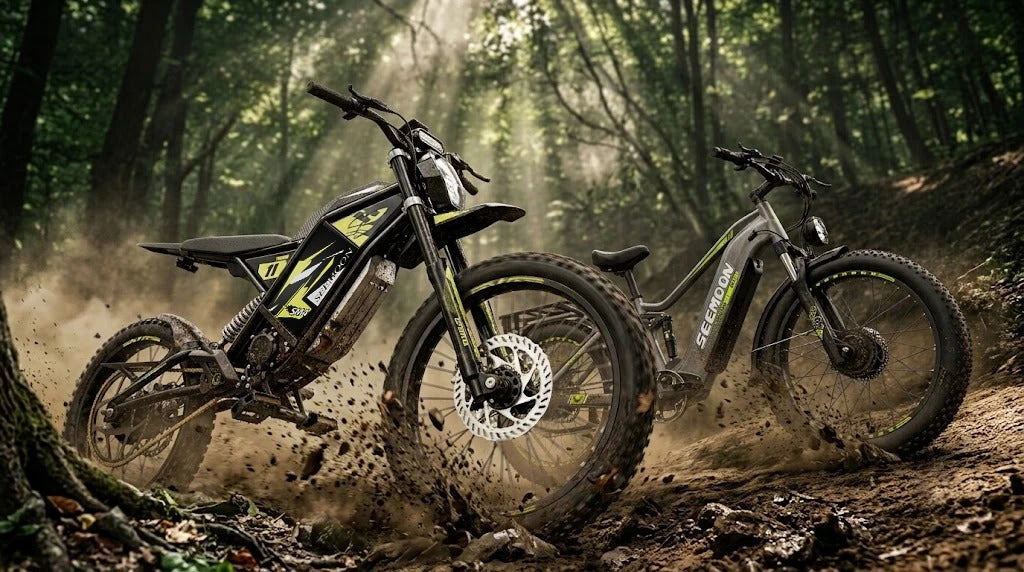
When upgrading your ride, the debate between mechanical vs hydraulic disc brakes is one of the most critical safety decisions you will ever make. Modern electric bikes and e-motorcycles are not your average pedal bikes; they are heavier, faster, and pack serious power. Naturally, the stopping power required to rein in that speed is significantly higher.
If you are navigating the e-bike market, you have likely seen "hydraulic brakes" listed as a premium feature. But what exactly are they, and are they worth the investment? In this comprehensive guide, we will break down how a hydraulic brake works, dive deep into the pros and cons, and help you find the perfect Seemoon e-bike for your riding style.
What is a Hydraulic Brake?
At its core, a hydraulic brake is a fully sealed braking system that uses fluid to transfer force from your hand to the brake pads. Instead of pulling a steel steel cable, you are pushing fluid through a hose.
Because liquid cannot be compressed, this setup offers unparalleled efficiency. The key features of a hydraulic system include:
-
Incredible Stopping Power: Amplifies your hand strength, allowing heavy e-bikes to stop on a dime.
-
Linear Modulation: Offers a highly responsive, butter-smooth feel at the lever, preventing accidental tire lock-ups.
-
Sealed Protection: Dust, dirt, and water are locked out, ensuring consistent performance in all weather conditions.

How Do Hydraulic Brakes Work?
Understanding the mysteries of hydraulic brakes is not difficult—you just need to know Pascal’s Law. This principle dictates that pressure applied to an enclosed fluid is transmitted equally in every direction.
The following is a detailed explanation of the steps that occur throughout the hydraulic brake system when you squeeze the brake lever:
-
The Master Cylinder: When you squeeze the brake lever, a small piston pushes into a reservoir filled with specialized mineral oil or DOT fluid.
-
The Hose: This pushes the fluid down the sealed brake hose.
-
The Caliper: The pressurized fluid enters the caliper at the wheel, forcing the pistons outward.
-
The Rotor: The pistons push the brake pads against the metal rotor attached to your wheel, creating immense friction that stops your e-bike instantly.
Because there is zero stretch in the fluid (unlike a metal cable), 100% of the effort you apply at the lever translates directly to braking power.
Mechanical vs Hydraulic Disc Brakes: Why Hydraulic Wins for High-Performance E-Bikes
To truly understand why high-powered e-bikes require top-tier braking, we have to look at the mechanical vs hydraulic disc brakes debate through the lens of e-bike physics and real-world riding. While both systems use calipers and rotors, their performance ceilings are vastly different.
1. E-Bike Physics and Stopping Mass
A traditional mountain bike weighs around 30 to 40 lbs. A high-performance e-motorcycle, like our Seemoon SM3 models boasting large 60V 30Ah batteries, can weigh well over 100 lbs. Combine that mass with speeds reaching 40 mph or more, and the kinetic energy you need to control is massive.
Using mechanical brakes to stop a heavy, fast-moving e-motorcycle requires intense hand strength. Hydraulic disc brakes provide a "multiplier effect," delivering massive clamping force on the rotor with minimal effort from the rider.

2. Linear Modulation
Mechanical brakes often have an "on/off" feel. Squeeze too lightly, and nothing happens; squeeze too hard, and you lock up the tires and skid.
Hydraulic brakes offer incredible modulation. This means the braking force increases smoothly and linearly the harder you pull. In wet conditions or muddy trails, this precise "one-finger braking" prevents lock-ups and gives you absolute control over your traction.
3. Low Maintenance & Weatherproof Reliability
American riders love the "set it and forget it" mentality. Mechanical cables stretch over time and brake pads wear down, requiring you to constantly turn barrel adjusters to keep your brakes feeling tight.
Hydraulic systems feature automatic pad wear adjustment. As your pads thin out, the pistons automatically sit closer to the rotor, keeping your lever feel exactly the same from day one to day one hundred. Furthermore, because it is a closed system, it pairs perfectly with IP65 waterproof e-bikes. Freezing rain or trail mud won't rust or freeze a hydraulic line.

4. Beating Brake Fade on Long Descents
If you ride aggressively or tackle steep downhill terrain, sustained braking generates extreme heat. Mechanical disc brakes are prone to "brake fade," where the heat causes a drastic loss of stopping power.
Premium hydraulic fluid can withstand much higher boiling points, ensuring that your brakes remain strong and reliable at the bottom of a mile-long descent.
The Objective Drawbacks of Hydraulic Brakes
While hydraulic disc brakes deliver superior performance, they do come with a few distinct disadvantages that riders should be aware of:
-
Higher Overall Costs: The initial purchase price of a hydraulic system is noticeably higher. Furthermore, replacement parts—such as specific calipers, levers, and the hydraulic fluid itself—are more expensive than standard mechanical cables and housing.
-
Complex Maintenance Process: Although e-bikes equipped with hydraulic brakes require less frequent routine maintenance, the procedures involved when service is needed can be complex and technically demanding. Removing air bubbles from the system (a process known as "bleeding") requires specialized syringe kits, specific mineral or DOT fluids, and a learning curve. Therefore, Many riders opt to take their e-bikes to a professional shop for this service.
-
Difficult Trail-Side Repairs: This is the most significant drawback for hardcore off-roaders. If a hydraulic hose is severed or severely damaged during a crash on a remote trail, it is nearly impossible to repair on the spot. Unlike a snapped mechanical cable that can often be easily swapped out with basic tools in your backpack, a broken hydraulic line usually means your ride is over for the day.
| Feature | Hydraulic Disc Brakes | Mechanical Disc Brakes |
| Stopping Power | Exceptional (Multiplier effect) | Moderate (Relies on hand strength) |
| Modulation | Smooth, precise, linear | Can feel abrupt or stiff |
| Maintenance | Low daily upkeep (auto-adjusts) | Requires frequent manual cable adjustments |
| Weather Resistance | Excellent (Sealed system) | Fair (Cables can rust or freeze) |
| Ideal For | High-speed e-bikes, off-roading | Commuting, entry-level budgets, DIYers |
Which Braking System is Right for You?
Choosing between the two comes down to your riding style, terrain, and power output.
Who should stick with mechanical disc brakes?
If you are a casual rider on a strict budget, or you primarily ride on flat, paved suburban roads at lower speeds, mechanical brakes will serve you just fine. For riders new to e-bikes, repairing a snapped brake cable by the roadside using a simple hex key isn't too difficult.
Who absolutely needs a hydraulic brake?
If you are riding a heavy, fat-tire e-bike, commuting through dense city traffic, or hitting off-road mountain trails, hydraulics are a must. High-speed riders and electric motorcycle enthusiasts cannot afford brake fade or cable stretch. Furthermore, riders with smaller hands or weaker grip strength will massively benefit from the ease of pulling a hydraulic lever.
Meet the Seemoon Lineup: Top E-Bikes for Every Rider
At Seemoon, we believe that power is nothing without control. We engineer our Seemoon e-bikes and Seemoon electric dirt bike with the exact braking systems needed for their specific use cases. Here is a look at how we apply these systems across our top models:
1. Seemoon SM5 Multi-Purpose E-Bike (The Everyday Hero)
The Seemoon SM5 is designed for daily commuters and light off-road enthusiasts, the SM5 offers incredible value.
-
Specs: 3000W peak power, front suspension, BMS battery protection, and five distinct riding modes.
-
The Braking Choice: We equipped the SM5 with reliable mechanical disc brakes. Because this bike is tailored for city streets and light off-roading, mechanical brakes provide ample stopping power while keeping the overall cost highly accessible and making home repairs incredibly simple.

2. Seemoon SM3 Off-Road E-Bike (The Trail Conqueror)
When you step up to high-speed trail riding, you need professional-grade stopping power.
-
Specs: A massive 6000W peak power from dual front and rear brushless motors, powered by a 60V 30Ah high-density lithium-ion battery. The robust 6061 aluminum alloy frame and full suspension handle massive drops.
-
The Braking Choice: With this much speed and momentum, top-tier hydraulic brakes are mandatory. The SM3's hydraulic system ensures that no matter how steep the descent or how muddy the trail, you can stop this beast safely with the pull of a single finger.

3. Seemoon SM4 Pro Electric Dirt Bike (The Ultimate Beast)
This is for the uncompromising extreme sports rider.
-
Specs: A 4000W peak output mid-drive motor pushing out a staggering 250N/m of torque—enough to climb a 45-degree mountain slope. It features IP65 waterproofing, adjustable hydraulic damping spring front suspension, and an adjustable hydraulic damping rear shock.
-
The Braking Choice: To match the extreme downhill forces and aggressive speeds, the SM4 Pro is outfitted with an oversized, racing-grade hydraulic disc brake system. It fights off brake fade on the most intense downhill circuits, giving you absolute confidence to push your limits.

Conclusion
Whether you are navigating downtown traffic on a budget-friendly mechanical setup or bombing down a mountainside relying on the sheer stopping power of a hydraulic brake, your safety is paramount.
While mechanical brakes hold their own in urban, lower-speed environments, hydraulic disc brakes are the undisputed champions for heavy, high-performance electric bikes. They offer the stopping power, linear feel, and weatherproof reliability that high-wattage riding demands.
Ready to experience the difference for yourself? Explore the Seemoon SM3 and SM4 Pro today and ride with absolute confidence.
Frequently Asked Questions (FAQs)
Are hydraulic brakes on e-bikes worth the extra money?
Absolutely. For any e-bike pushing over 1000W (and certainly for our 3000W to 6000W models), the kinetic energy is too high for basic brakes. Hydraulic systems are an investment in your safety and will save you money on ongoing maintenance.
Do hydraulic brakes require more maintenance?
Day-to-day, they require significantly less maintenance. They automatically adjust for pad wear and don't suffer from cable stretch. You will only need to perform a system bleed (replacing the fluid) roughly once a year or every two years.
Can I upgrade my e-bike from mechanical to hydraulic brakes?
Yes, many riders do this. However, you must ensure your frame and motor cut-off wire harnesses are compatible with hydraulic levers. Often, it is much more cost-effective and safer to purchase an e-bike inherently designed around high speeds, like the Seemoon SM3, which comes with optimized hydraulic brakes straight out of the box.
Share:
Unleash AWD Power: The True Potential of the Seemoon Dual Motor Ebike