
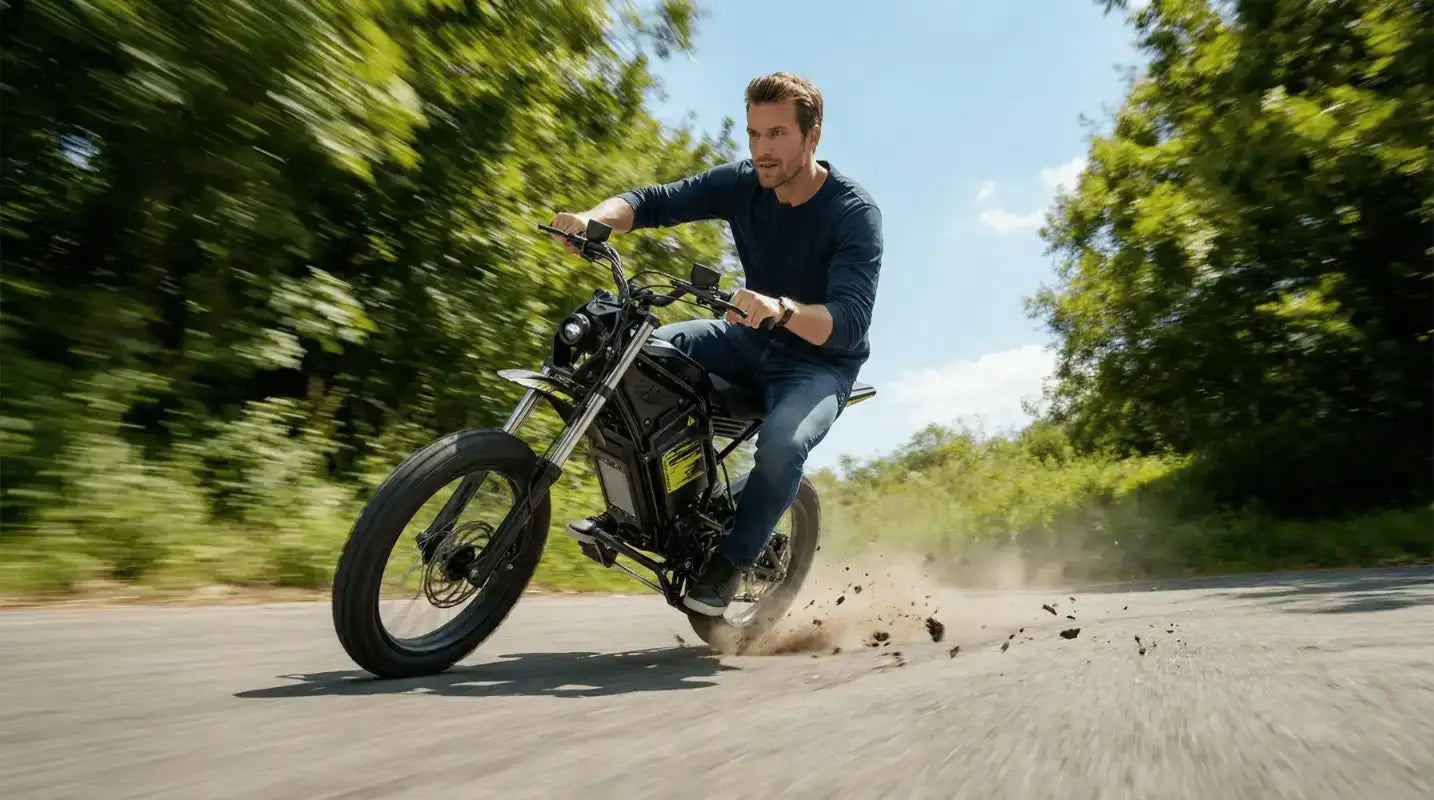
Every morning during traffic jams, you can see SUVs idling, while lightweight and quiet two-wheeled electric motorcycles speed past on the non-motorized vehicle lanes.By 2026, the adult electric motorcycle has graduated from being a niche toy for tech enthusiasts to a legitimate, survivalist tool for the modern urban commuter. It represents a shift in mobility philosophy: minimum footprint, maximum utility.
But if you have typed "electric motorcycles for sale" into Google recently, You're likely to be confused because the US electric motorcycle market is incredibly polarized. On one hand, there are high-voltage electric motorcycles like the Zero or LiveWire that cost up to $12,000, requiring a motorcycle license (M license), hefty insurance, and a garage. On the other hand, Amazon sells plastic scooters for $800 that are so flimsy they can't even climb a driveway. So, where can a consumer find an electric motorcycle that's sturdy enough to legally ride on American streets, doesn't require waiting in line at the DMV, and is affordable enough to recoup its cost within a year through fuel savings?
This guide is your manifesto. As industry veterans with over a decade of experience in SEO and electric motorcycle manufacturing, we are going to strip away the marketing fluff. We will decode the "spec-sheet lies" manufacturers tell you, explain the physics of 170Nm torque, and teach you how to choose a utility electric moped—like the Seemoon SM4—that serves you, not the other way around.
Part 1: Decoding the Regulatory Landscape — E-Bike or Electric Motorcycle?
Before investing in a high-performance personal electric motorcycle , it is critical to navigate the regulatory nuance that makes these machines so financially advantageous in the United States. For many prospective buyers, the purchasing decision is paralyzed by a single question: "Do I need a motorcycle license, insurance, and registration for this?"
The answer hinges not on the aesthetic of the frame, but on the legal definition of the drivetrain—specifically, the pedals and the wattage.
The "Golden Loophole": Understanding Federal Class 3 Compliance
To the uninitiated, a rugged electric two-wheeler like the Seemoon SM4 appears indistinguishable from a light electric motorcycle. With its long café-racer saddle, robust 17-inch DOT-rated tires, and dual-suspension geometry, it visually aligns with a traditional motorbike.
However, legal classification in the US is defined by function, not form. Because the vehicle retains functional pedals, in addition, its standard power output is limited to 750W (The peak motor output power may be higher than this value.).and adheres to specific speed caps, it falls under the Federal Class 3 E-bike classification (codified under HR 727). Therefore,for the daily commuter, this is the "Golden Ticket." It allows you to operate a vehicle with motorcycle-grade stability in bike lanes* without the friction of DMV registration or an M-class endorsement.
The Three-Tier Classification System
To ensure you remain street-legal, you must understand the three generally accepted classes of electric bicycles in the US.
-
Class 1 (PAS Only):
- Mechanism: The motor engages strictly via the Pedal Assist System (PAS). There is no throttle.
- Limits: Assistance cuts off at 20 mph.
- Verdict: Excellent for fitness enthusiasts, but often impractical for commuters who need to arrive at the office without breaking a sweat.
-
Class 2 (Throttle Assist):
- Mechanism: Features a throttle (twist or thumb) that allows for propulsion without pedaling.
- Limits: Throttle and PAS are both capped at 20 mph.
- Verdict: Ideal for bike paths and mixed-use trails, but the 20 mph cap can feel dangerous when trying to merge with faster-moving city traffic.
-
Class 3 (Speed Pedelec):
- Mechanism: Enhanced PAS allows for higher speeds. (Note: Many modern Class 3 bikes also feature a throttle, though state laws vary on whether the throttle can push past 20 mph without pedaling).
- Limits: Assistance continues up to 28 mph.
- Verdict: The Commuter’s Sweet Spot. This class offers the torque and velocity required to safely take the lane in urban traffic while remaining legally classified as a bicycle.
Pro Tip: Always check your specific state and local laws. While Federal law defines the bike, local jurisdictions (like New York City or California) control where you can ride it

Why "Class 3 Moped Style" Wins
By choosing a high-performance 3 Class lightweight electric motorcycle, you get 90% of the utility of a motorcycle with 0% of the bureaucratic headache.
-
No M-Class License: In most states (like California and Texas), you generally do not need a specific motorcycle endorsement. A standard driver's license suffices.
-
No Registration/Tags: You skip the annual DMV fees and the hassle of mounting a license plate.
-
Insurance Flexibility: While we always recommend liability coverage, it is rarely mandatory by law, saving you $500-$1,000 annually compared to a gas motorcycle.
-
Lane Filtering: In many jurisdictions, you retain the right to use the bike lane to bypass gridlock—a superpower during rush hour.
Expert Insight: Always check your local state laws (DMV codes). For example, New York has different rules regarding throttles than Florida. However, responsible brands like Seemoon explicitly label their vehicles with a "Strictly prohibited for under 16 years old" warning. This isn't just about safety; it's about aligning with the "Moped" definition to keep your ride street-legal.
Part 2: Deconstruct the Spec Sheet – How to Spot Marketing "Fluff"
If you are currently staring at a manufacturer's spec sheet, proceed with caution. The electric motorcycle industry is infamous for "spec inflation"—a marketing tactic where theoretical maximums are presented as everyday capabilities. To ensure you are buying a performance machine rather than a glorified toy, you need to read the fine print like an engineer.
Lie 1: "750W Motor is Enough"
You will see thousands of electric motorcycyle listed as "750W." This is often a legal placeholder to satisfy import regulations, not a performance metric. For an adult rider (180 lbs+) carrying a backpack (15 lbs), a generic 750W motor will die on a 15-degree incline.
The Real Metric: Peak Power & Controller Amps. The motor is just a vessel; the controller is the brain. You need to look for Peak Power. The Seemoon SM4, for instance, might be rated conservatively for compliance, but it unleashes 3200W of Peak Power when you twist the throttle. This power comes from the controller dumping high amperage into the motor when you need it most.
- Standard: 1000W Peak. (Struggles on hills).
- Pro-Grade: 3200W Peak.
The Physics of 170 Nm Torque (Why Speed is Irrelevant)
Here is the biggest secret in the industry: Top speed is a vanity metric. In a city, you spend 90% of your time between 0 mph and 25 mph. You stop at lights, stop signs, and crosswalks.
What you need is Torque (Newton-meters). Torque is the rotational force that pushes you off the line.
- Average E-bike: 40-60 Nm. (Feels like a bicycle).
- Performance E-Moped: 80-100 Nm. (Feels zippy).
- The "Monster" Tier (SM4): 170 Nm.
Why 170 Nm? At Seemoon, we engineered the SM4 with 170 Nm of torque not for racing, but for safety. When you are sitting at a red light with a Ford F-150 behind you, you are vulnerable. When the light turns green, you need to accelerate from 0 to 20 mph faster than the car behind you to establish your lane presence. Low torque makes you a sitting duck; high torque makes you the leader of the pack.
Lie 2: "50 Mile Range" (Tested Downhill with a Tailwind)
Range estimates are the "miles per gallon" of the EV world—often wildly exaggerated. To know the real range, ignore the miles listed on the sticker. Look at the Watt-Hours (Wh).
- The Formula: Voltage (V) × Amp-Hours (Ah) = Capacity (Wh).
Most "cheap" electric motorcycles use a 48V 12Ah battery. That’s only 576Wh. In real-world city riding (stop-and-go, headwinds), that battery will suffer from Voltage Sag—where power drops as the battery drains—and will likely be dead in 15 miles. Therefire,for a serious commuter, you need at least 1000Wh. The Seemoon SM4 packs a 48V 28Ah lithium-ion battery. That’s 1344Wh of energy density. This massive tank ensures that even after two years of natural battery degradation, you still have enough range to get to work and back without "range anxiety."
Technical Note: The SM4 battery also features a sophisticated BMS (Battery Management System) that balances the cells during charging. This prevents the "one bad apple" effect where a single weak cell ruins the whole pack, significantly extending the battery's lifespan to 800+ cycles.

Part 3: The Economics of Ownership (TCO)
Let’s discuss the financial reality of commuting. Smart buyers know that the sticker price is just the entry fee; the real story is the Total Cost of Ownership (TCO). A common pitfall for first-time buyers is the "False Economy"—saving $1,000 upfront on a budget e-motorcycle, only to spend double that in repairs and downtime later. This is the difference between price and value.
Below is the TCO analysis of "Buy Nice or Buy Twice," calculated over a standard 2-year ownership cycle (approx. 6,000 miles).
1. The Energy Delta: Fuel vs. Electrons
The efficiency gap between internal combustion and electric propulsion is massive. When you crunch the numbers on cost-per-mile, the difference isn't just a saving; it’s a paradigm shift.
-
The Gas Benchmark (50cc Moped):
- Efficiency: ~80 MPG.
- Cost: At a conservative $3.50/gallon, you are paying $0.04 per mile.
- 2-Year Cost: Over 6,000 miles, you burn $240 in fuel.
-
The Electric Advantage (Seemoon SM4):
- Efficiency: Consumes ~2 kWh per 100km (62 miles).
- Cost: At the US national average of $0.15/kWh, you are paying just $0.005 (half a cent) per mile.
- 2-Year Cost: Over 6,000 miles, you spend just $30 in electricity.
The Verdict: The Seemoon SM4 is 800% more efficient to fuel than a standard gas moped.
2. Maintenance: The Hidden Variable
This is where budget electric motorcycles fail. Sub-$1,000 electric motorcycles often utilize "bicycle-grade" mechanical components. While sufficient for a 15mph pedal bike, these parts cannot structurally handle the torque, speed, and unsprung weight of a motorized motorcycle commute.
| Component | Budget E-Bike / Moped | Seemoon SM4 |
| Braking System | Mechanical Cable Brakes. Prone to cable stretch requiring weekly tightening. Pads suffer from thermal fade and wear out monthly. | Hydraulic Disc Brakes. A fully sealed, self-adjusting automotive-style system. Provides consistent stopping power with minimal maintenance intervals. |
| Tires & Wheels | Standard Bicycle Fat Tires (20x4"). Thin sidewalls are highly susceptible to "pinch flats" and road debris. Rear hub-motor tire changes are labor-intensive ($80+ shop fee). | Automotive-Grade Rubber (2.47-17). Built with heavy-duty ply ratings designed to resist city hazards like glass and nails. Superior traction and longevity. |
3. The ROI Calculation (Return on Investment)
When you view the Seemoon SM4 as a commuter tool rather than a toy, the payback period is incredibly short. Let's assume a moderate 15-mile daily round trip, replacing a car or rideshare service:
- Operational Savings: By avoiding gas, depreciation, parking fees, and Uber surges, you save approximately $1,500 annually.
- Maintenance Avoidance: By choosing a high-quality build over a budget moped, you avoid approx. $300 annually in parts and shop labor.
- Total Annual Benefit: ~$1,800 USD.
The Bottom Line: A premium electric motorcycle like the Seemoon SM4 pays for itself in 10 to 12 months. After year one, your commute effectively becomes "free money," putting nearly $2,000 back into your pocket every single year.
Part 4: Safety Features You Can't See
As industry experts, Our standard for judging the safety performance of an electric motorcycle is not its speed, but by how safely it stops and handles electrical loads. When shopping, you must ask these two questions to determine if a electric motorcycle is a "toy" or a "vehicle."
1. "Does it have an Air Switch?"
This is a feature rarely found on sub-$2000 electric motorcycles, but it is standard on the Seemoon SM4. An Air Switch (Circuit Breaker) is an industrial safety device located near the battery. It physically cuts the connection between the battery and the controller.
- Why it matters: When you connect a massive 48V 28Ah battery, the initial in-rush of current creates a spark. Over time, this spark erodes connectors and can damage the sensitive MOS-FETs in the controller.
- The Protocol: The SM4 user manual explicitly states: "Before installing the battery, turn off the air switch." This simple step protects your investment. If a manufacturer doesn't include a breaker, they are cutting corners on longevity.
2. "Are the brakes Hydraulic or Mechanical?"
We cannot stress this enough: Do not buy a 2000W electric motorcycyle with mechanical brakes. Physics dictates that a 134 lb bike + 180 lb rider moving at 28 mph carries significant kinetic energy. Mechanical brakes rely on steel cables that stretch, rust, and eventually snap under panic-braking loads.
Hydraulic Disc Brakes use fluid dynamics (mineral oil) to multiply your hand force. You can lock the wheels with a single finger. On the SM4, the hydraulic system also includes a designated Motor Cut-Off Sensor. The millisecond you touch the brake lever, the sensor kills power to the motor. This prevents the motor from fighting against the brakes, significantly reducing stopping distance.

3. "Is it suspended properly?"
City streets are not smooth. Potholes, curbs, and speed bumps are the enemy. A rigid frame transfers all that impact energy directly to your spine. The SM4 utilizes a Full Suspension system (Front Fork + Rear Shock). This isn't just about comfort; it's about traction. Suspension keeps your tires in contact with the road over bumps, ensuring you don't lose grip when cornering on imperfect asphalt.

Part 5: The Top Recommendation — Seemoon SM4
We didn’t set out to write a manifesto; we set out to bridge a fundamental gap in the urban mobility landscape. When analyzing the current market, we identified a glaring disconnect: riders are often forced to choose between flimsy e-bikes that feel unstable at 20 mph, or "over-spec’d" electric motorcycles that are neither price-effective nor practical for a standard 5-mile commute.
The Seemoon SM4 is the definitive answer to that middle ground—a precision-engineered machine that merges fiscal accessibility with uncompromising utility.
The "Insider" Spec Breakdown
- Powertrain Dynamics: At the heart of the SM4 is a high-torque motor delivering a 3200W peak output and 170Nm of raw torque. We didn't gear this for the interstate; we optimized the power band specifically for the "0-30 mph" urban sprint. It’s about winning the holeshot at every stoplight and maintaining lane dominance in dense city traffic.
- Chassis & Mass Centralization: Tipping the scales at a curb weight of 134 lbs (60.8 kg), the SM4 hits the "Goldilocks zone" of mass. It carries enough heft to remain planted and deflect crosswinds—addressing the "skittish" feeling common in lightweight e-bikes—while remaining nimble enough for manual maneuvering in tight garage spaces.
- The Aesthetic Identity: Moving away from the utilitarian "step-through" scooter silhouette, the SM4 adopts a sophisticated Cafe Racer/Moped aesthetic. With a 30.5-inch seat height and 17-inch wheels, it commands a physical presence on the road. You aren't just a cyclist on the shoulder; you are a rider with presence.
- Hard-Working Utility: We’ve integrated features that veteran commuters demand. This includes an IP54 ingress protection rating for all-weather reliability and an integrated 360-degree camera mount for dual-purpose use as a dashcam or vlogging rig. With a 330 lb structural payload capacity, it’s built to handle both the rider and a full tactical loadout of gear without compromising frame integrity.
Comparison: Generic "Cheap" E-Bike vs. Seemoon SM4
| Feature | Generic $1,200 E-Bike | Seemoon SM4 | The Advantage |
| Torque | 50-80 Nm | 170 Nm | Over 2x climbing power; safer acceleration. |
| Brakes | Mechanical Cable | Hydraulic Disc | Reliable stopping power; self-adjusting. |
| Battery | 48V 13Ah (624Wh) | 48V 28Ah (1344Wh) | Double the range (50-100 miles). |
| Tires | Thin 20" Fat Tire | 2.47*17" All-Terrain | Better obstacle clearance, stability, and wear life. |
| Protection | Standard Fuse | Air Switch Breaker | Industrial-grade circuit protection. |
Conclusion: The New Physics of the Urban Commute
The shift to electric propulsion isn't a trend—it’s a decoupling from a broken system. Choosing an electric motorcycle means opting out of the "sunk time" of gridlock and reclaiming the autonomy of the road.
In 2026, the barrier to entry has never been lower, but the delta between a "gadget" and a "Real electric motorcycles" has never been wider. Navigating this landscape requires a focus on engineering over marketing.
The Professional Standards for 2026
To ensure your machine can withstand the harsh conditions of American urban environments, please prioritize the following technical specifications before purchasing.
- Powertrain Reliability: Look for brushless DC motors with high peak-wattage ratings. It’s not just about speed; it's about the torque-to-weight ratio required to navigate inclines and heavy traffic safely.
- Battery Lifecycle & Range Security: Demand transparency on watt-hour (Wh) capacity and BMS (Battery Management System) sophistication. A "smart" commuter knows that true range is measured by real-world load, not ideal lab conditions.
- Hardware Grade: In an era of plastic imports, prioritize frames with verified stress-test ratings and hydraulic braking systems. Your safety is a function of build quality.
Stop being a passenger in your own life. Transition from a passive commuter to an active rider. Invest in a machine that mirrors your ambition and respects your time.
- [Check the Seemoon SM4 Price & Availability]
- [Read our Guide on Electric Motorcycle Maintenance] (Link to Cluster 4)
- [Is the SM4 Legal in Your State? Check our Legal Guide] (Link to Cluster 5)
Optimized FAQ
Q: Is the Seemoon SM4 street legal?
A: Yes. The SM4 is designed to comply with Class 3 E-bike regulations (limited to 28mph). In most US states, this means it can be ridden on streets and bike lanes without a license, registration, or insurance. Note: Riders must be 16 or older.
Q: How fast does the Seemoon SM4 go?
A: The SM4 has a top speed of 28 mph to maintain legal compliance. However, its high torque (170 Nm) means it reaches that speed very quickly, making it ideal for city traffic flow.
Q: Can I ride the SM4 in the rain?
A: Yes. The SM4 has an IP54 waterproof rating, meaning it can handle splashes and light rain. However, avoid submerging the motor or battery in deep water.
Q: How long does the battery last?
A: The 48V 28Ah battery provides a range of 50-100 miles depending on throttle usage and terrain. It takes approximately 8-9 hours to fully charge from 0%.
Share:
Street Legal & Affordable: The 2026 Buying Guide to Electric Motorcycles & Mopeds
The Ultimate Guide to Fat Tire Electric Bikes: Why You Need a 60V High-Performance Beast in 2026