
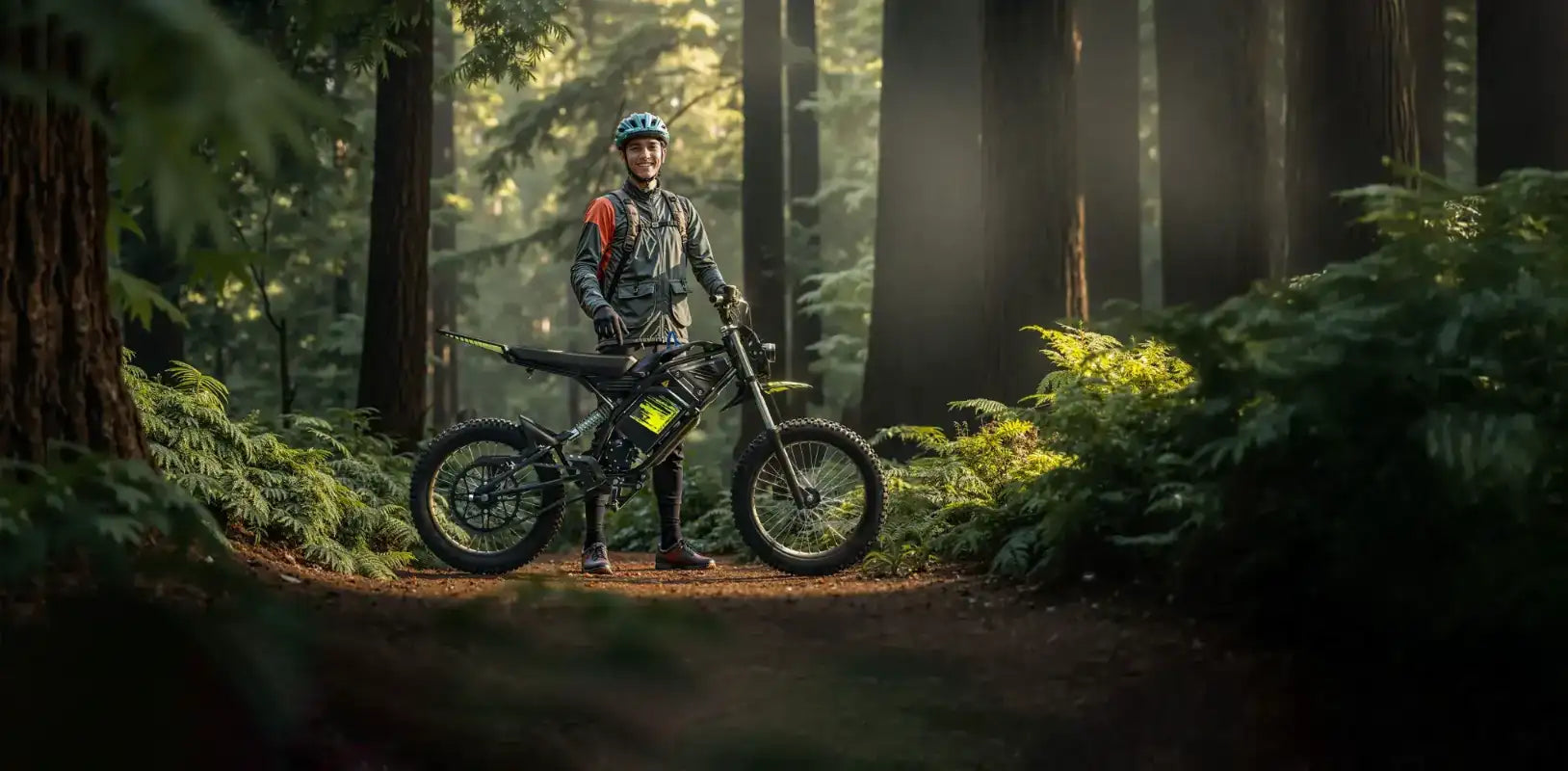
By The Seemoon Tech Team | Last Updated: February 3, 2026 | Read Time: 12-15 Minutes
Table of Contents
The American commute is undergoing a silent revolution. The days of firing up a heavy, gas-guzzling SUV just to travel 5 miles to work are numbered. In 2026, the smart money is moving toward the Electric Moped Class—agile, silent, and incredibly efficient vehicles that sit perfectly in the gap between a bicycle and a heavy motorcycle.
However, the market is a minefield. A quick search for an affordable electric motorcycle for sale yields thousands of results, from flimsy toys to unregistered off-road dirt bikes masquerading as commuters. Buying the wrong one doesn't just mean wasting money; it means risking impoundment by the police or being stranded on a hill because your motor lacks torque.
This comprehensive guide is written for the serious buyer. Drawing on technical engineering data, US traffic laws, and real-world ownership cost analysis, we will walk you through exactly what makes an electric motorcycle "street legal," "high value," and "road-ready."
Part 1: The Reality Check – "Ghost Vehicles" vs. Road Ready
Before we dive into top speeds or aesthetic design, we must address the most critical factor in electric mobility: Legal Compliance. The market is currently saturated with low-cost electric bikes and "e-motos" that lack the necessary documentation for public road use. In the eyes of the Department of Transportation (DOT) and the DMV, a vehicle without proper certification is a "Ghost Bike." Operating an uncertified vehicle on public streets—especially in strictly regulated states like California or New York—carries severe liabilities, including heavy fines, driver’s license points, and permanent vehicle impoundment.
The VIN: Your Vehicle’s "DNA"
For a vehicle to be deemed "Street Legal," it must possess a Vehicle Identification Number (VIN). This 17-digit code is far more than a serial number; it is a globally standardized identifier that confirms the vehicle meets Federal Motor Vehicle Safety Standards (FMVSS). Without a valid VIN, your bike effectively does not exist to the systems that matter.
-
No VIN means you cannot secure Liability Insurance.
-
No Insurance means you cannot Register the vehicle.
-
No Registration means you are restricted to private property, rendering your "commuter" useless.
The Seemoon Standard: Built for the Road, Not the Sidewalk
At Seemoon, we classify the SM4 as a high-performance vehicle, not a toy. To ensure seamless integration into US traffic infrastructure, every SM4 chassis features a permanent, DOT-compliant VIN laser-etched into the right side of the head tube.
Because we provide a legitimate VIN alongside a formal Bill of Sale and Manufacturer’s Certificate of Origin (MCO), Seemoon owners can walk into their local DMV with confidence, register their ride, and ride away with a legal license plate.
Part 2: The "Regulatory Sweet Spot" — Navigating U.S. State Laws
Why does the Seemoon SM4 feature a factory-governed top speed of 28 mph, despite its high-performance 3200W peak output motor? This isn't a limitation of the hardware; it’s a strategic engineering decision designed to maximize utility while minimizing the "Total Cost of Ownership" (TCO) for American riders.
In the complex landscape of U.S. vehicle classification, the sub-30 mph threshold represents a regulatory goldmine.
-
The Over-30 MPH Penalty: Once a vehicle exceeds 30 mph, it is legally reclassified as a "Motorcycle." This trigger leads to high-friction requirements: a mandatory Class M license (requiring a rigorous road test), expensive liability insurance premiums (often $500+/year), and strict DOT-certified full-face helmet mandates in most jurisdictions.
-
The 28 MPH Advantage: By maintaining a top speed of 28 mph, the SM4 typically falls under the "Moped" or "Motorized Bicycle" categories. This allows riders to enjoy high-torque performance with nothing more than a standard Class C driver’s license, minimal registration fees, and far more lenient insurance requirements.
2026 Regulatory Snapshot: Is the SM4 Street-Legal in Your State?
Pro Tip: While the SM4 is designed for compliance, local ordinances (especially in "Home Rule" states) can change rapidly. Always verify current statutes with your local DMV or DOT.
| State | Legal Classification | Licensing Required | Registration & Insurance | Key Restrictions / Notes |
| California | Moped (Motorized Bicycle) | Class M1 or M2 | One-time plate ($); Insurance optional | Must be 16+; DOT-compliant helmet mandatory. No passengers allowed unless bike is equipped with permanent pedals/seats. |
| New York | Class B Limited Use Motorcycle | Any valid Driver’s License | Registration & Insurance Required | Limited to right-hand lane/shoulder. Strictly prohibited from bike lanes and most sidewalks. |
| Texas | Moped | Class M (Moped-restricted) | Registration & Insurance Required | Annual safety inspections are mandatory to maintain "Moped" status. |
| Florida | Moped | Class E (Standard) | Registration Required; No Insurance | Riders 16+ are exempt from helmet laws (though we strongly advise gear for SM4's 2000W torque). |
| General U.S. | Low-Speed Motorized Vehicle | Typically 16+ | Varies by State | Generally prohibited for riders under 16; optimized for road and designated lane use. |
The Bottom Line: Performance Meets Prudence
The SM4 is engineered to hit the 28 mph ceiling precisely because it offers the most aggressive power-to-legality ratio available. It allows you to outpace city traffic and conquer steep inclines without the bureaucratic headaches—and hundreds of dollars in annual fees—associated with full-sized motorcycles.
Part 3: Performance Deep-Dive — Why Torque Outperforms Top Speed
When shopping for an affordable electric motorcycle, most buyers fall into a common "rookie trap": they obsess over Watts (Power) while overlooking Newton-meters (Torque). In the world of electric mobility, power is what you talk about, but torque is what you feel.
1. The Myth of "Peak Power" vs. Real-World Output
Manufacturers often use power ratings as a marketing lever, leading to confusion. You might see a "3000W" electric motorcycle that feels sluggish, while a well-engineered "800W" motorcycle launches like a rocket. Here is the technical breakdown:
-
Rated Power (Continuous): This is the thermal equilibrium limit—the power the motor can sustain indefinitely without overheating. The SM4 is rated at 800W (0.4kW), ensuring strict compliance with global street-legal standards.
-
Peak Power (Burst): This is your tactical reserve. The SM4’s powertrain peaks at 3200W.
-
Why Peak Power Matters: It’s not about reckless speed; it’s about active safety. When a light turns green and you have a 4,000-lb SUV on your tail, you need that 3200W burst to achieve "instant separation" and merge safely into the flow of traffic.
-

2. Torque: The True Measure of "Muscle"
If horsepower (or Watts) represents how fast you hit a wall, torque is how far you move that wall. Torque is the rotational force that actually turns the wheel.
-
Average E-motor: 60–80 Nm.
-
50cc Gas Mopeds: 70–110 Nm (at the crank).
-
Seemoon SM4: 170 Nm of Maximum Torque.
The 170 Nm Advantage: This level of torque provides "tractor-like" pulling power. While internal combustion mopeds struggle, whine, and lose momentum on steep inclines, the SM4’s high-torque density maintains constant velocity. For riders on the heavier end of the scale—with a max payload of 330 lbs (150 kg)—torque is the only metric that guarantees a responsive ride under load.
3. Hydraulic Braking: No-Compromise Safety
Going is optional; stopping is mandatory. At 28 mph, the mechanical cable brakes found on "budget" bikes are a liability. Cables stretch, pads wear unevenly, and emergency stops require a "death grip" on the levers.
The SM4 utilizes Dual-Piston Hydraulic Disc Brakes on both the front and rear wheels.
-
The Physics of Control: Unlike mechanical cables, hydraulic fluid is incompressible. This allows for single-finger modulation, translating minimal hand effort into massive clamping force at the rotors.
-
The Electronic Safety Net: The system features an integrated Motor Inhibitor. The millisecond you graze the brake lever, the controller cuts all power to the motor. This prevents "whiskey throttle" and ensures your motor never fights your brakes during a panic stop.
-

Part 4: Financial Case Study — The 5-Year Cost Calculator
Is a $1,500 electric moped truly more economical than a $2,000 used gas staple like the Honda Ruckus? To move beyond surface-level pricing, we conducted a Total Cost of Ownership (TCO) analysis over a 60-month horizon.
The Scenario: A standard urban commute of 20 miles per day, 5 days a week (approx. 5,000 miles annually).
1. Energy Efficiency: Electrons vs. Octane
While gas prices fluctuate, the efficiency gap between internal combustion engines (ICE) and electric drivetrains is widening.
-
The Gas Benchmark: A well-tuned 50cc moped averages 100 MPG. At a conservative $3.50/gallon, your annual fuel expenditure sits at $175.
-
The Seemoon SM4 Advantage: Electric propulsion operates at a fraction of the thermal waste. The SM4 consumes roughly 2 kWh per 100km (62 miles). At the US average utility rate of $0.16/kWh, your annual "fuel" cost drops to a staggering $25.76.
The Verdict: Electricity is nearly 7x more cost-efficient than gasoline. Over a 5-year lifecycle, the fuel savings alone reclaim $750 of your initial investment.
2. The Maintenance Gap: Engineering Simplicity
Internal combustion engines are "chaos machines"—they rely on thousands of mini-explosions and constant vibration, which inevitably leads to fastener fatigue and component wear. A 50cc ICE requires a rigorous schedule of oil changes, spark plug replacements, and CVT belt adjustments. In contrast, the Seemoon SM4’s hub motor features only one moving part. By eliminating the transmission, oil gaskets, and exhaust system, you aren't just saving money; you’re eliminating the "mechanical downtime" that plagues gas riders.
3. 60-Month TCO Comparison Table
When we compile the data, the answer to the question of whether electric motorcycles or gasoline motorcycles are more cost-effective becomes clear.
| Cost Category (5-Year Projection) | ICE Moped (e.g., Honda Ruckus) | Seemoon SM4 (Electric) | Net Savings |
| Purchase Price (MSRP) | $2,899 (New) | $1,300 (Normal) | +$1,599 |
| Fuel / Energy | $875 | $129 | +$746 |
| Routine Maintenance | ~$1,000 (Oil, Belts, Labor) | ~$250 (Tires, Brake Pads) | +$750 |
| Total 5-Year Cost | $4,774 | $1,879 | $3,095 |
The Verdict: The ROI of "Affordable"
The data suggests that the Seemoon SM4 essentially pays for itself within the first 30 to 36 months of ownership. For the modern commuter, choosing electric motorcycle isn't just an environmental statement—it’s a disciplined financial strategy.
[Calculate Your Savings: Input your local gas price and daily mileage to see how much the SM4 saves you.]
Part 5: Engineering Mastery — DIY Maintenance & Technical Specifications
At the core of the SM4 is a philosophy of transparency. Unlike proprietary systems designed to keep riders out, the SM4 is an open invitation for DIY enthusiasts and "garage scientists" to master their machines. This section provides the critical technical baseline required for professional-grade maintenance.
1. The "Air Switch" Protocol: Protecting Your Logic Boards
The hallmark of a high-performance electric motorcycle—as opposed to a consumer toy—is the inclusion of a dedicated Air Switch (Circuit Breaker). This is your primary failsafe for the high-voltage (HV) system.
-
Location: Integrated within the chassis/battery compartment.
-
The Function: It provides a physical galvanic isolation between the lithium-ion cells and the high-current controller.
-
The Golden Rule: Always toggle the Air Switch to OFF before removing the battery or engaging in electrical diagnostics.
Pro Tip: This prevents arcing at the terminals and shields the controller’s capacitors from destructive inrush current or voltage surges. Treating this switch with respect is the difference between a long-lasting powertrain and a fried controller.
2. Torque Specifications for the Garage Mechanic
Precision is the baseline of safety. In the world of high-torque electric motors, "hand-tight" is not a measurement. Over-tightening leads to stripped aluminum threads, while under-tightening can lead to catastrophic component failure under vibration. To maintain the structural integrity of your SM4, always use a calibrated torque wrench to meet these factory specs:
| Component | Torque Specification (Metric) |
| Front Axle Nut | 30 N·m |
| Rear Axle Nut | 30 N·m |
| Mid-Drive / Center Axle Nut | 45 N·m |
| Handlebar Stem Bolts | 18 N·m |
3. Battery Chemistry & The "Cold-State" Mandate
Lithium-ion cells are sensitive chemical engines. To maximize the life cycle of your SM4 pack, you must manage its thermal environment, particularly in the US's varied climates.
-
The $0^{\circ}C$ (32°F) Hard Line: Never initiate a charge cycle if the battery’s internal temperature is below freezing. Charging "frozen" cells triggers Lithium Plating—a phenomenon where lithium ions coat the surface of the anode instead of intercalating into it. This causes irreversible capacity loss and increases internal resistance.
-
Winterization & Storage: If the bike is sidelined for the winter, do not let it sit at 0% or 100%. Aim for a "storage charge" (approx. 50-60%) and re-verify the voltage every 15 days. A deep-discharged battery left in a state of chemical stagnation for months can suffer from "cell sleep," often requiring professional recovery or total replacement.
Part 6: Comfort & Technology — The Commuter’s Cockpit
Beyond the raw power of the motor, the "ride quality" is fundamentally defined by the chassis engineering. This is where the distinction between a basic motorized bicycle and a high-performance electric moped becomes clear.
Full-Suspension Framework vs. Hardtail
Many budget electric motorcycles compromise safety to cut costs by utilizing rigid rear frames (hardtails). At speeds of 28 mph, the violent impact generated when a rigid frame hits a pothole can not only be uncomfortable, but can also easily cause the vehicle to lose control, leading to unexpected consequences.
The SM4 is engineered with a sophisticated dual-suspension system, featuring both front and rear shock absorbers. This setup ensures constant tire-to-ground contact, providing superior mechanical traction and dampening high-frequency vibrations. For the daily commuter, this translates to a stable, "planted" feel even on deteriorating urban infrastructure.

All-Terrain Versatility
A true commuter vehicle must excel beyond pristine asphalt. The SM4 is built to handle the "last mile" of unpaved paths or gravel shortcuts with ease.
-
Pro-Grade Wheelset: The SM4 is equipped with 17-inch all-terrain tires (2.47 x 17). The larger diameter provides a significantly better angle of attack compared to the 10-12 inch wheels found on standard electric motorcycle . This allows the motorcycle to roll over obstacles and debris rather than being deflected by them.
-
IP54 Environmental Protection: The chassis and electrical components are rated IP54, meaning the vehicle is protected against dust ingress and multidirectional water splashes. While it is built to withstand heavy rain during your commute, we recommend avoiding deep standing water to protect the hub motor's integrity.

The Intelligent Digital Interface
In modern commuting, data is the key to control. The SM4’s integrated cockpit provides real-time telemetry at a glance, allowing you to monitor system health and efficiency:
-
Dual-Metric Flexibility: Easily toggle between Metric (km/h) and Imperial (mph) by pressing the "M" button, ensuring compliance and readability regardless of your region.
-
Advanced Trip Tracking: Gain insights into your riding efficiency by switching between ODO (Total Odometer) and TRIP meters. A long press of the "-" and "M" buttons allows you to reset trip data, making it easy to calculate range-per-charge for your specific route.
FAQ: Your Questions Answered
Q: Do I need a license to ride the SM4?
A: In most US states, because the SM4 is capable of 28 mph, you will need at least a standard Driver's License (Class C). You typically do not need a Motorcycle License (Class M) for this speed class, but laws vary by state (see Part 2).
Q: Can I ride it in the rain?
A: Yes. The SM4 is rated IP54, making it safe for rain and puddles. However, do not use a high-pressure washer on the electrical components or submerge the motor.
Q: How do I unlock the speed to go faster than 28 mph?
A: The SM4 is factory-limited to comply with Moped regulations. Modifying the speed limiter may legally reclassify the vehicle as an unregistered motorcycle, void your warranty, and expose you to legal liability.
Q: Is the battery removable?
A: Yes. You can unlock the battery compartment, flip the air switch, and carry the 48V 28Ah pack inside to charge at your desk or in your apartment.
Conclusion: The Smart Commuter's Choice

In the rapidly evolving 2026 micro-mobility landscape, the market is saturated with options, yet few achieve the surgical balance of performance and regulatory compliance found in the Seemoon. It features a fully compliant Vehicle Identification Number (VIN) and factory-calibrated speed governors, ensuring you remain compliant with moped-specific legal frameworks.
Meanwhile, the SM4 has also undergone extensive hardware design work, aiming to withstand the rigorous tests of daily use. The integration of liquid-cooled hydraulic disc brakes and a pro-grade dual suspension system (utilizing a triple-clamp hydraulic fork) offers mechanical stability that rivals lightweight internal combustion motorcycles. From a financial perspective, the ROI is undeniable. With the elimination of oil changes, spark plug replacements, and the ever-fluctuating costs of fossil fuels, the SM4 reduces your total cost of ownership by an estimated 60-70% compared to traditional gas mopeds.
In conclusion, given the current uneven quality of electric motorcycles on the market, the high-performance SEEMOON SM4 is an ideal choice. Ready to Ride? [Check the Latest Price & Availability for the SM4]
-
[Deep Dive: How Electric Motorcycle Motors Work]
Share:
The Guide to Owning an Electric Motorcycle for Adults: Performance, Legality, and the Future of Commuting
The 2026 Commuter’s Manifesto: How to Choose an Adult Electric Motorcycle That Actually Pays for Itself