
The 2026 electric bicycle market will be flooded with thousands of brands, all touting the same slogans: "Fastest speed," "Longest range," and "Best value for money." But a closer look at their specifications reveals striking similarities.
A $900 bike and a $2,500 bike might both claim to have a "1000-watt motor" and a "top speed of 40 mph." So where does the real price difference lie? The truth lies in the engineering details that most manufacturers avoid discussing. This isn't just about basic power, torque, and battery capacity; it's about the battery cells and safety certifications, and even whether your controller uses a smooth sine wave or a jagged square wave.
At Seemoon .we believe an educated rider is our best customer. This isn’t just a sales pitch; this is an engineering-level breakdown designed to empower you. We are going to deconstruct the e-bike spec sheet so you can make a decision based on facts, safety, and performance—not just hype.
Here is your ultimate checklist for choosing an electric bike in 2026.
1. Decode the Legal Landscape: Class 1, 2, or 3?
Before you obsess over top speeds, you need to answer a more fundamental question: Where are you actually allowed to ride?
In the United States, e-bikes aren't defined by aesthetics or motor wattage alone, but by a standardized 3-Class System. Navigating this framework is the most critical step in your purchase journey; choosing the wrong class doesn't just mean a mismatched ride—it could mean being legally barred from your favorite local trails or paved paths.
The Breakdown of the 3-Class System
-
Class 1: Pedal Assist (PAS) Only The motor provides power only when you are actively pedaling, with a governed assistance limit of 20 mph.
-
The Verdict: This is the "gold standard" for access. Class 1 bikes are generally treated like traditional bicycles and are permitted on most multi-use paths and specialized mountain bike (MTB) trails.
-
-
Class 2: Throttle-on-Demand Equipped with a throttle that can propel the bike without any pedaling input, capped at 20 mph.
-
The Verdict: While perfect for stop-and-go city traffic, Class 2 bikes face stricter scrutiny on non-motorized nature trails. Always check local municipal codes before heading off-road.
-
-
Class 3: The "Speed Pedelec" A high-performance tier providing pedal assistance up to 28 mph. Because of the increased kinetic energy at these speeds, these bikes often require a speedometer and may be subject to age restrictions or helmet mandates.
-
The Verdict: The ultimate commuter tool for keeping pace with urban traffic, but they are frequently restricted from shared-use paths to ensure the safety of pedestrians and traditional cyclists.
-

The Pro Insider Tip: Prioritize "Configurable" Firmware
If you're looking for the best ROI, don't lock yourself into a single category. The industry is shifting toward Configurable Class Technology, and for good reason.
The most versatile e-bikes—like our Seemoon SM Series—utilize sophisticated motor controllers that allow riders to toggle between classes via the onboard display or a dedicated app.
The Seemoon Philosophy: We believe your bike should adapt to your life, not the other way around. Our SM series ships in a street-legal Class 2 configuration by default, but provides the granular control to "unlock" Class 3 performance for private property or down-convert to a strict Class 1 profile for trail compliance.
Why this matters: Investing in a "Multi-Class" capable bike ensures that your Monday morning 28 mph commute and your Sunday afternoon restricted trail ride can happen on the exact same machine. Don't just buy a bike; buy the freedom to ride anywhere.
2. The Heart of the Beast: Motors, Torque, and the Controller "Brain"
(The Dirty Secret: Why "750 Watts" is Often a Marketing Myth)
Most buyers fixate on the wattage sticker—500W, 750W, 1000W—assuming a higher number automatically equates to a superior ride. While wattage measures raw power consumption, it’s a poor predictor of real-world performance. In the e-bike world, wattage is what you pay for, but torque is what you feel.
Torque is King: Why Newton-Meters (Nm) Matter
Think of it like this: Watts are the speed; Torque is the muscle. If you have two weightlifters, one might move light weights quickly, while the other can move a mountain slowly. On a bike, torque is that "mountain-moving" force. It’s what gets you off the line at a stoplight and keeps you moving when the road tilts upward.
-
Low Torque (30–40Nm): Ideal for flat urban commutes and casual boardwalk cruising.
-
Mid Torque (50–60Nm): The "sweet spot" for moderate inclines and bridge crossings.
-
High Torque (80Nm+): The gold standard. Essential for fat-tire builds, heavy cargo hauling, or conquering steep, off-road terrain.
The Reality Check: If you’re eyeing a heavy-duty fat-tire bike or plan on hauling groceries, don't settle for less than 60Nm. A "750W" motor with low torque will bog down and stall on a serious hill, whereas a high-torque "500W" motor will pull you right to the top.

The Silent Brain: Sine Wave vs. Square Wave Controllers
The controller is the most underrated component of an e-bike. It dictates how the battery talks to the motor. While most brands hide this spec to save a few dollars, we believe it defines the entire ride quality.
-
Square Wave Controllers: Found on budget-tier bikes, these use "all-or-nothing" power delivery. This results in a noticeable "buzzing" motor noise and a jerky, unrefined acceleration that can feel twitchy and unpredictable.
-
Sine Wave Controllers: At Seemoon, we exclusively use advanced Sine Wave technology in our SM series. These controllers provide a smooth, linear power curve. The result? A "whisper-quiet" motor and a sophisticated, premium feel that responds gracefully to your input.
Sensors: The "Feel" of the Ride (Cadence vs. Torque)
How does the bike know when to help you? This is the invisible link between rider and machine, and the choice here changes the soul of the bike.
The Cadence Sensor (The "Cruise Control" Feel)
A cadence sensor acts like a binary switch. It uses a ring of magnets to detect if you are pedaling. Once it senses rotation, it kicks the motor in at a preset power level. It doesn't care how hard you’re pushing—it just wants to go. It’s perfect for effortless commuting where you want to arrive at your destination without breaking a sweat.
The Torque Sensor (The "Superhuman" Feel)
A torque sensor is a precision instrument. It uses a strain gauge to measure exactly how much force you are applying to the pedals in real-time. The motor then amplifies your own strength proportionally. It feels intuitive, seamless, and athletic—less like you're being pushed by a machine and more like you suddenly have bionic legs.
The Verdict: * Choose a Torque Sensor if you want an authentic cycling experience, better battery efficiency, and a great workout.
3. Safety is Non-Negotiable: Why UL 2849 is the Gold Standard
(And why a "bargain" battery is a gamble you’ll eventually lose.)
We’ve all seen the headlines: catastrophic e-bike fires making national news. While these incidents are alarming, they are almost exclusively linked to uncertified, low-quality battery systems. In 2026, safety compliance isn't a premium "add-on"—it is the baseline for responsible ownership.
What Exactly is UL 2849 Certification?
Many riders mistakenly believe that a safety sticker on the battery alone is enough. However, UL 2849 is fundamentally different from older standards. While traditional inspections might focus solely on the battery, UL 2849 evaluates the entire electrical powertrain as a unified ecosystem. To earn this certification, every component must communicate flawlessly:
-
The Battery Pack: Engineered with redundant failsafes to prevent overcharging, short-circuiting, and thermal runaway.
-
The Charger: Validated for precise voltage regulation to ensure it doesn't "cook" the cells.
-
The Drive Motor: Tested to handle sustained high-torque loads without internal melting or electrical arcs.
-
The Controller: Acting as the "brain," it must be programmed to manage complex power distribution and thermal monitoring.
The primary goal of UL 2849 is the prevention of thermal runaway. If the controller detects the motor is reaching a critical temperature, it must be capable of instantly "handshaking" with the battery to cut power. If these components are sourced from different, uncertified vendors, that digital handshake often fails.

The Golden Rule: If a brand cannot provide documentation for UL 2849 (system-wide) or at least UL 2271 (battery-specific), walk away. Your safety—and your home—are worth more than a discount.
Battery Cells: Why Tier-1 Chemistry Matters
Peel back the plastic casing of an e-bike battery, and you’ll find dozens of individual lithium-ion cells (typically the 21700 or 18650 form factor). The quality of these "mini batteries" determines your bike's soul.
The Risk of Generic/No-Name Cells
Inexpensive, generic batteries are notorious for voltage sag. When you’re tackling a steep hill or accelerating into traffic, these cells struggle to maintain a stable discharge rate. You’ll feel a physical "bogging down" exactly when you need power most. Beyond performance, generic cells often degrade after just 300 to 400 cycles, leading to a massive loss in range and an expensive replacement bill within your first year of riding.
The Tier-1 Advantage (Samsung, LG, Panasonic)
For riders who prioritize longevity and professional-grade reliability, Tier-1 cells are the only option. Global leaders like Samsung, LG, and Panasonic utilize superior chemical stabilizers and high-purity materials. These cells offer:
-
Higher Energy Density: More range in a lighter, more compact package.
-
Superior Thermal Stability: Better heat dissipation during fast charging and high-speed riding.
-
Extended Cycle Life: Expect 800 to 1,000+ charge cycles before seeing significant capacity loss.
Pro Tip: Always check the fine print in the spec sheet. Look for specific cell models—for example, "Samsung 50E 21700 cells." If a manufacturer uses vague language like "High-Capacity Lithium Battery" without naming the cell provider, they are likely cutting corners where it matters most.
4. Range Reality: Decoding the "Marketing Miles"
We’ve all seen the bold headlines: "Up to 80 miles on a single charge!" But as any veteran rider will tell you, those claims often come with an invisible asterisk. Manufacturers typically test these figures under "laboratory-perfect" conditions: a 100lb rider, zero wind, perfectly flat pavement, and the lowest possible assist level.
To truly understand how far your e-bike will take you, you need to look past the marketing fluff and focus on the energy capacity.
The True Metric: Watt-Hours (Wh) vs. Amp-Hours (Ah)
In the e-bike world, Watt-Hours are the only "apples-to-apples" metric for comparing battery life. While many brands highlight Amp-Hours ($Ah$), that number only tells half the story. The voltage of the system—the "pressure" pushing the energy—is equally critical.
To find the size of your "fuel tank," use this formula:
Comparison at a Glance:
-
A 48V 15Ah Battery: 48×15 = 720Wh
-
A 52V 20Ah Battery: 52×20 = 1,040Wh (Over 40% more energy capacity)
Estimating Your Real-World Range
For a standard fat-tire e-bike (averaging 70–80 lbs), the energy consumption depends entirely on how much work the motor is doing versus your legs. Here is a realistic breakdown based on a 720Wh battery:
1. Full Throttle (Zero Pedaling)
When you let the motor do 100% of the work, expect a high consumption rate of 25–30 Wh per mile.
Calculation: 720Wh ÷ 25Wh/miles = 28Miles
2. Pedal Assist (Moderate Effort)
By meeting the motor halfway, your efficiency doubles. Consumption typically drops to 12–15 Wh per mile.
Calculation:720Wh ÷15Wh/miles = 48Miles
The "Range Killers": Why Your Battery Drains Faster
Physics is the ultimate judge of your range. If you find your percentage dropping faster than expected, it’s likely due to these four variables:
-
Elevation Gain: Gravity is expensive. Sustained hill climbing can consume up to 3x more power than flat-ground cruising.
-
Aerodynamic Drag: Headwinds are invisible battery thieves. Because air resistance increases exponentially with speed, riding at 28 mph drains the battery significantly faster than riding at 15 mph.
-
The "Cold Factor": Lithium-ion chemistry thrives in the heat but struggles in the cold. Riding in temperatures below 40°F (4°C) can reduce your effective capacity by roughly 20%.
-
Rolling Resistance: Fat tires are designed for traction, but under-inflated tires create a massive "contact patch" that creates drag. For maximum range on pavement, ensure your PSI is at the top end of the manufacturer’s recommendation.
Pro Tip: If you're planning a long-distance trek, always calculate your range based on the "Throttle Only" math. It’s better to arrive home with 20% battery left than to be pedaling a 80lb bike uphill without power.
5. The Science of Ride Quality: Brakes, Tires & Geometry
Stopping power and vibration damping aren't just "features"—they are the pillars of rider safety and long-range comfort.
Stopping Power: The Hydraulic Imperative
Electric bikes—particularly fat-tire builds—are heavy machines. A typical fat-tire e-bike can easily tip the scales at 75 lbs. When you factor in a 200 lb rider, you are managing nearly 300 lbs of kinetic energy traveling at 28 mph (Class 3 speeds). Stopping that much mass requires more than just a friction pad; it requires leverage.
-
Mechanical Disc Brakes: These rely on a physical steel cable. Over time, cables stretch and housings compress, leading to "mushy" lever feel and frequent maintenance. On a heavy e-bike, they often require a full-hand grip just to come to a controlled stop.
-
Hydraulic Disc Brakes: These systems use incompressible fluid (typically mineral oil) to transfer force. This allows for "one-finger braking," providing superior modulation (the ability to control braking force precisely) and automatic pad adjustment as the material wears down.
The Verdict: For any high-performance or fat-tire e-bike, hydraulic brakes are a non-negotiable safety standard. This is why we equip the Seemoon SM Series with 180mm hydraulic rotors as standard equipment—ensuring heat dissipation and reliable stopping power in all weather conditions.
The "Fat Tire" Advantage: Nature’s Suspension
In the U.S. market, 4.0-inch tires have become the gold standard, and it’s not just for the rugged aesthetic. Fat tires serve as a high-volume passive suspension system.
Unlike high-pressure road tires that deflect off obstacles, fat tires (typically 20"x4.0" or 26"x4.0") operate at lower pressures—often between 15–25 PSI. This allows the tire to "conform" to the terrain.
-
Vibration Damping: The large air volume absorbs high-frequency vibrations from potholes and gravel before they ever reach the frame or your wrists.
-
The Contact Patch: A wider footprint creates massive mechanical grip. This is essential for maintaining stability on "loose-over-hard" terrain, such as sandy coastal paths or snowy winter commutes.
-
Floating Effect: On soft surfaces like beach sand or deep mud, the increased surface area provides "flotation," preventing the bike from sinking and washing out.
By combining active frame geometry with the pneumatic cushion of fat tires, the SM Series transforms a bumpy commute into a smooth, "cloud-like" ride across virtually any American landscape.
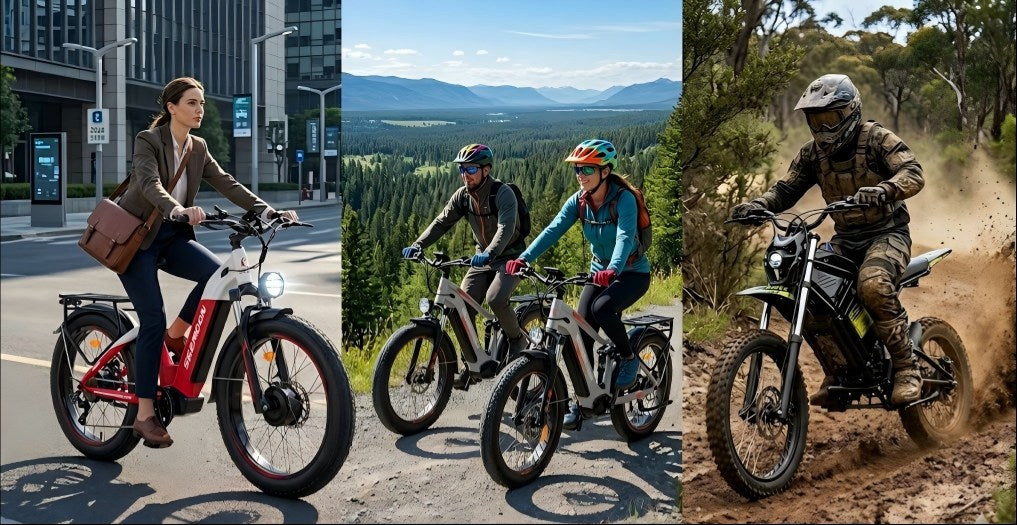
1. The Urban Commuter: Precision & Utility
For those looking to ditch the four-wheel cage, reliability and safety are the primary ROI. You need a build that navigates the chaos of stop-and-go traffic while ensuring you arrive at the office looking sharp, not sweat-soaked.
-
Core Priorities: High-output integrated LED visibility, full-coverage fenders for all-weather protection, and a robust rack system with MIK or pannier compatibility.
-
Technical Deep Dive:
-
Class 3 Capabilities: To safely "flow" with urban traffic, a Class 3 motor (providing pedal assist up to 28 mph) is essential for maintaining pace in bike lanes and crossing intersections decisively.
-
Hydraulic Disc Brakes: When you're hauling a laptop, groceries, and gear in the rain, mechanical rim brakes won't cut it. Hydraulic systems offer superior modulation and heat dissipation for short, predictable stopping distances.
-
-
Our Recommendation: [SM1 All Terrain Commuter E-Bike] — The ultimate utility-focused powerhouse for the daily grind.

2. The Weekend Explorer: Versatility & Torque
If your rides involve a "choose your own adventure" mix of paved paths, loose gravel, and fire roads, you need a hybrid setup that balances plush comfort with raw capability.
-
Core Priorities: High-volume tires for a larger contact patch (stability) and a sophisticated suspension chassis to dampen high-frequency vibrations on washboard terrain.
-
Technical Deep Dive:
-
High-Torque Hub Motors: Look for motors with high Nm (Newton-meter) ratings specifically tuned for sustained climbing, preventing thermal throttling during steep, low-speed ascents.
-
Dual-Motor Configuration: For riders tackling soft surfaces like sand or loose loam, a dual-motor setup provides "all-wheel drive" traction, pulling you through corners where rear-drive bikes might fishtail.
-
-
Our Recommendation: [SM3 All Terrain Off-road E-Bike] — Engineered for those who refuse to let the pavement dictate where the journey ends.

3. The Off-Road Enthusiast: Performance & Range
When the goal is pure adrenaline and technical mastery, "standard" e-bikes are left in the dust. You need a platform built for high-impact durability and maximum power density to handle the rigors of the trail.
-
Core Priorities: True all-terrain geometry (slack head tube angles for stability) and massive battery watt-hour (Wh) capacity to sustain peak output during long-range expeditions.
-
Technical Deep Dive:
-
Heavy-Duty Full Suspension: Beyond just "travel," look for adjustable compression and rebound settings. This allows you to tune the bike to your body weight, ensuring the tires stay glued to the ground on technical descents.
-
Extended Range Architecture: We utilize high-discharge lithium-ion cells optimized for high current draw. This ensures your motor maintains peak performance without "voltage sag" even when the battery levels start to dip.
-
-
Our Recommendation: [SM4 Off-road electric motorcycles] — Defining the intersection of electric agility and raw, unadulterated power.

7. Frequently Asked Questions (FAQ)
(Expert answers to common questions)
Q: How long do e-bike batteries last? A: High-quality batteries (like Samsung/LG cells) typically last 800-1000 full charge cycles before they degrade to 80% capacity. For the average rider, this means 3 to 5 years of regular use.
Q: Do I need insurance or a license for an e-bike? A: In most US states, Class 1 and Class 2 e-bikes do not require a license, registration, or insurance, as they are treated like bicycles. Class 3 bikes may have different rules depending on your state (like California or New York). Always check local DMV laws.
Q: Can I charge the battery while it is on the bike? A: Yes! Most premium e-bikes, including Seemoon models, allow you to charge the battery while it is mounted on the frame, or remove it to charge indoors (which is better for the battery in winter).
Q: Why are e-bikes so heavy? A: Between the motor, battery, and reinforced frame (to handle the speed), e-bikes often weigh between 50-75 lbs. However, many models feature "Walk Mode," which allows the motor to push the bike at 2mph while you walk beside it—perfect for getting up ramps.
The Pre-Flight Checklist: Engineering the Perfect Ride
Before you pull the trigger on a new E-bike, you need to look past the flashy paint and marketing fluff. A high-performance machine isn’t defined by its top speed, but by the synergy of its components.
Run your potential purchase through this 5-point technical audit. If it doesn’t clear these hurdles, it belongs in the "budget" bin, not your garage.
1. Powertrain Intelligence
-
The Torque Threshold: For true versatility—especially if you're tackling 15% grades—insist on at least 60Nm of torque.
-
The Controller: Look specifically for a Sine Wave Controller. Unlike cheaper "Square Wave" alternatives that feel jerky and loud, Sine Wave technology modulates current smoothly, providing a whisper-quiet motor note and surgical throttle control.
2. Battery Chemistry & Safety Standards
-
Certification: In the US, UL 2849 certification is the gold standard for electrical system safety. It’s not just a label; it’s peace of mind that your home won’t be at risk during a charge cycle.
-
Cell Integrity: Don't settle for "generic" lithium. Demand Tier-1 cells from Samsung, LG, or Panasonic. These manufacturers offer superior energy density and higher discharge cycles, ensuring your battery doesn't degrade after just one season.
3. Braking Architecture
-
Hydraulic vs. Mechanical: For any Class 3 E-bike (28mph), Hydraulic Disc Brakes are non-negotiable. The increased mass of an E-bike requires the superior heat dissipation and "one-finger" modulation that only hydraulic systems provide. If a brand is cutting corners on your stopping power, they’re cutting corners everywhere.
4. Real-World Range (The Wh Equation)
Ignore the "estimated miles" on the box—that’s usually calculated for a 110lb rider on flat pavement. Do the math yourself:
Voltage (V) × Amp-Hours (Ah) = Watt-Hours (Wh)
-
The Benchmark: For a dependable commute or trail session, aim for a minimum of 720Wh (e.g., a 48V 15Ah configuration). This ensures you have enough "fuel" to maintain high PAS (Pedal Assist) levels without range anxiety.
5. Post-Purchase Infrastructure
-
Domestic Support: An E-bike is only as good as the parts available to fix it. Verify the brand maintains a US-based warehouse and dedicated service team. In the world of micro-mobility, "Direct-from-Overseas" often means "Disposable." Ensure you have access to a local warranty pipeline and a steady supply of proprietary components.
Conclusion: Prioritize Engineering Over Aesthetics
An e-bike is more than a lifestyle accessory; it is a high-performance vehicle and a long-term investment in your personal mobility. While entry-level models often dominate social media feeds with sleek frames and low price points, the real value of an electric bike lies in the components you cannot see from a distance.
Cutting corners on "budget" builds often means sacrificing the structural integrity and electrical safety that define a reliable ride. To ensure your investment stands the test of time—and the rigors of the road—you must look beyond the hype and evaluate the core engineering:
-
Dynamic Performance: Look for high-torque mid-drive or rear-hub motors that provide consistent power delivery on steep inclines, rather than just high top speeds on flat pavement.
-
Safety Benchmarks: Never compromise on UL 2849 certification. This industry gold standard ensures the entire electrical drive train—including the battery and charger—has undergone rigorous testing to prevent thermal runaway and fire hazards.
-
Kinetic Control: At higher speeds and heavier curb weights, mechanical rim brakes are insufficient. Professional-grade hydraulic disc brakes are essential for heat dissipation and reliable stopping power in all weather conditions.
Ready to experience the pinnacle of e-bike safety and performance? Explore the SM Series—where rigorous testing meets uncompromising power.
Share:
The Life Cycle of Power: When Should You Actually Replace Your E-Bike Battery?
The Ultimate Guide to Electric Motorcycles (2026 Edition): Specs, Performance & How to Choose