
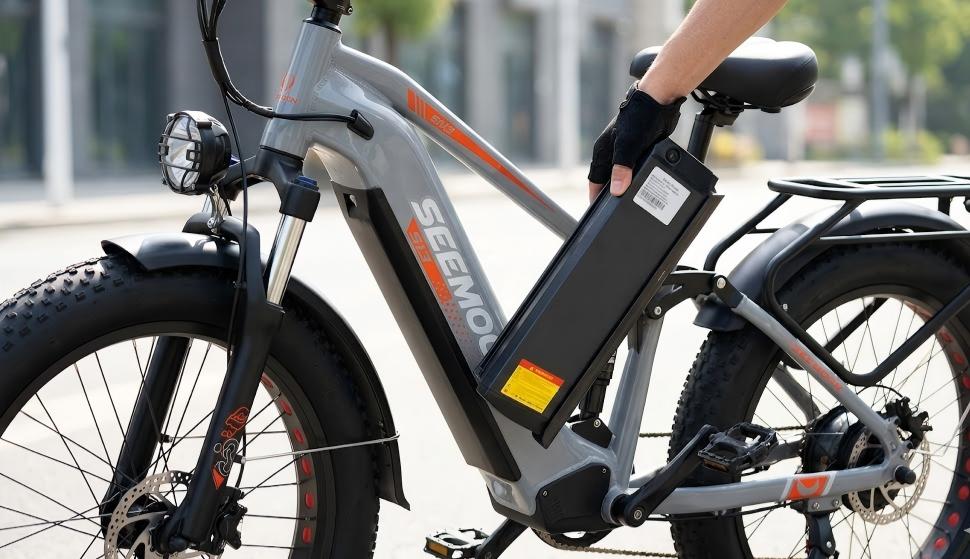
For most riders, an e-bike battery is a black box: plug it into the wall, wait for the charger light to flip green, and hit the throttle. But beneath that sleek casing sits an active electrochemical system—one that is constantly degrading, even when the bike is parked.
Here at Seemoon, the most common question hitting our engineering desk is simple: "When do I actually need to replace my battery pack?"
If you ask the forums, you’ll get the standard "every two to four years" rule of thumb. Frankly, that’s incomplete advice. Time on a calendar doesn't kill lithium-ion cells; charge cycles, thermal stress, and depth of discharge (DoD) do.
We believe in engineering transparency, which means skipping the generic answers. Below, we're breaking down the lithium-ion chemistry inside your e-bike. We'll show you how to spot the real-world technical symptoms of cell degradation—like severe voltage sag under heavy load—so you can pinpoint the exact moment your bike needs a fresh pack, without wasting money replacing it a season too early.
1. E-Bike Battery Lifespan: Tracking Cycles Over Years
Forget the calendar. While lithium-ion cells do experience minor calendar aging, your e-bike battery’s true lifespan is dictated by chemical wear and tear—specifically, charge cycles.
How Charge Cycles Actually Work
Premium lithium-ion packs, like the ones engineered for Seemoon e-bikes, are designed to deliver between 500 and 800 full charge cycles before significant degradation sets in.
A common misconception among new riders is that every time you plug the charger into the wall, you burn through a cycle. In reality, a single charge cycle is strictly defined as a cumulative 100% discharge.
If you drain 50% of your battery commuting on Monday, top it off overnight, and use another 50% on Tuesday, you haven't used two cycles. You’ve only completed one. The battery's internal management system tracks total energy throughput, not the number of times you connect the plug.
State of Health (SOH) and the 80% Benchmark
When a battery finally hits its cycle limit, it doesn't just suddenly stop working.
In EV and e-bike engineering, we measure long-term degradation using a metric called State of Health (SOH). The industry standard dictates that a lithium-ion battery reaches the end of its "optimal" lifespan when its maximum capacity drops to 80% of its original factory rating.
Hitting an 80% SOH simply means a battery that originally held 500 watt-hours (Wh) now safely holds roughly 400Wh. You can absolutely keep riding the bike. However, you will notice a tangible drop in your maximum range, and the pack will likely exhibit more voltage sag—meaning slightly weaker power delivery when you're heavily relying on the motor to climb steep hills or accelerate quickly.
2. Beyond Decreased Range: 3 Technical Signs Your E-Bike Battery is Failing and 2 DIY testing methods
You don’t need a lab-grade multimeter to diagnose a dying lithium-ion pack—you just need to know how to read your e-bike’s behavior under stress. While a drop in your maximum mileage is the most obvious red flag, the real story of chemical degradation is a bit more subtle.
If you want to know what's actually happening inside the casing, look for these specific symptoms of internal cell failure.
1. Severe Voltage Sag Under Load
We’ve all been there: you’re cruising with three bars showing on the display. You hit a steep grade, thumb the throttle, and instantly the battery indicator flashes empty, or the motor completely cuts out. Then the motor and power indicator light slowly returned to normal, as if all the malfunctions had never happened. This isn't a glitch in your controller; it’s a textbook case of extreme voltage sag caused by high internal resistance (IR).
The mechanics of it: As lithium-ion cells age and degrade through hundreds of charge cycles, the internal resistance inside those cells naturally climbs. When you suddenly demand high current for heavy acceleration or hill climbing, the voltage drops drastically across that resistance.

When your e-bike's Battery Management System (BMS) registers this sudden voltage nosedive. Assuming the battery is dangerously close to an over-discharged state, the BMS does exactly what it's programmed to do: it trips the power to protect the cells. Therefore if your bike frequently shuts down under heavy load despite showing a healthy charge at a standstill, the internal resistance has simply become too high. The cells are worn out.
2. The "False Full" (Accelerated Charging)
A healthy pack—like the high-quality cells used in Seemoon batteries—follows a highly predictable, linear charging curve. If you start noticing that your battery is hitting 100% drastically faster than it used to (for example, peaking in two hours instead of the usual five), don't celebrate the speedy charge time.
This is actually a symptom of severe capacity loss. Think of the battery cells as your e-bike's gas tank. As the internal chemistry breaks down over years of use, the functional volume of that "tank" effectively shrinks. A smaller tank takes significantly less time to fill up at the charger, but it also means you'll drain it much faster on your commute.
3. Battery Casing Deformation and Swelling
This is the ultimate "stop riding immediately" symptom. If your battery casing appears warped, bulging, or is difficult to slide into the bike's mounting track, do not plug it into the wall.
In the EV community, swollen lithium pouch cells are sometimes jokingly referred to as "spicy pillows," but the reality is an immediate safety threat. This bulging is the physical result of trapped gas buildup caused by internal electrolyte decomposition or a breached cell separator. It represents a severe fire hazard. If the geometry of your battery pack has changed at all, do not attempt to charge or discharge it. Safely store it outside away from flammable materials, take it to a certified battery recycling center, and order a replacement.

4. How to Test Your E-Bike Battery Health at Home
Is your e-bike losing its "zip" or struggling to climb hills it used to conquer easily? Based on the above battery malfunction symptoms, you don’t need a professional lab to check your battery’s condition. Here are two DIY methods to accurately assess your battery health:
1. The Multimeter Voltage Test (Precision Check)
The most accurate way to check for cell degradation is by measuring the resting voltage after a full charge.
-
Step 1: Charge your battery to 100% and wait about 30 minutes after the charger light turns green.
-
Step 2: Set your multimeter to DC Voltage (V⎓).
-
Step 3: Carefully touch the probes to the battery’s discharge ports (positive and negative).
-
The Verdict: Compare your reading to the standard full-charge voltage. For example:
-
48V Battery: Should read approximately 54.6V when healthy.
-
36V Battery: Should read approximately 42.0V.
Pro Tip: If your 48V battery only reaches 50V or lower after a full charge, it indicates significant cell aging or a balancing issue within the BMS (Battery Management System).
-
2. The "Real-World" Range Log
Lab numbers are great, but road performance is what matters. Digital tracking helps you spot gradual decline before it leaves you stranded.
-
The Test: Choose a consistent local route with similar terrain and wind conditions.
-
The Tool: Use an app like Strava or Google Maps to record your mileage from 100% charge down to the "low battery" cutoff.
-
Tracking: Keep a simple log once every three months. A sudden 15-20% drop in range under identical conditions is a clear signal that your battery's internal resistance is increasing.
3. What Actually Ruins an E-Bike Battery? The Science of Pack Longevity
Ever wonder why one rider gets five solid years out of a battery pack while another is shopping for a replacement in under 18 months? It rarely comes down to a defective unit from the factory. Most premature battery failure is driven by three specific environmental and behavioral factors. The following is a detailed analysis of the actual internal operating principle of a battery under improper use and how to prevent it.
1. Depth of Discharge (DoD) and Mechanical Stress
Lithium-ion cells thrive in the middle of their voltage range. Consistently draining your pack down to 0%—known as a deep discharge—wreaks havoc on its internal chemistry.
When you bottom out the battery, it puts extreme mechanical stress on the cell's electrodes during intercalation (the process of lithium ions moving in and out of the anode and cathode). Over time, this physical strain literally fractures the internal microstructures, permanently reducing the amount of energy the cell can hold.
-
The Fix: Treat your e-bike battery a bit like your smartphone. Try to throw it on the charger when the display reads between 20% and 30%. Keeping the pack out of that extreme low-voltage danger zone is the easiest way to maximize your total lifetime cycle count.
2. Thermal Degradation: The Heat and the Frost
Temperature extremes are the fastest way to kill a healthy lithium pack.
-
The Cold (Below 32°F / 0°C): You can ride in the cold, but never charge a frozen battery. Forcing current into cells that are below freezing triggers a catastrophic process called lithium plating. Instead of safely absorbing into the graphite anode, metallic lithium hardens on the cell's surface.
This damage is irreversible, kills your capacity, and creates a severe short-circuit hazard. Always bring your battery indoors and let it acclimate to room temperature before plugging it in.
-
The Heat (Above 104°F / 40°C): Heat is a slow, quiet killer. Storing or charging your battery in a sweltering garage or leaving it in direct summer sun accelerates parasitic chemical reactions inside the cell. Prolonged heat exposure thickens the Solid Electrolyte Interphase (SEI) layer and consumes the liquid electrolyte, leading to high internal resistance and a permanent drop in your riding range.
3. High-Voltage Stress During Long-Term Storage
If you are getting ready to winterize your Seemoon e-bike, do not make the mistake of leaving the battery sitting at a 100% charge.
When lithium cells are topped off, they are operating at their absolute maximum voltage limit. Leaving them parked in this high-pressure state for months oxidizes the electrolyte and degrades the cathode material at an accelerated rate.
-
The Fix: For off-season storage, drain or charge the pack down to its nominal voltage—usually right around 50% to 60% capacity. This keeps the internal cell chemistry relaxed and stable, ensuring your battery is ready to perform when the spring riding season rolls back around.
4. The Seemoon Edge: Engineering for Thermal Stability and Longevity
At Seemoon, we view the battery as the neural center of your e-bike, not just a power source. While many manufacturers rely on generic, off-the-shelf components, our engineering philosophy centers on maximizing the electrochemical lifespan of every pack. By integrating sophisticated management hardware with premium cell chemistry, we aim to push the boundaries of the standard more than 800-cycle benchmark.
1. Intelligent BMS: The "Brain" of Power Delivery
Every Seemoon battery features a proprietary Battery Management System (BMS). This isn't just a safety shut-off; it’s a dynamic controller that manages the complex physics occurring inside your pack.
-
Active Cell Balancing: Over time, individual cells inevitably drift in voltage and internal resistance. A standard BMS ignores these discrepancies, leading to "unbalanced" packs that die prematurely. Our system actively redistributes energy during the charge cycle, ensuring each cell stays within its optimal voltage window and preventing a single weak link from throttling your range.
-
Precision Safety Guarding: Our circuitry operates with microsecond latency to mitigate risks from over-current, over-charging, and thermal runaway. By maintaining the cells' chemical integrity through rigorous threshold management, we significantly reduce the degradation caused by heat and electrical stress.

2. Automotive-Grade High-Consistency Cells
The performance of a multi-cell pack is dictated by the "weakest link" principle. To solve this, Seemoon utilizes high-consistency, automotive-grade lithium-ion cells.
Unlike consumer-grade cells that vary wildly in internal resistance, our cells undergo a strict grading and "binning" process. This ensures that every cell in your pack shares nearly identical discharge curves and aging characteristics. By minimizing cell mismatch, we eliminate the localized overheating and uneven wear that typically plague cheaper e-bike batteries, resulting in a pack that delivers consistent power from the first mile to the last.
3. Uncompromising UL 2849 certification.
Seemoon adheres strictly to this industry gold standard to ensure that the entire electric drive system, including batteries and chargers, undergoes rigorous testing to prevent thermal runaway and fire hazards.
Unlike other e-bike brands that focus solely on the battery, Seemoon evaluates the entire electric powertrain as a unified ecosystem. Based on high standards of compliance with UL 2849 certification, Seemoon rigorously requires that each of the following components perfectly adhere to these standards:
-
The Battery Pack: Engineered with redundant failsafes to prevent overcharging, short-circuiting, and thermal runaway.
-
The Charger: Validated for precise voltage regulation to ensure it doesn't "cook" the cells.
-
The Drive Motor: Tested to handle sustained high-torque loads without internal melting or electrical arcs.
-
The Controller: Acting as the "brain," it must be programmed to manage complex power distribution and thermal monitoring.
The primary goal of Seemoon is to prevent thermal runaway. If the controller detects that the motor temperature has reached a critical level, it must be able to immediately "handshake" with the battery to cut off power.

Frequently Asked Questions (FAQ)
Q: Can I replace the cells inside the battery case myself?
A: We strongly advise against DIY cell replacement. E-bike batteries pack a tremendous amount of energy. Opening the sealed casing can compromise the waterproofing (IP rating) and risks damaging the BMS or causing a thermal event. For safety and performance, always replace the entire unit with a genuine Seemoon certified battery.
Q: Will a bigger battery (higher Amp Hours) last longer?
A: Generally, yes. A battery with a higher Amp-Hour (Ah) rating has a larger capacity. This means for the same 10-mile commute, you are using a smaller percentage of its total capacity (lower Depth of Discharge) compared to a smaller battery. This "lighter load" often results in a longer overall lifespan.
Q: How do I dispose of my old e-bike battery?
A: Lithium-ion batteries are hazardous waste and should never be thrown in the regular trash. In the US, look for Call2Recycle drop-off locations or visit your local hazardous waste disposal facility. Seemoon is committed to sustainability—contact our support team for guidance on recycling centers near you.
Conclusion: When Is It Time to Retire Your Battery?
Based on the information above, you now know the exact lifespan of an e-bike battery isn’t just about counting months; it’s about understanding the lithium-ion lifecycle. Most high-quality packs are rated for 500 to 1,000 full charge cycles before their capacity significantly degrades.
How does that translate to your real-world riding?
-
The Weekend Warrior: If you’re hitting the trails or cruising the boardwalk once or twice a week, your battery will likely remain healthy for 3 to 5 years. At this stage, chemical aging—rather than cycle count—is the primary factor in performance loss.
-
The Daily Commuter: For those logging 10+ miles daily, the frequent charge-discharge cycles mean you'll likely hit that "capacity cliff" within 2 to 3 years. High-demand riding puts more thermal stress on the cells, accelerating internal resistance. Therefore, it is recommended that you immediately replace the battery with one that is compatible with your electric bicycle model when you notice that the battery is malfunctioning more and more.
The Bottom Line: Investing in a fresh, high-quality battery is the single most effective way to restore your bike’s original torque and efficiency. It’s a fraction of the cost of a new e-bike and ensures your ride remains safe and reliable.
Ready to refresh your ride? [Browse Genuine Seemoon Replacement Batteries Here]
Share:
Seemoonebike brand story
How to Choose the Best E-Bike in 2026: A Complete Guide to Specs, Safety, and Style