
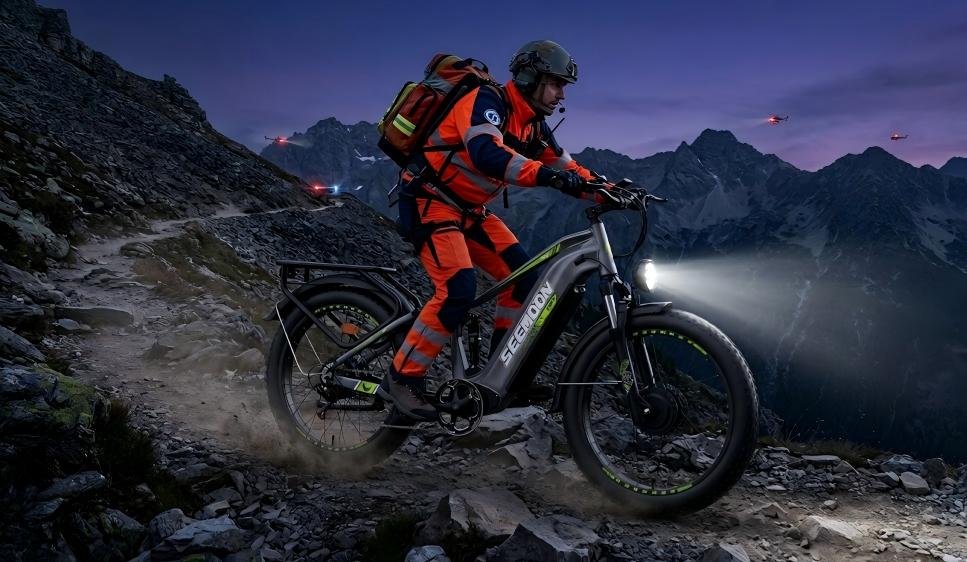
Historically, Search and Rescue (SAR) teams, K9 tracking units, and Bureau of Land Management (BLM) rangers have relied on the heavy ATVs. However, these vehicles share a fatal operational flaw: they are confined to wide, relatively clear fire roads. When the trail narrows into rugged single track, or becomes entirely blocked by fallen timber and mudslides, responders are forced to abandon their vehicles and proceed on foot, this will not only greatly prolong the rescue time.
However, ordinary commuter bicycles cannot withstand the extreme loads and harsh environments of rescue missions. Elite rescue teams require professional industrial-grade electric bicycles, while tactical heavy-duty all-terrain electric bicycles bridge the gap between four-wheel-drive ambulances and foot patrols.
Enter the SEEMOON SM3. the SM3 is armed with a 6000W All-Wheel Drive (AWD) system, a 330 lb payload capacity, and an advanced 60V architecture. More importantly, its programmable computer allows tactical operators to bypass civilian safety limits to achieve military-grade responsiveness. Here is the definitive operational guide to utilizing the Seemoon SM3 for Search and Rescue, extreme extraction, and stealth wildlife patrol.
1. Shaving Seconds Off Response Times
When an emergency distress beacon goes off deep in the backcountry, response time is the only metric that matters. For search and rescue (SAR) operators, an e-bike can’t just be fast—it has to be ready to move the second the rider is in the saddle. Here is how field technicians modify and utilize the Seemoon SM3 for rapid deployment.
Parameter P09: Bypassing "Kick-to-Start" for Instant Torque
Most electric bicycles come with a pre-installed "non-zero start" safety lock. This feature requires the rider to manually pedal to increase the speed to approximately 2 mph before the controller allows the throttle to start the motor, thus preventing accidental acceleration at traffic lights. In a tactical rescue scenario, however, this delay is a liability
To solve this, SAR operators access the SM3’s advanced display settings and reprogram Parameter P09. By flipping this value from 1 (Non-Zero Start) to 0 (Zero Start), the factory safety delay is bypassed. This simple software tweak fundamentally changes the bike's behavior off the line. The moment the throttle is twisted, the controller instantly feeds power to the dual 2,000W hub motors. This delivers the full 200 Nm of torque from a stationary position, giving operators the immediate, uninterrupted momentum required to push through challenging terrain.
Rapid Field Reloads: The Baffle-Less Battery Architecture
Running massive, multi-day grid searches requires a staggering amount of energy, and stopping to plug into a generator at base camp simply isn't an option. To keep the search grid moving, field teams rely on carrying spare batteries in their support vehicles and performing "hot swaps" directly at the trailhead.
This is where the physical engineering of the Seemoon SM3 really caters to tactical use. Unlike traditional rail-mounted or top-loading battery housings—which often require riders to wrestle with tight frame clearances and precise alignment—the SM3’s downtube compartment features a baffle-less, bottom-loading design.
When a responder pulls into the mobile command center, the reload process is incredibly streamlined:
-
Insert the key to disengage the mechanical lock.
-
Gravity naturally assists as the massive 60V battery drops smoothly out of the frame and into the rider's hands.
-
A fresh battery is pushed upward into the cavity, locking with a definitive click.

Because there is no lower baffle or restrictive rail to navigate, a practiced operator can swap out the primary power plant in under five seconds. It’s a frictionless system designed specifically to minimize downtime and maintain relentless forward progress during critical missions.
2. Disaster Zone Resilience & Critical Mission Comms
Navigating the aftermath of a hurricane, tornado, or flash flood requires more than just a standard E-bike; it demands a tactical vehicle capable of handling a "high-threat" terrain profile. In these environments, the ground is a treacherous mosaic of jagged structural debris, shattered glass, and pressurized hazards that would instantly disable conventional tires.
Puncture-Resistant All-Terrain Armor
Deploying a standard commuter bike into a disaster recovery site is a recipe for immediate mechanical failure. To combat this, the SM3 is engineered with oversized 24x4.0-inch fat tires featuring an integrated, heavy-duty aramid-reinforced casing.
These high-volume, multi-ply treads are designed to maintain structural integrity even when rolling over splintered timber or glass shards. By pairing this rugged "footprint" with a precision-tuned dual hydraulic suspension system, the SM3 functions as a localized bulldozer. It effectively dampens high-frequency vibrations from ruined infrastructure, ensuring the rider maintains traction and control when every second counts.

The 5V/1A "Lifeline": Redundant Power for Field Comms
In a search-and-rescue (SAR) scenario, communication is not a luxury—it is the backbone of the entire operation. When a responder’s VHF radio, satellite uplink, or GPS unit hits "critically low," they transition from a rescuer to a liability.
The SM3 addresses this via a hardware-level redundancy: a weather-sealed 5V/1A Type C charging port integrated directly into the LCD cockpit. This isn't just a gimmick; it’s a direct tap into the bike’s massive 60V 30Ah (1,800Wh) lithium-ion reservoir. This integration transforms the bike into a mobile, high-capacity power station. Whether navigating uncharted wilderness via GPS or maintaining a signal with a central command post, responders can "hot-charge" their essential gear while in transit, ensuring their electronic lifeline never goes dark.
3. Mastering the Triage Scene: Tactical Illumination at Night
Wilderness search and rescue (SAR) missions often turn into arduous operations, frequently lasting into the cold, dark night. When medical personnel finally locate the wounded on remote, dimly lit ridges, their primary task is not only to treat the injured, but also to establish a safe, well-lit area, which is fundamental to effective wilderness medical care.
Overriding Parameter P04: Transitioning from Commuter to Lifesaver
The SM3 is engineered to serve as a silent, stationary medical floodlight, utilizing a high-output LED array drawing directly from the primary 60V battery. However, there is a critical software hurdle to clear. By default, the SM3’s onboard computer is programmed for "Commuter Efficiency," this means that in order to extend battery life, it will automatically force shutdown after being idle for a period of time.
In a rescue context, having your light source plunge you into total darkness while you are cinching a tourniquet or stabilizing a cervical spine is a life-threatening failure. To transition the SM3 into Tactical Mode, operators must manually override Parameter P04 (Auto-Sleep Timer).
The Field Protocol:
-
Secure the Platform: Deploy the heavy-duty kickstand on stable ground to ensure a fixed light trajectory.
-
Access the P-Setting Menu: Press and hold the (+) and (-) buttons simultaneously for 3 seconds to enter the settings interface. A short press of the power button switches between function levels.
-
Adjust P04 to 0: A short press of the power button switches between function levels. Use the (+) and (-) keys to adjust the value to parameter P04, and toggle the value to 0 (Disable).
Setting P04 to zero at this point bypasses the automatic sleep logic, forcing the system to remain active. This allows the SM3 to project a bright and uninterrupted beam of light onto the patient. This provides the medical team with the clear vision needed for surgery and also provides the necessary quiet environment for clear radio coordination with rescue aircraft.
4. Extreme Extraction: Field Diagnostics Under Load
Once the patient is stabilized, the true test of your equipment begins: the extraction. In dense canopy or volatile weather where medevac bird access is impossible, ground teams must rely on a wheeled Stokes basket or a specialized rescue trailer coupled to the e-bike’s drivetrain.

Monitoring E06/E07: Thermal Management & System Protection
Towing an injured adult and a heavy steel litter up technical, high-gradient trails places an immense load on any electric propulsion system. While the Seemoon SM3’s AWD architecture is engineered for industrial-grade durability, sustained low-speed/high-torque towing can push internal copper windings toward their thermal ceiling.
To prevent this, the lead operator must be proactive in monitoring the LCD interface for real-time diagnostic feedback.
The SM3 utilizes a network of precision thermal probes to safeguard the 60V ecosystem. If the system’s thermistors detect temperatures approaching critical thresholds, the onboard controller will trigger specific alerts:
-
Error Code E06 (Motor Overheat): Indicates the motor’s internal temperature has exceeded safe operating parameters.
-
Error Code E07 (Controller Overheat): Signals that the MOSFETs or capacitors within the motor controller are nearing thermal shutdown.
Tactical Protocol: If these codes flash, the operator must immediately cease electric throttle input. The rescue mission certainly wouldn't stop at this point, but in order to reduce the motor temperature, the electric bicycle's power output had to be switched.
The team should transition to a combination of manual pedaling and physical pushing to assist the vehicle. This "active cooling" phase allows airflow to dissipate heat from the motor casing and prevents irreversible damage to the magnet wire insulation.
Mastering these diagnostics ensures that your vehicle—and your patient—successfully makes it off the mountain.
5. Tactical Patrol: The Science of Silent Interdiction
In addition to the fields of rescue and search and rescue, high-performance e-bikes have redefined the operational parameters for law enforcement and land management. For Game Wardens, Park Rangers, and Border Patrol agents, acoustic stealth is the primary tactical advantage when navigating sensitive environments. In high-risk operations such as intercepting poachers or illegal logging, the decibel level of an electric bicycle determines whether it is possible to approach the criminal target undetected.
A traditional internal combustion engine (ICE) dirt bike is a tactical liability; its exhaust note echoes through canyons for miles, providing ample early warning for suspects to scatter, destroy evidence, or reposition.
PAS 0: Achieving Absolute Acoustic Neutrality
While the Seemoon SM3 operates with a fraction of the noise of a gas engine, the high-torque whine of dual hub motors under heavy load can still be detected in a "dead-silent" wilderness or high-desert environment. When an operator is closing in on a suspect’s perimeter at dawn, even a low-frequency hum is too much risk.
To mitigate this, tactical operators utilize the PAS 0 (Pedal Assist System Level 0) setting—a crucial feature for covert "last-mile" approaches.
-
Mechanical Isolation: By selecting PAS 0, the rider electronically severs power to the dual motors. This eliminates the magnetic "cogging" noise and electrical frequency emissions associated with active propulsion.
-
Active Intelligence: Unlike turning the bike off, PAS 0 keeps the LCD dashboard, GPS navigation, and USB-integrated communication gear fully powered. Operators maintain situational awareness and connectivity without emitting a sound.
-
The 107 lb Stealth Glider: In this mode, the SM3 transitions from a motorized vehicle to a purely mechanical asset. By leveraging the 7-speed Shimano® drivetrain, a warden can silently pedal down ridgelines or coast through undergrowth.
At this level of engagement, the only remaining acoustic signature is the ambient "crunch" of the fat tires over debris—a sound easily mistaken for local wildlife. This allows law enforcement to penetrate deep into hostile sites, effectively rolling into a camp before the occupants even realize the perimeter has been breached.
Tactical Note: The ability to switch instantaneously from high-speed motor pursuit to silent mechanical pedaling gives the SM3 a versatile "stealth-on-demand" profile that traditional ATVs simply cannot match.
Conclusion: SM3's tactical advantages
In the high-stakes environments of backcountry patrol and disaster relief, equipment reliability isn't just a metric—it’s a prerequisite for survival. When traditional transport is sidelined by debris or dense terrain, the Seemoon SM3 transitions from a recreational vehicle into a mission-critical tactical asset.

To optimize operations in search and rescue (SAR) and emergency response, SM3 uses its deep engineering parameters to shorten response times, thus providing more valuable time for rescue efforts:
-
Zero-Latency Deployment: By configuring the P09 parameter to non-zero start, responders gain immediate torque delivery from a dead stop—essential for steep-incline launches or navigating through heavy mud.
-
Sustained Life Support & Visibility: Utilize the P04 sleep timer settings to ensure that integrated lighting and the high-output Type C charging port remain active during stationary triage, keeping vital communication arrays powered and emergency scenes illuminated.
-
Optimized Hot-Swaps: The SM3’s baffle-less battery architecture is a strategic advantage in the field. the SM3 allows for instantaneous battery extraction once unlocked, enabling rapid "hot-swaps" that keep the unit in constant rotation during 24-hour operations.
By mastering these technical configurations, first responders don't just move faster—they operate with a sophisticated piece of hardware designed to extract patients and deliver aid where traditional internal combustion engines fail. In the backcountry, the SM3 isn't just a electric bike; it's a lifeline.
【Explore the SM3 AWD Product Page Now】
-
👉 Respond in Any Weather: If a search mission takes you into a brutal winter storm, ensure your team understands the physics of snow riding in our winter fat tire and extreme cold guide.
-
👉 Navigate the Mud: Spring rescues often involve flooded trails and deep bogs. Prepare your SM3 for deep water crossings with our waterproof engineering and swamp navigation manual.
-
👉 Rapid Transit: To get from the station to the trailhead as fast as possible, master the bike's high-speed stability in our heavy-duty highway touring breakdown.
FAQ: Tactical and Search & Rescue E-Bikes
Why are e-bikes replacing ATVs in some Search and Rescue operations?
Heavy-duty e-bikes like the PUJH SM3 offer critical tactical advantages over ATVs: they are highly maneuverable on narrow singletrack trails where wide ATVs cannot fit, they operate in near-total silence (crucial for hearing calls for help or maintaining stealth), and they produce no exhaust fumes, making them safer to operate in dense brush with high wildfire risks. They also do not require carrying highly flammable liquid fuel into disaster zones.
What happens if a tactical e-bike battery dies during a deep woods rescue?
Elite tactical e-bikes are designed for rapid field maintenance. For example, the PUJH SM3 features a baffle-less battery compartment. By simply turning a key, the depleted battery drops directly downward, allowing a responder to snap a fresh 60V battery into place in under five seconds. If no spare is available, the bike retains a 7-speed Shimano mechanical drivetrain, allowing the operator to manually pedal out of the wilderness.
Can an electric bike tow a rescue stretcher or Stokes basket?
Yes, heavy-duty All-Wheel Drive (AWD) e-bikes possess the 200 Nm torque necessary for towing. However, pulling a heavy patient up an incline generates extreme electrical heat. Operators must closely monitor the LCD display for thermal warning codes (such as E06 or E07). If an overheat code triggers, the team must supplement the motor's pulling power by physically pushing the bike and stretcher until the system cools down to prevent motor burnout.
Share:
The Ultimate Rugged E-Bike for RV and Vanlife Exploration
6000W AWD vs 1300W RWD: Seemoon SM3 and KINGBULL Rover 2.0 Fat Tire All Terrain E-Bike Review