
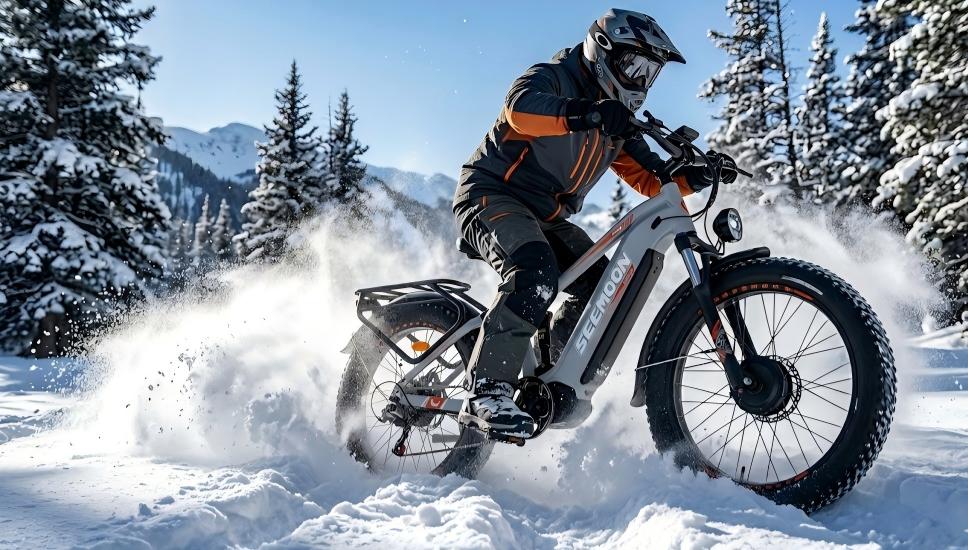
For the vast majority of e-bike owners, the arrival of the first significant winter blizzard signals the immediate end of the riding season. Clean the car, fully charge the battery, and then store it in the warehouse to quietly await the arrival of spring. But in 2026, the landscape of electric mobility has shifted. Winter riding is no longer just for extreme athletes; with the right heavy-duty engineering, it is an exhilarating and practical new frontier.
However, conquering the frozen tundra requires much more than simply slapping wide tires onto a standard commuter frame. Winter presents the ultimate double-threat to electric bicycle physics: traction on black ice is practically non-existent, and sub-zero temperatures are the sworn enemy of lithium-ion cell chemistry.
When our testing team took e-bikes out into the brutal -10°F (-23°C) winters of Minnesota and the snowy trails of Colorado, we learned quickly that surviving the cold requires a machine built with absolute mechanical redundancies and intelligent software failsafes.
The Seemoon SM3 all terrain electric bicycle is engineered specifically for these hostile extremes. By utilizing its true All-Wheel Drive (AWD) platform, advanced digital torque customization, and a modular high-voltage battery ecosystem, the SM3 allows you to confidently conquer ecosystems that would destroy lesser bikes. Here is the professional rider’s guide to taming the cold.
1. Mastering the Elements: Taming Dual-Motor Power on Ice and Snow
When navigating treacherous winter commutes or snow-packed backcountry trails, your primary adversary isn't just the deep powder—it’s the unpredictable black ice lurking beneath.
The Seemoon SM3 is an undeniable powerhouse, engineered with Dual High-Speed Hub Motors that unleash a combined 6000W peak output and a staggering 200 Nm of torque. While this raw power provides "unstoppable" acceleration on dry pavement or steep inclines, physics shifts on frozen terrain. Without precise mechanical and software modulation, that same explosive torque will break traction instantly, risking a low-side crash before the rider can even react.
The Science of "Soft Start": Optimizing Parameter P12
While the mechanical advantages of All-Wheel Drive (AWD) provide superior "push-pull" traction—similar to the flotation principles discussed in our guide to Conquering Soft Sand and Desert Overlanding—ice requires a digital intervention.
To handle these high-torque demands, the SM3 features a critical safety failsafe within its advanced firmware: Parameter P12 (Start Intensity). Unlike standard Pedal Assist Levels (PAS 1-5) which govern top speed, P12 acts as a digital governor for the motor controller’s initial current ramp-up. It dictates how aggressively those 200 Nm are unleashed from a standstill.
Based on extensive winter field testing, we recommend the following protocol for icy conditions:
-
Access the Advanced Menu: Long-press the navigation buttons on your full-color LCD.
-
Locate Parameter P12: Factory defaults are typically set to level 3 or 4 for "punchy" urban performance.
-
Recalibrate to Level 1: This is the lowest "Soft Start" setting.
Why It Works: Torque Curve Flattening
By dialing P12 down to Level 1, you are effectively flattening the torque curve. When the throttle is cracked open on a frozen surface, the controller prevents the motors from "hunting" for immediate peak power. Instead, the power delivery is linear and gradual.
This allows the 24x4.0-inch fat tires to find mechanical grip through surface deformation rather than spinning out. Once the SM3 is in motion, the gyroscopic stability and the 107 lbs (48.5 kg) solid aluminum chassis provide a planted, confident center of gravity—offering a level of winter dampening and safety that lighter, folding e-bikes simply cannot replicate.
Pro Tip: In sub-zero temperatures, always monitor your LCD's voltage sag. High-torque starts on Level 5 in the cold can put undue stress on battery cells; switching to P12 Level 1 doesn't just save your traction—it preserves your battery's long-term health.
2. The Cold Weather Battery Killer (And How to Beat It)
The most significant psychological hurdle in winter commuting is range anxiety. To understand why your mileage drops when the mercury dips, we have to look at the chemistry. Lithium-ion batteries generate power through electrochemical reactions; however, extreme cold dramatically increases internal resistance within the battery cells. This sluggishness can result in a temporary capacity loss of up to 40% when temperatures hit 14°F (-10°C).
But here is the industry’s "cold" hard truth: the real danger isn't riding in the cold—it’s charging in it.
Attempting to charge a frozen lithium-ion battery triggers a destructive process known as lithium plating. Instead of intercalating into the graphite anode as intended, the lithium ions accumulate on the surface. This creates irreversible capacity degradation and, in extreme cases, poses a severe thermal runaway risk.
Modular Charging: The Tactical Advantage of the Mechanical Key Lock
Engineering a true all-terrain vehicle means designing for environmental extremes. The SM3 addresses this through its modular, removable battery architecture. While the massive 60V 30Ah pack is seamlessly integrated into the downtube for a low center of gravity, it remains easily accessible via a heavy-duty physical Battery Key Lock.
This lock serves as more than just a theft deterrent; it is a critical maintenance tool. When you arrive home from a sub-zero commute, the SM3’s engineering protocols are clear: never leave your battery plugged into the frame in a freezing garage. By utilizing the physical key to remove the battery, you can bring the "heart" of your machine into a climate-controlled environment. To protect the chemical integrity of the cells, Seemoon’s safety guidelines dictate that the battery must be stored and charged in ambient temperatures between 50°F and 77°F (10°C–25°C). While your rugged 107 lb frame is built to withstand the snow, your power source belongs indoors.

Precision Power: Adhering to the 2-Amp Charging Protocol
In the high-performance e-bike sector, longevity is built on technical discipline. Because the SM3 utilizes a high-capacity 1,800Wh (60V 30Ah) system, rushing the recharge cycle is a recipe for premature cell failure.
The SM3 technical data sheet specifies a maximum input current of 2 Amps. While the temptation to use an aftermarket "fast-charger" is high, these devices often force excessive current into the cells. This leads to Joule heating—internal thermal stress that degrades the electrolyte and shortens the battery's lifecycle.
Pro Tip: Stick to the included 2A slow-charging protocol. It may take 10–11 hours for a full cycle, but it ensures that your investment delivers peak voltage and maximum cycle life for years to reach.
3. Defending Against the Slush, Salt, and Corrosion
Winter riding in an urban environment is rarely a picturesque journey through pristine snow. For the dedicated commuter, the real challenge begins after the plows pass: the arrival of corrosive road slush.
Municipalities deploy thousands of tons of rock salt and liquid de-icers (like magnesium chloride) to keep roads clear. When mixed with melting snow, this creates a highly conductive, abrasive slurry. Left unchecked, this mixture will rapidly oxidize chains, penetrate budget electrical connectors, and compromise the integrity of inferior frame coatings. To survive a coastal or Northern winter, your e-bike requires more than just power—it needs industrial-grade hardening.
IP54 Engineering & Aviation-Grade Connectivity
The SM3 is engineered as a year-round "daily driver," built to withstand the chemical warfare of winter roads. Our electrical architecture is validated to an IP54 rating, ensuring the core electronics are shielded against multi-directional splashes and fine particulate ingress.
However, the real "failure point" on most e-bikes is the wiring harness. The SM3 mitigates this by utilizing "arrow-to-arrow" aviation-grade waterproof connectors. These threaded, O-ring-sealed interfaces prevent salty brine from "wicking" into the motor and lighting cables—a critical failure mode that often leads to short circuits in lesser builds. This level of environmental sealing mirrors the ruggedized standards required for riding through high-moisture wetlands and muddy terrain.

Full-Coverage Fenders: More Than Just Aesthetics
While electrical sealing protects the "brain," physical shielding protects the "body." To combat the corrosive spray kicked up by high-velocity tires, the SM3 features heavy-duty, full-coverage fenders as standard equipment.
Unlike the minimalist "moto-style" mudguards found on typical electric mountain bikes—which prioritize style over utility—the SM3’s fenders wrap extensively around the 4.0-inch fat tires. This design is crucial for two reasons:
-
Drivetrain Longevity: By intercepting salt spray before it coats the rear shock absorber and the bottom bracket, the fenders significantly reduce mechanical wear and "crunchy" bearings.
-
Rider Comfort: They prevent the "skunk stripe" of freezing slush from soaking your back and legs, keeping you dry and extending your riding season into the coldest months.
Tech Tip: Even with superior shielding, we recommend a quick freshwater rinse after riding on heavily salted roads to neutralize chemical buildup and maintain the SM3’s finish for years to come.
4. Eliminating "Voltage Sag" Anxiety: Precision Power Management
We’ve all been there: you pull your smartphone out in the freezing cold, the screen shows 30% battery, and ten seconds later, it goes black. This phenomenon is known as Voltage Sag. For e-bike riders using basic displays, this isn't just a nuisance—it’s a source of constant "range anxiety" that can ruin a winter expedition.
The Problem with "The 5-Bar Trap"
Budget e-bike displays typically rely on a primitive 5-bar graphic derived from instantaneous voltage. In sub-freezing temperatures, internal resistance within the battery cells increases. When you pin the throttle to power through a snowdrift, that massive current draw causes the voltage to dip momentarily.
A "dumb" display misinterprets this temporary dip, plummeting from 5 bars to a flashing red warning in seconds. Once you let off the throttle, the bars "magic" themselves back up to 4. This constant fluctuation makes it impossible to know your true remaining range, leading to unnecessary panic in the backcountry.
Real-Time Voltage: The Professional’s Choice
The SM3’s engineering-grade color LCD dashboard replaces guesswork with laboratory-grade data. By toggling the display settings from the standard graphic to the Real-Time Exact Voltage Reading, you gain a transparent window into your powertrain’s health.
Mastering your machine requires understanding the discharge curve of your battery. For the SM3’s high-performance 60V architecture, here are the critical benchmarks:
| Charge Level | Voltage Reading | Rider Context |
| Fully Charged (100%) | ~58.2V | Peak potential; maximum torque available. |
| Nominal Charge (~50%) | ~51.0V | The stable "meat" of the discharge cycle. |
| Low Battery (Cutoff) | ~48.0V | The BMS (Battery Management System) will safely cut power to prevent cell degradation. |
Why Precision Matters in the Cold
By monitoring raw voltage, you can interpret your bike’s performance like a seasoned pro. In 10℉ weather, a fully charged pack might initially read 58.2V. Under a heavy AWD load, you might see that number dip to 51V.
Because you are reading the raw data, you'll recognize this as cold-weather sag—a physical property of lithium-ion chemistry—rather than a depleted battery. This level of granular data allows for hyper-accurate range calculations in real-time, ensuring you can push the limits of the backcountry without ever fearing a "dead" display.
Conclusion: Taming the Winter Tundra
Winter riding with the SM3 AWD isn't an exercise in fighting the elements—it’s about leveraging heavy-duty engineering to master them. To safely navigate sub-zero terrain, a rider needs more than just raw power; they need a sophisticated synergy between hardware and software.
A Holistic Approach to Cold-Weather Performance
Conquering black ice, deep powder, and corrosive road salt requires a vehicle designed with specialized logistics. The SM3 provides a multi-layered defense against the "Big Freeze":
-
Software Precision: Utilize the P12 Torque Dampening settings via the onboard firmware to prevent wheel spin on low-friction surfaces.
-
Mechanical Dominance: Rely on the AWD Push-Pull Traction system, which dynamically distributes torque to ensure directional stability where RWD-only bikes fail.
-
Thermal Resilience: Follow smart physical protocols by utilizing the Indoor Modular 2A Charging system, ensuring your lithium-ion cells remain within optimal chemical operating temperatures to prevent voltage sag.
More Than an E-Bike: A All Terrain Survival Vehicle
When you’re ten miles deep into a desolate, freezing landscape, speed is secondary to reliability. You don't just need an electric bike; you need a highly capable survival vehicle engineered to anticipate environmental threats. The Seemoon SM3 isn't just built for the trail—it’s built for the season that stops everyone else.
However, winter is only one fraction of what this 6000W machine can handle. To fully understand its 60V architecture, solid frame dynamics, and how it navigates US trail laws year-round, explore our Comprehensive Guide to All-Terrain Electric Bikes before your next expedition.
Ready to expand your riding season and conquer the fourth dimension of off-roading? [Explore the SM3 AWD Product Page Now]
FAQ: Winter Riding Redefined
Do I need a dual motor ebike for snow riding?
While fat tire single-motor (RWD) e-bikes can handle lightly packed snow on flat ground, a dual-motor AWD system is vastly superior for deep powder, loose snow, and slush. AWD allows the front wheel to actively "pull" the bike through the material while the rear motor pushes. This prevents the "plowing effect" where the front wheel digs a trench, ensuring you maintain forward momentum without sinking.
How do I charge my ebike battery in the freezing winter?
You must never charge a lithium-ion e-bike battery while it is freezing cold. Charging a cold battery causes "lithium plating," which permanently destroys the cell chemistry and creates fire hazards. The SM3 features a modular removable battery with a key lock. The proper protocol is to unlock and remove the battery from the cold frame, bring it inside to a climate-controlled area (50°F-77°F), and allow it to warm up to room temperature for a few hours before plugging it into the charger.
How do I prevent an AWD ebike from slipping on black ice?
While 4.0-inch fat tires offer a wide footprint, 6000W of AWD power must be managed carefully on ice. High torque engages abruptly and causes immediate slip. The SM3 allows you to digitally tune your starting torque via Parameter Setting P12 (Power Assist Start Intensity). By lowering P12 to level 1, you dampen the immediate power curve, ensuring a gentle, highly controllable engagement that seeks traction on frozen surfaces rather than spinning out.
Share:
Conquering Soft Sand and Desert Heat: The SM3 AWD E-Bike Guide
The 45mph Prairie Cruiser: High-Speed Touring and Urban Security with the SM3