
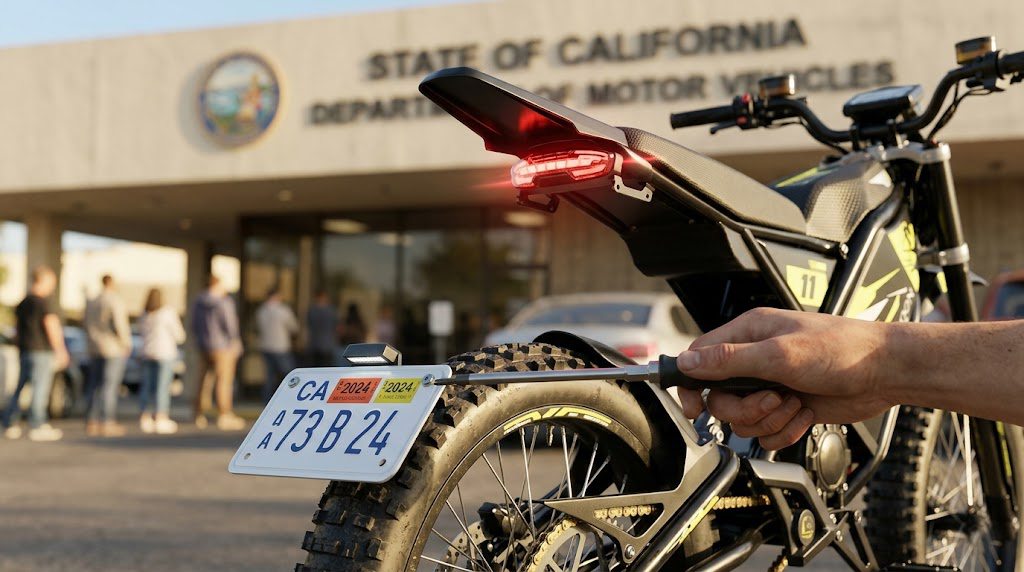
By Seemoon E-Mobility Experts | 10+ Years of Industry Experience | Updated: June 2026
Imagine this: on a Saturday morning, you're riding your motorcycle along a dusty mountain road, adrenaline surging through your veins. After your ride, instead of hauling the heavy electric scooter to a trailer, you simply ride onto a public road and ride straight home.
This seamless transition is the ultimate dream for many riders. However, the reality of strict traffic laws, complex Department of Motor Vehicles (DMV) registration processes, and Department of Transportation (DOT) standards often stands in the way.
In this comprehensive guide, we will break down exactly what defines a street legal electric dirt bike, the essential modifications required, the hidden risks of riding an illegal bike, and how to choose the smartest, hassle-free option.
Key Takeaways
-
A street legal electric dirt bike must comply with strict DOT standards, including lighting, mirrors, and tires, to ride on public roads.
-
The biggest hurdle in converting an off-road bike is obtaining a federally recognized 17-digit VIN (Vehicle Identification Number).
-
Riding illegally can result in vehicle impoundment, massive fines, and zero insurance coverage in the event of an accident.
-
Factory road-ready options, purchase a legally road-legal electric off-road motorcycle, which eliminate DIY headaches by providing all legal hardware and proper DMV documentation straight out of the box.
What Exactly is a Street Legal Electric Dirt Bike?
Electric dirt bike that are legally driven on roads have been officially classified as motorized two-wheeled vehicles that fully complies with public road safety standards—specifically the Federal Motor Vehicle Safety Standards (FMVSS) set by the NHTSA, alongside your local state regulations.
Unlike traditional off-road models (classified as Off-Highway Vehicles, or OHVs), a street-legal version bridges the gap between an aggressive dirt trail machine and a safe urban commuter motorcycle. It possesses the necessary safety equipment, a valid manufacturer-issued 17-digit VIN, and proper documentation (like a Manufacturer's Certificate of Origin, or MCO) required to be registered, plated, and insured for public highways.
The Ultimate Checklist: Essential DOT Requirements
To legally ride on public roads, your electric motorcycle must meet the required accessories and motorcycle information as specified by federal and local regulations.
If you are evaluating whether your existing off-road electric bike is legal for public use, here is the technical hardware you must have:
1. Comprehensive Lighting System
A flashlight taped to your handlebars will not pass inspection. You must have a DOT-approved headlight with distinct high and low beam functions. Furthermore, you need a red taillight that remains illuminated while riding, functional brake lights that activate with both the front and rear brake levers, and amber turn signals on both the front and rear.
2. Rearview Mirrors
Visibility is a matter of life and death on the road. Most states require at least one left-side rearview mirror. However, for maximum safety and to comply with stricter states, dual mirrors (left and right) are highly recommended to eliminate blind spots.
3. DOT-Approved Dual-Sport Tires
Standard "knobby" dirt tires are explicitly illegal on the street for good reason. They lack sufficient surface contact area, which drastically reduces your braking power on wet asphalt and causes them to wear out in a matter of days. You must equip DOT-approved dual-sport tires.
4. Electric Horn
A standard bicycle bell is useless against the soundproofing of modern cars. The law requires an electronic horn that produces a decibel level loud enough to warn drivers in heavy traffic.
5. A Valid 17-Digit VIN (The Dealbreaker)
This is where 90% of DIY conversions fail. Without a federally recognized 17-digit VIN stamped directly onto the metal frame, the DMV computer system literally cannot register your vehicle.
How to Get Your Electric Dirt Bike Certified for Public Roads
If you are trying to convert an existing off-road bike, you are in for a bureaucratic journey. Here is the standard roadmap to achieving street legality:
-
Assess and Upgrade Your Hardware: Audit your current setup against the checklist above. Purchase a high-quality "Street Legal Kit" and wire it into your bike's electrical system. Swap your off-road tires for DOT-certified rubber.
-
Verify State-Specific DMV Regulations: Motorcycle laws vary wildly. For instance, Texas is relatively lenient with inspections, while California (under the CARB and strict DMV guidelines) heavily scrutinizes converted off-road vehicles. Always check your local DMV website for specific inspection criteria before leaving the house.
-
Gather Your Documentation: You will need your bill of sale, the original MCO, and proof of insurance. If your bike lacks a standard VIN, you may have to apply for an "Assembled Vehicle" title, which often involves a state highway patrol inspection.
-
Register and Insure: Once you pass the visual inspection and your paperwork is approved, you will pay the registration fees, receive your license plate, and officially be street legal.
The Hidden Risks of Riding an Illegal Dirt Bike on Public Roads
It might be tempting to risk a quick ride down the street on your non-compliant bike, but the consequences can be devastating:
-
Severe Safety Hazards: Without turn signals or brake lights, you are unpredictable to distracted drivers. This exponentially increases the risk of rear-end collisions.
-
Financial Ruin in Accidents: Because illegal bikes cannot be officially insured for street use, any property damage or bodily injury caused in an accident will come entirely out of your own pocket.
-
Vehicle Impoundment: Police officers have the authority to tow and confiscate unregistered, unplated off-road vehicles on the spot, leaving you stranded and out of thousands of dollars.
DIY Conversion vs. Buying a Street-legal Electric Dirt Bike
Is it worthwhile to convert an existing motorcycle into a road-legal one compared to simply buying a new, street-legal electric motocross bike? Let's look at the data.
| Evaluation Metric | DIY Conversion (Modifying an Off-Road Bike) | (Factory Street Legal) |
| Financial Cost | Requires buying expensive lighting kits and DOT tires (Approx. $400 - $900) | Zero extra cost. Comes fully equipped out of the box. |
| Time & Effort | Days of rewiring, splicing, and navigating failed DMV inspections. | Effortless. Take the included MCO and VIN directly to the DMV. |
| Registration Success | High risk of rejection by strict state DMVs. | Guaranteed. Engineered with a standard, legally recognized VIN. |
| Warranty Security | Splicing electrical wires for aftermarket lights often voids the battery warranty. | Fully protected. comprehensive factory warranty. |
Why are street legal electric dirt bike your ideal riding companion?
Instead of spending weeks dealing with wiring harnesses and DMV staff, why not just buy an electric off-road motorcycle that's fully compliant with road regulations right out of the box and ride your dream bike the same day?
Out-of-the-Box Readiness
There is no need to hunt for aftermarket parts. The Road-legal electric motocross motorcycles comes standard with ultra-bright LED headlights, responsive brake lights, DOT-approved turn signals, dual mirrors, and a loud electric horn.
All-Terrain Dominance
Road-legal electric motocross motorcycles are typically equipped with DOT-certified high-performance dual-purpose tires, which provide excellent grip on loose dirt roads while rolling smoothly and safely on city streets.
“I bought a road-legal electric motocross motorcycle so I could ride it on public roads to nearby off-road trails without having to transport it by truck. I took the documents that came with the motorcycle to the Texas DMV, got the license plate in 15 minutes, and was on the road. These road-legal electric motorcycles combine the power of a gasoline-powered motorcycle, so they perform exceptionally well on highways.” —Mark T, Austin, Texas

Hassle-Free Registration
All legally road-legal electric off-road motorcycles bear a compliant 17-digit Vehicle Identification Number (VIN) and are accompanied by a clear Certificate of Origin (MCO). Registration is very simple.
Conclusion
Converting an illegal motocross motorcycle into a legal electric motocross bike is a complex and expensive process. Not only do you need to buy expensive modification kits, but you also have to hope it passes the DMV inspection—it's simply not worth it.
Instead of going through the trouble of modification, choose a vehicle designed specifically for roadworthiness. A Street Legal Electric Dirt Bike perfectly combines the thrill of motocross with legal compliance. It allows you to experience true all-terrain freedom without constantly dodging police lights.
FAQ: Common Questions About Street Legal E-Bikes
Do I need a motorcycle license to ride a street legal electric dirt bike?
Yes. Because street legal electric dirt bikes can achieve high speeds and operate alongside cars, almost all US states classify them as motorcycles. You will need a valid driver's license with a Class M (Motorcycle) endorsement to operate them legally.
How fast can a street legal electric dirt bike go?
Speeds vary by model, but to safely merge with traffic, they need significant power. High-performance electric dirt bike are capable of achieving top speeds that allow riders to safely keep up with city traffic and suburban commuting.
Can I convert any off-road electric bike to be street legal?
No, you cannot. Even if you install all the required lights and mirrors, the deciding factor is the VIN. If your e-bike frame does not have a 17-digit VIN recognized by the federal government, or if the manufacturer labeled it "For Off-Road Use Only," most DMVs will outright reject your registration application.
Share:
The No-BS Electric Dirt Bike Guide: TOP 15 FAQs & Seemoon SM4Pro Unleashed
The Ultimate Guide to E-Bike Batteries: Everything You Need to Know in 2026