
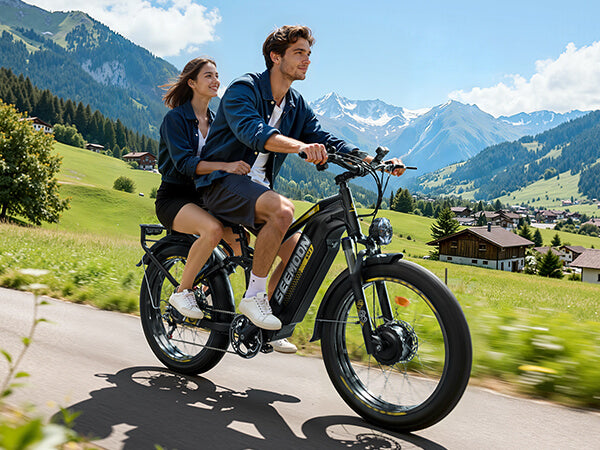
Picture this: You’ve just unboxed the Seemoon SM3. Backed by a robust 60V architecture and a massive 6000W peak powertrain, it effortlessly hits top speeds of 42–45 mph, setting a new benchmark in the high-performance e-bike category.
But as you throttle up to merge into traffic or approach your local greenway, that initial adrenaline rush often collides with a cold reality check: Where exactly am I legally allowed to ride this?
This is the elephant in the room for the hyper-bike community. Because it pushes well past the 28 mph limit of standard Class 3 e-bikes, the SM3 technically occupies a regulatory gray area, often blurring the line between a motorized bicycle and a moped under US law. While other manufacturers slap vague "street-legal" disclaimers on their products just to push inventory, Seemoon operates on Radical Transparency.
In this guide, we aren’t just flexing the SM3’s speed. We’re giving you a definitive breakdown of how to navigate the complex US legal framework for out-of-class e-bikes. You’ll learn exactly how to leverage your display's hidden P-Settings to electronically govern your motor for trail compliance, the best practices to follow if you are pulled over by law enforcement, and how to lock down your high-value asset using our proprietary Triple Security System.
1. The Legal Reality: Seemoon SM3 vs. U.S. E-Bike Classification
Navigating the legal landscape of electric mobility requires a granular understanding of the Three-Class System—the regulatory framework managed by PeopleForBikes and codified in DMV statutes across the majority of U.S. states. To ensure you remain compliant and protected, we have audited the SM3’s specifications against these federal and state-level standards.
The Compliance Matrix: Engineering vs. Regulation
The table below contrasts the legal thresholds of standard e-bikes against the SM3’s high-performance powertrain architecture.
| Specification | Class 1 E-Bike | Class 2 E-Bike | Class 3 E-Bike | Seemoon SM3 |
| Max Peak Power | 750W | 750W | 750W | 6000W |
| Top Speed | 20 mph | 20 mph | 28 mph | 42-45 mph |
| Drive Activation | Pedal Assist (PAS) | Throttle & PAS | Pedal Assist (PAS) | Throttle & PAS |
| Legal Status | Electric Bicycle | Electric Bicycle | Electric Bicycle | Electric Bicycle |
The Verdict: Navigating the "Out-of-Class" Frontier
Technically and mechanically, the Seemoon SM3 transcends standard e-bike definitions. While the consumer market is largely capped at the 750W nominal limit to maintain "bicycle" status, the SM3 utilizes a high-torque 60V architecture capable of massive power spikes.
This performance profile places the vehicle in a specialized category known as Out-of-Class Electric Vehicles (OCEV). It is less of a traditional bicycle and more of a "silent scrambler" or lightweight electric motorbike.
Public Road & Urban Implications
In highly regulated jurisdictions—notably California (AB 1096), New York, and Texas—the SM3’s output typically reclassifies it as a Motor-Driven Cycle or Moped.
-
Licensing & Registration: To operate on public asphalt, you may be required to obtain an M1/M2 endorsement, vehicle registration, and specialized insurance.
-
Safety Standards: Local ordinances often mandate DOT-approved helmets (rather than standard bicycle foam) for any vehicle capable of exceeding 28 mph.
-
Access Restrictions: Be aware that "Out-of-Class" power levels often prohibit use on dedicated multi-use paths or paved bike lanes.
Off-Road & Backcountry Dominance
Where the SM3 truly thrives is in the "Grey Zone": private property and OHV (Off-Highway Vehicle) trails. Because it is not tethered by the 750W restriction, the SM3 is a purpose-built tool for:
-
High-Gradient Ascents: Effortlessly navigating steep, technical inclines that would overheat or stall a standard mid-drive or 750W hub motor.
-
Utility & Stewardship: An ideal platform for hunting, ranching, and large-scale property management where DMV restrictions do not apply.
Instantaneous Torque: Leveraging its 60V system for maximum "out-of-the-hole" acceleration, crucial for clearing obstacles in backcountry environments.

2. The "Stealth" Solution: Mastering P08 for Tactical Compliance
While most e-bike enthusiasts obsess over peak wattage and raw torque, seasoned riders understand that discretion is a high-performance feature. The SM3 is an engineering marvel capable of a blistering 45 mph top speed, yet the hallmark of a professional rider is knowing when—and where—to deploy that power.
The SM3’s programmable LCD serves as your onboard ECU (Electronic Control Unit), providing a sophisticated interface to "gate" your motor’s output electronically. By mastering the P08 parameter, you can transform a high-speed disruptor into a street-legal commuter in seconds. This allows you to maintain strict compliance on regulated urban bike paths before unlocking the bike's full kinetic potential on private trails.
Engineering Your Limits: The P08 Speed Governor Tutorial
The SM3’s open-architecture firmware empowers riders to toggle performance profiles on the fly. Whether you’re navigating strict municipal codes or optimizing battery range, here is how to recalibrate your speed ceiling with surgical precision:
-
Initialize the Interface: When the vehicle is started or parked and the instrument panel is functioning normally, press and hold the (+) and (-) buttons simultaneously for 3 seconds to enter the settings interface. The settings code will be displayed in the medium speed range.
-
Navigate to P08: A short press of the power button switches the function level value. Use the (+) and (-) keys to adjust the function level to the value P08. In the controller logic of SM3, this value usually represents the upper limit of the total output speed of the motor.
-
Calibrate Your Performance Profile:
-
Class 2 Simulation (Street Legal): When the value is 25, the maximum speed limit is 25 km/h (≈16 mph). This is the regulatory "sweet spot" for most US multi-use paths and urban infrastructure.
-
Class 3 Simulation (Commuter Pro): When the value is 32, the maximum speed limit is 32 km/h (≈20 mph). This aligns with high-speed commuter regulations, offering a balance of velocity and legality for road-adjacent cycling lanes.
-
Off-Road Unleashed: Restoring the parameter value to any value between 33 and 100 indicates no speed limit, allowing the use of the SM3's native 42-45 mph extra speed.
-
-
Commit to Memory: Then, press and hold the (+) and (-) keys simultaneously for 3 seconds to manually save the settings, or wait 8 seconds for automatic saving. All gear positions and numerical changes will be displayed in real time on the digital display in the lower left corner. If no operation is performed in the settings interface for 8 consecutive seconds, the system will automatically exit the settings interface.
Pro-Tip: Always perform a "Static Lift Test" after reconfiguring. Elevate the rear drive wheel and engage the throttle to verify the new RPM limit before you put rubber to the pavement.
3. Navigating the "Grey Area": A Strategic Moped Registration Guide
If you find yourself consistently pushing the Seemoon SM3 to its performance ceiling, you’ve likely realized it occupies a unique "grey area" in the micro-mobility landscape. With its high-torque output and sustained top-end speeds, the SM3 transcends the typical "e-bike" label.
For the serious commuter, transitioning from a Class 3 e-bike designation to a formal Moped (or Motor-Driven Cycle) registration is a high-leverage move. By securing a license plate, you shift from a "sidewalk intruder" to a legitimate road user. This move effectively eliminates the ambiguity of local ordinances, granting you full right-of-way access and robust legal protection within the flow of traffic.
Why the SM3 is "Street-Ready" by Design
Unlike DIY e-bike builds that often fail DMV inspections due to substandard wiring or lack of safety redundancies, the SM3 is engineered with a vehicular-grade hardware suite. It features:
-
Integrated Lighting: High-lumen headlamps and reactive brake lights.
-
Acoustic Signaling: An integrated horn meeting decibel requirements for urban environments.
-
Peripheral Awareness: Standard-issue rearview mirrors.
These specs ensure the SM3 meets the physical hardware requirements for most state-level moped classifications "out of the box."

The Registration Roadmap: A Technical Checklist
While DMV regulations are localized (e.g., California’s M2 requirement vs. New York’s Class B Limited Use Motorcycle), the path to legitimacy generally follows this technical framework:
-
Audit the VIN/Serial Number: Locate the unique identifier stamped into the head tube (the forward-most structural component of the frame). Ensure this is legible and documented; this is the primary reference for your vehicle title and state database.
-
Secure the MCO (Manufacturer’s Certificate of Origin): Think of this as your bike’s "Birth Certificate." It proves the vehicle's provenance and provides the DMV clerk with the necessary data on motor wattage and maximum design speed.
-
File the "Motor-Driven Cycle" Application: Download the specific form for mopeds or low-speed motorcycles from your state’s DMV portal. Be prepared to provide the SM3’s curb weight, wheel diameter, and propulsion type (Electric).
-
Acquire Specialty Liability Insurance: One of the most overlooked perks of moped registration is the low barrier to entry. Moped-specific liability and theft coverage is remarkably affordable—often under $100 per year. This provides a layer of financial protection that standard e-bike warranties and homeowners' insurance simply cannot match.
-
Mount the Plate: Once approved, install your plate on the rear rack. In an urban environment, this small piece of aluminum serves as your definitive "hall pass," signaling to law enforcement that you are a compliant, insured, and regulated operator.
Pro Tip: In many jurisdictions, registering as a moped removes the "28 mph" software ceiling imposed on Class 3 e-bikes. This allows you to legally pace with city traffic, significantly increasing your safety by reducing the "speed differential" between you and surrounding passenger vehicles.
Summary of Benefits
| Feature | Class 3 E-Bike | Registered Moped |
| Top Speed | Limited to 28 mph | Dictated by Motor/Flow of Traffic |
| Road Rights | Restricted in some lanes | Full Motor Vehicle Status |
| Insurance | Often excluded from policies | Dedicated, affordable liability |
| Legal Clarity | Subject to local bike bans | Protected by State Vehicle Code |
4. Scenario Guide: What to Do If You Get Stopped
So, you are riding your SM3 and you see blue lights in your rearview mirror. Don't panic. Here is a scenario guide based on real-world rider experiences. As a car owner, please remember this important rule. The Golden Rule: Attitude is everything. Most officers stop e-bikers because they are riding recklessly, not just because of the bike.
-
Stop Immediately & Safely: Pull over to a safe spot.
-
Be Honest: If asked "How fast does this go?", do not lie. You can say, "It is capable of higher speeds for off-road use, but I have it electronically limited to [20/28] mph for street use right now."
-
Show, Don't Just Tell: Offer to show them the display settings (P08) that cap your speed. Demonstrating that you have proactively limited the bike shows responsibility.
-
Highlight Your Safety Gear: If you are wearing a full-face helmet and high-visibility gear, and using your turn signals, officers are far more likely to view you as a responsible commuter rather than a nuisance.
5. Advanced Security Protocols: Safeguarding Your High-Performance Investment
The SM3 isn’t just an electric bike; it’s a high-performance machine with a power profile that demands respect. With its 6000W output, this bike is a high-value asset that requires a multi-layered defense strategy. To mitigate the risk of theft and ensure operational safety, we’ve engineered the SM3 with a Triple-Tier Security System.
Follow this professional protocol to harden your bike against unauthorized use and theft.
1. The Integrated Throttle Deadbolt (Safety & Immobilization)
Unlike standard e-bikes, the SM3 features a physical Key-Operated Throttle Lock. This serves as your first line of defense against both accidental discharge and opportunistic tampering.
-
The Technical Risk: The SM3’s powertrain generates a massive 200 Nm of peak torque. In a "live-parked" state (system powered on), a bystander or child accidentally twisting the grip can cause a violent "whiskey throttle" incident, launching the 107 lb bike forward instantly.
-
The Protocol: Whenever the bike is stationary, engage the handlebar key lock. This creates a physical break in the signal path between the hall-effect sensor and the controller. Even with the display active, the drivetrain remains inert, providing peace of mind in high-traffic public spaces.
2. High-Capacity Battery Integration & Extraction
The 60V 30Ah Lithium-ion power cell is the "heart" of the SM3 and its most valuable component. Protecting it requires both mechanical diligence and strategic removal.
-
The "Click" Verification: The battery is secured via a heavy-duty internal deadbolt. When sliding the pack into the 6061 Aluminum frame, apply firm pressure until you hear an audible mechanical click. This confirms the locking pin is fully seated within the battery casing.
-
Strategic Depowering: For extended stops (30+ minutes), we recommend a "Battery-Out" policy. Removing the battery serves two purposes: it significantly reduces the bike's curb weight for your own transport, but more importantly, it renders the SM3 electrically bricked. A 6000W e-bike without its proprietary power source has near-zero resale value on the black market.
3. Frame-Anchored Physical Security
While the SM3’s 107 lb (48.5 kg) weight acts as a natural deterrent against "grab-and-go" thefts, professional thieves often use vans to bypass heavy locks.
-
Primary Anchor Point: Always secure your bike to a permanent, immovable structure (like a cemented steel bollard). Ensure your primary heavy-duty chain or U-lock passes through the main triangle of the 6061 Aluminum Alloy frame.
-
The "Wheel-Only" Trap: Never lock the bike solely by the wheels. Modern quick-release or bolt-on hubs can be bypassed in seconds, leaving you with a locked wheel and a missing bike.
Redundant Locking: Use the included SM3 factory lock as a secondary deterrent. Apply it to the rear hub to prevent the bike from being rolled, even if a thief manages to cut your primary chain.
Pro Tip: For maximum GEO-specific security in high-theft urban corridors (like San Francisco, NYC, or London), consider hiding a GPS tracker or AirTag within the frame’s internal cable routing channels for real-time recovery capabilities.
7. FAQ: Legal & Safety Edition
Q: Can I ride the SM3 on the sidewalk?
A: Absolutely not. With a weight of 107 lbs and high power, riding on the sidewalk is dangerous to pedestrians and illegal in almost every jurisdiction. Stick to the road or bike lanes where permitted.
Q: Does the SM3 come with a title?
A: E-bikes typically do not come with a DMV title like a car. However, you can use the bike's serial number and your bill of sale for registration in states that allow Moped registration.
Q: Is the throttle lock mandatory to use?
A: No, the bike runs without locking it. However, we highly recommend engaging the Turn Handle Lock every time you dismount to prevent accidental acceleration.
Q: Is the bike waterproof?
A: The SM3 is rated IP54. This means it is resistant to water splashes and dust (rain is fine), but it is not waterproof. Do not submerge the bike or use a high-pressure washer on the electrical components.
Conclusion: Responsibility Equals Freedom
The Seemoon SM3 blurs the lines between traditional bicycles and high-performance motorcycles. While its powerful performance is exciting, the key to truly mastering this machine lies in responsible operation and adherence to relevant regulations.
-
Understand the local laws and regulations: First, you need a clear understanding of the U.S. e-bike three-tier classification system. Second, you need to understand the specific e-bike regulations in your state. Of course, using the P08 speed limiter will allow you to transform the SM3, this high-speed beast, into a law-abiding scooter, ensuring you ride within the legal boundaries of local bike lanes.
-
Ride Legal: If you plan to use your SM3, with its top speed of 45 mph, for commuting, then your vehicle actually falls into the moped/motorized bicycle category. We strongly recommend that you check your state's Department of Motor Vehicles requirements regarding registration, vehicle identification number verification, and the M-class license required for high-speed driving. This will not only ensure compliance with regulations but also allow you to experience the beastly speed of 45 mph.
-
Secure It: The SM3's high torque output requires users to develop a "safety first" habit. Always lock the accelerator immediately after exiting the vehicle. This prevents accidental acceleration—a significant risk for high-power in-wheel motors—and also serves as an effective anti-theft measure.
By understanding and complying with the above information and code of conduct, you can enjoy the thrill of the SM3 without the legal headaches.
[Explore The SM3 All Terrain & Fat Tire E-bike Product Page Now]
[ Ready to see the specs? Check out our Ultimate Guide to Fat Tire Electric Bikes]
Share:
The Ultimate Guide to Fat Tire Electric Bikes: Why You Need a 60V High-Performance Beast in 2026
Under the Hood: The Engineering Science Behind the SM3's 6000W Peak Power