
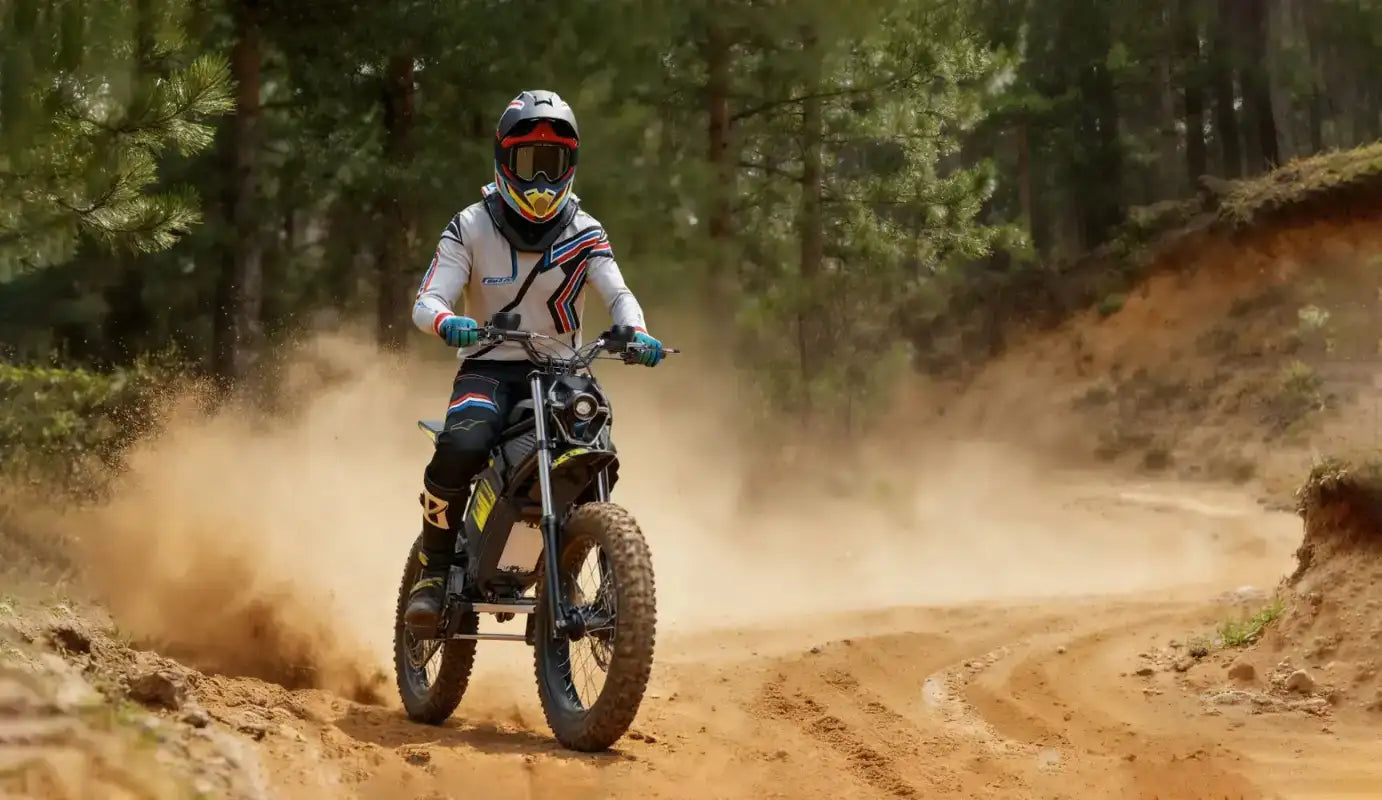
Reshaping Perceptions: The "Mini" Revolution in the US Powersports Market
Currently, the US powersports market suffers from a significant cognitive lag in the perception of "Adult Electric Mini Motorcycle." Most consumers still equate them with children's toys in large stores or the poorly made, low-performance Small gasoline-powered motorcycles of the 2000s. However, a technological paradigm shift has quietly rewritten the rules. We have officially entered the era of the performance-grade adult electric mini-moto.
Modern platforms have moved far beyond the backyard; they are sophisticated machines integrating high-torque brushless motors, precision-engineered hydraulic braking systems, and high-density Lithium-ion (Li-ion) battery architecture. These bikes are dual-purpose by design, offering the agility needed for urban lane-filtering and the structural integrity required for rugged off-road exploration.
Crucially, they occupy the vital "Mid-Tier" gap in the market—bridging the chasm between $500 disposable leisure vehicles and $4,500+ professional-grade competition bikes.
Inside This Comprehensive Guide:
-
The Hardware Core: An engineering breakdown of the components that separate "pro-sumer" mini-bikes from entry-level toys.
-
Regulatory Navigation: A deep dive into U.S. street-legality, deciphering the complexities between Class 2 e-bike standards and off-road VIN requirements.
-
The Industry Benchmark: How the SM4 Scrambler is single-handedly redefining the torque-to-weight ratio and long-term reliability in the micro-mobility secto
Part 1: Defining the "Adult Mini" Category
The "Adult Mini" Standard: Why Your Choice of Rating Defines Vehicle Integrity
In the burgeoning electric mini-moto market, the line between a precision-engineered machine and a disposable toy is often blurred by flashy fairings. For the discerning rider, the most reliable metric for build quality isn't the price tag—it’s the manufacturer’s age certification.
The "12+" Trap: Avoiding Plastic Internals
Many entry-level models carry a "Ages 12+" label. While enticing for younger enthusiasts, this classification is often a technical red flag. To meet toy-grade price points, these units frequently utilize thermoplastic gear sets and light-duty bushings in the transmission. Under the thermal stress of sustained adult riding, these components are prone to catastrophic deformation and premature failure.
The "16+" Benchmark: Professional Grade Mechanicals
Professional-grade platforms, such as the SM4, are explicitly labeled with a 16+ Age Requirement. This isn't merely a legal disclaimer for public road use; it is a testament to the vehicle’s structural DNA. A 16+ rating signals that you are investing in:
-
All-Metal Drivetrains: Hardened steel gearing designed for high-torque duty cycles.
-
Automotive-Grade Chassis: Frame geometry and welds capable of handling adult weight distribution at speed.
-
Long-Term Serviceability: Components designed to be maintained, not discarded.
Why are there age restrictions for riders of mini electric motorcycles? Because the power-to-weight ratio of the vehicles is too high:
- Peak Power: The SM4 pushes 2000W of peak output.
- Torque: It delivers a massive 170Nm of torque.
- Voltage: It runs on a high-voltage 48V system.

To better understand this 170 Nm of torque, let's use a reference point: a standard 650cc gasoline motorcycle typically has a peak torque of only 60-70 Nm. Yes, the torque calculation logic for electric motorcycles is different (acting directly on the wheels), but the difference in driving experience brought by the SM4 is revolutionary. Thanks to the characteristics of the electric motor, it reaches its peak immediately from a standstill, with no power lag. This means that the SM4 is a true adult vehicle with climbing ability; its mechanical qualities determine that it belongs in the wild and in mountains, not in children's backyard.
Internal Link: Wondering if this power is too much for you? Read our deep dive: [Cluster 1: Mini Electric Dirt Bikes for Adults – Sizing & Power Guide]
Part 2:Balancing Ultra-Portability and Rider Ergonomics: The Modern Mini-Moto Dilemma
How do you strike the perfect balance between ultra-portable design and all-day riding comfort? For most adults, the primary grievance with "mini motos" isn't power—it's ergonomics. No rider wants their knees hitting the handlebars or their spine cramped after a ten-minute commute.
However, the industry's traditional fix—simply Simply reduce the frame size—is a non-starter for those who value the agility and "trunk-friendly" convenience of a compact bike. To define a true adult-spec modern mini-moto, we must look beyond aesthetics and focus on three critical engineering benchmarks.
1. The "Active-Stance" Seat Height
For riders standing 5’5” or taller, a seat height below 26 inches creates a cramped, unsustainable posture. Engineering the SM4 with a 30.5-inch seat height was a deliberate choice to shift the rider into an "active" ergonomic triangle—similar to a high-end mountain bike but with the mechanical leverage of a motor.
2. Structural Integrity & Payload Capacity
Many entry-level electric bikes are rated for 150 lbs, effectively classifying them as youth models. A robust, adult-oriented electric mini-moto must account for the rider plus gear (backpacks, locks, or groceries).
The SM4 utilizes a high-tensile reinforced frame capable of a 330 lb maximum payload. Achieving this level of structural integrity while maintaining a curb weight of just 158 lbs is a feat of material efficiency, ensuring the bike remains nimble without compromising on long-term durability.
3. The 17-Inch Wheel Dominance: Gyroscopic Stability
Wheel diameter is the most overlooked factor in ride quality. Where traditional scooters rely on twitchy 10-inch tires and pit bikes often stop at 14 inches, the SM4 utilizes 17-inch wheels (2.47 x 17).
From a physics standpoint, the larger diameter significantly increases gyroscopic stability. At its top speed of 28 mph, the SM4 feels planted and predictable. Furthermore, the increased "angle of attack" allows the 17-inch wheels to roll over potholes and urban obstacles that would typically unsettle a smaller-wheeled vehicle, providing a much higher safety margin for the everyday rider.

Part 3: The Torque War (Watts are Vanity, Torque is Sanity)
Many riders fall into the "power trap" when choosing an electric motorcycle. While peak power determines your top speed, torque determines whether you coast slowly or accelerate rapidly. Most entry-level to mid-range competitors on the market currently use motors with a torque ceiling of 80-120 Nm. On paper, they seem good; however, in actual riding, these motorcycles often feel underpowered when facing steep inclines or complex terrain.
SM4's Advantage: Dominating its Price Range
The standard SM4 breaks class leadership with a peak torque of 170 Nm. This is not just a number, but a performance philosophy. Seemoon engineers have fine-tuned the SM4 in multiple ways, enabling its power output to be instantaneous. By optimizing the low-twist line, the SM4 achieves "zero-delay" throttle response. Whether weaving through city traffic or tackling a 30-degree incline, acceleration is rapid, exhilarating, and continuous.
The Silent Hero: High-Discharge Battery Architecture
You cannot have massive torque without the "juice" to back it up. Torque is a byproduct of amperage, and drawing that much current requires a battery that won't sag under pressure.
-
The Powerhouse: The SM4 is equipped with a high-capacity 48V 28Ah Lithium-ion battery. * Capacity Matters: In a segment where 15–20Ah is the norm, our 28Ah configuration provides the necessary headroom for high-current discharge without compromising cell longevity.
-
Real-World Range: Leveraging this high energy density, the SM4 delivers an estimated 50–100 miles of range.
Pro Tip: In the Electric Motorcycle world, range is a sliding scale. If you’re heavy on the "whisky throttle" to enjoy that 170 Nm of torque, expect to land on the lower end of that estimate. If you’re cruising efficiently, the 100-mile mark is well within reach.

See how electric torque compares to gas engines in our showdown: [Cluster 2: Electric Mini Dirt Bike vs. Gas – The Torque War]
Part 4: The Digital Cockpit & Safety Systems
In the world of electric mini-motorcycles, the line between a "toy" and a high-performance "machine" is defined by its telemetry. While entry-level bikes often rely on vague LED "fuel" bars that sag under load (voltage dip), professional-grade electric motorcycles utilize sophisticated digital interfaces to provide actionable, real-time data.
Advanced Instrumentation & Telemetry
Moving beyond rudimentary indicator lights, the SM4 features a high-contrast digital dashboard engineered for maximum legibility even in direct sunlight. This isn't just an aesthetic upgrade; it’s a data-driven command center designed for the serious rider.
-
Precision Speedometry: Configurable for both km/h and mph to ensure compliance with regional road standards and rider preference.
-
Dual-Logic Odometer Tracking:
-
ODO (Total Mileage): Vital for monitoring the duty cycles of the brushless motor and battery health over the vehicle's long-term service life.
-
TRIP Meter: A critical tool for benchmarking real-world range performance and eliminating "range anxiety" during long-distance commutes.
-
-
Dynamic Power Management: Unlike basic displays that provide a mere estimate, the SM4 provides real-time voltage feedback. This allows riders to monitor current draw and adjust their riding style for maximum efficiency, ensuring every watt is accounted for.
Why This Matters for Your Ride
This level of telemetry is essential for riders who treat their SM4 as a primary commuter tool rather than a weekend hobby. By understanding the relationship between throttle input and voltage sag, you can optimize your battery's Depth of Discharge (DoD), effectively extending the overall lifespan of your power cells.
Safety Engineering: The Brake Power Cut-Off System
When you’re managing an electric motor capable of $170\text{Nm}$ of instantaneous torque, safety systems must be proactive, not reactive. The SM4 utilizes an integrated Brake Power Cut Protection system. This electronic failsafe is hardwired into the hydraulic brake levers. The moment the sensors detect engagement—front or rear—the system sends a kill signal to the controller, instantly neutralizing motor output.
Expert Insight: This is a vital defense against "whiskey throttle," a common phenomenon where a rider inadvertently twists the throttle while braking in a panic. By prioritizing the brake signal over the throttle input, the SM4 ensures the machine remains under control even in high-stress scenarios.
Compliance & Ownership: The VIN Standard
Professional-grade electric motorcycles require a paper trail. Unlike unbranded imports, every SM4 is stamped with a unique Vehicle Identification Number (VIN) on the right side of the seatpost. This 17-digit identifier serves as the bike’s legal fingerprint. In the US market, a VIN is the "Golden Ticket" for:
-
Asset Protection: Registering the bike in your name to deter theft.
-
Insurance Eligibility: Most major carriers require a VIN to issue a comprehensive or liability policy.
-
Resale Value: A verified VIN provides a transparent vehicle history, significantly increasing the bike's secondary market value.
Part 5: Street Legality & The Dual-Sport Reality
Can you legally ride these bikes on the street? In the United States, the answer is a nuanced "yes," but it depends entirely on your vehicle’s configuration and the specific jurisdictional laws of your state.
Decoding the "Class 2" Framework
To navigate city streets and bike lanes legally, most states look for compliance with the Three-Tier E-Bike Classification System. Out of the box, the SM4 is engineered to meet Class 2 Standards:
-
The 20 mph Threshold: Many states permit e-bikes on designated paths provided they are electronically limited to a top speed of 20 mph.
-
Throttle Logic: As a Class 2 vehicle, the SM4 utilizes a functional throttle, making it accessible to riders who want power without constant pedaling.
-
Manual Precision: Per the SM4 Operator’s Manual: "To maintain compliance in non-motorized zones, the vehicle must operate within the 20 mph limit to ensure the safety of all path users."
Unleashing "Beast Mode" (Off-Road Performance)
The SM4 is a true hybrid, featuring Dual-Power Profiles. When you transition from the pavement to private land or closed OHV (Off-Highway Vehicle) trails, you can unlock the full potential of the motor:
-
Peak Performance: In "Off-Road Mode," the SM4 can reach speeds of 28 mph and beyond, delivering aggressive torque curves for steep climbs.
-
The Legal Line: It is vital to remember that "Unlocking" the bike often reclassifies it as a Class 3 e-bike or a moped, which may require a driver’s license, registration, or insurance depending on your local DMV.
Street-Essential Hardware: Don’t Buy a "Naked" Bike
In a dense urban environment, conspicuity is safety. You should never settle for a "naked" off-road frame if you plan on commuting. The SM4 comes standard with a professional-grade safety suite designed for visibility:
-
High-Lumen Integrated Lighting: Features a high-output LED headlight and an active brake-responsive taillight. This isn't just for your vision—it’s so distracted drivers can’t miss you.
-
Full-Coverage Fenders: Engineered from high-impact polymers, these protect the rider and the electrical components from road debris and water spray.
-
Expansion Ready: The SM4 includes pre-wired points for mirrors and turn signals, allowing for easy "street-legal" conversions to meet stricter municipal codes.
Pro Tip: Before you pull the trigger on a new ride, make sure you aren't being fooled by "hidden" missing parts. Check our full breakdown here: [Part 4: Buyer’s Guide – 6 Hidden Specs to Verify]
Part 6: All-Weather Capability (IP54 Rating)
Scramblers are, by definition, built for the grit. If an electric bike lacks a verified Ingress Protection (IP) rating, it isn't a dual-sport machine—it’s a fair-weather commuter. The SM4 separates itself from the "indoor toys" by carrying a certified IP54 rating, ensuring that your off-road ambitions aren't sidelined by a bit of mud or a sudden downpour.
What IP54 Means for Your Ride
In the world of electrical engineering, the IP code is the gold standard for durability. For the SM4, this rating breaks down into two critical layers of defense:
-
Dust Protection (5): The first digit indicates that the SM4’s internal components are protected against harmful dust ingress. While not 100% airtight, it prevents enough particulate matter from entering to ensure the high-torque motor and controller operate at peak efficiency in arid, sandy environments.
-
Water Resistance (4): The second digit confirms protection against multidirectional water splashes. Whether it’s grit-heavy slush or high-velocity spray from a puddle, the SM4’s seals are designed to keep the high-voltage vitals dry.
Navigating the "Submarine Rule"
-
While the SM4 is engineered for the elements, it isn’t a U-boat. To maintain the integrity of your powertrain and battery longevity, we advocate for the Submarine Rule:Never submerge the hub motor or allow standing water to rise above the centerline of the rear axle. Maintaining water levels below the axle ensures that the atmospheric pressure doesn't force moisture past the motor's gaskets during prolonged exposure. Respect the limits of the hardware, and the SM4 will reward you with years of reliable, all-terrain performance
Part 7: Maintenance 101 (Wrenching vs. Riding)
One of the most compelling arguments for the transition from Internal Combustion Engines (ICE) to electric motor is the radical reduction in mechanical complexity. By eliminating carburetors, oil filters, and complex transmission systems, you can bypassed 80% of traditional garage headaches. However, "low maintenance" does not mean "no maintenance." To preserve the SM4’s high-torque output and ensure chassis longevity, you must stay ahead of the wear-and-tear on your moving parts.
The SM4 Preventative Maintenance Schedule
To keep your SM4 performing at peak efficiency, treat these three checkpoints as non-negotiable:
1. Drivetrain Integrity: Chain Tension & Alignment
The SM4 delivers instantaneous torque, which puts significantly more stress on the drive chain than a standard gas bike.
-
The Schedule: Inspect every 350 miles.
-
The Spec: Aim for 2–6 mm of slack.
-
Pro Tip: An over-tightened chain increases friction and saps battery range, while a loose chain risks "jumping" the sprocket under heavy acceleration. Always lubricate with a high-quality wax-based lube to prevent grit buildup.
2. Rolling Resistance: Precision Tire Pressures
Electric bike range is hyper-sensitive to rolling resistance. Even a slight drop in PSI can lead to "range anxiety" and sluggish handling.
-
The Spec: Maintain 33 PSI (230 kPa ±10) for both front and rear tires.
-
The Benefit: Proper inflation ensures a consistent contact patch, protecting your rims from pinch flats during off-road excursions and maximizing your miles-per-charge.
3. Structural Security: Critical Torque Specs
Electric motors produce high-frequency vibrations that can, over time, back out even the most stubborn fasteners.
-
The Priority: Focus on the Front and Rear Axle Nuts.
-
The Spec: Use a calibrated torque wrench to hit 30 N.m (approx. 22 lb-ft).
-
The "Break-in" Rule: Perform your first bolt check after the first 50 miles of riding, then every 500 miles thereafter.
Expert Insight: Unlike gas bikes where you listen for "engine knocks," on an electric motorcycle, you listen for "chassis chatter." If you hear a new click or hum, it’s likely a loose bolt or a dry chain. Stay proactive, and the SM4 will stay silent.
Internal Link Opportunity: Get the full step-by-step maintenance guide here: [Cluster 5: Electric Mini Motorbike Maintenance & Assembly]
Conclusion
The market landscape in 2026 has undergone a dramatic transformation, Mini motorcycles are becoming increasingly popular. If you're looking for a versatile ride—one that combines the thrill of off-roading with the convenience of commuting, while also enjoying the quiet experience of an electric motor—the SM4 is undoubtedly the ideal choice. With an impressive 170 Nm of torque, an IP54 protection rating, and a load capacity of up to 330lb weight limit, it proves itself designed for high-intensity riding.
Keys in hand, ready to hit the road? Welcome to Seemoon to view more product details about the SM4 electric motorcycle and join the community of riders who have made the switch.
People Also Ask (FAQ)
Q: How fast does the SM4 electric mini motorcycle go?
A: The SM4 has a top speed of 28 mph. However, for street use in bike lanes, it should be kept under 20 mph to comply with standard regulations.
Q: Can I ride the SM4 in the rain?
A: Yes, the SM4 is rated IP54 waterproof. It handles rain and splashing well. However, never submerge the rear motor hub in deep water.
Q: How long does the battery last?
A: The 48V 28Ah battery offers a range of 50-100 miles. Factors like rider weight, terrain, and temperature will affect this. Charging takes 8-9 hours.
Q: Is it difficult to assemble?
A: The bike comes partially assembled. You will need to install components like the handlebars and front wheel. SEEMOON provides an Assembly Video accessible via QR code in the manual.
Legal Disclaimer
The information provided in this article regarding street legality (Class 2/3 e-bike laws) is for general informational purposes only and does not constitute legal advice. Electric vehicle laws vary significantly by state, county, and city. Always check your local DMV or transportation authority regulations before riding on public roads.
Share:
The Ultimate Guide to Electric Dirt Bikes for Adults (2026 Edition)
The Guide to Owning an Electric Motorcycle for Adults: Performance, Legality, and the Future of Commuting