
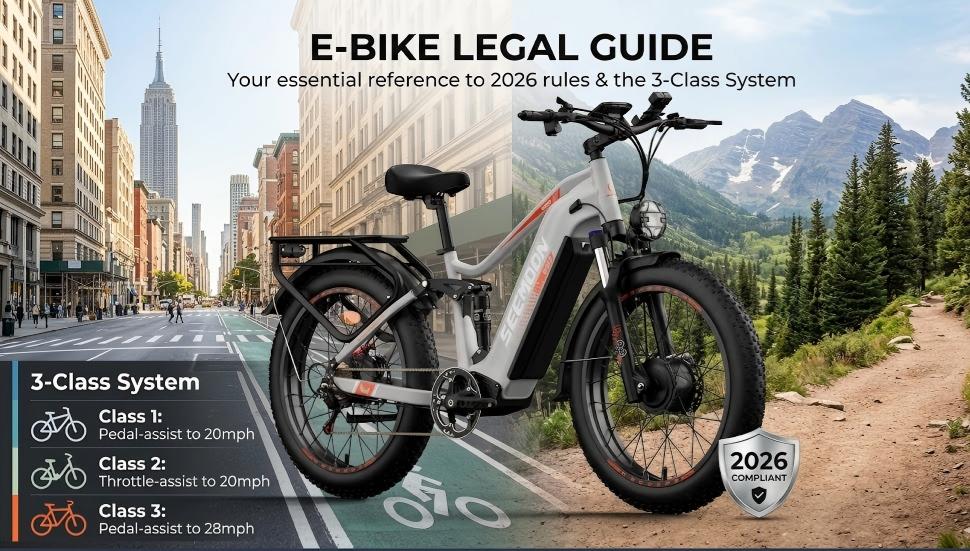
The electric bike boom is here. From the bustling streets of New York City to the scenic trails of Colorado, e-bikes have transformed how Americans commute and explore. But as the popularity of e-bikes has surged, so has the confusion surrounding the laws that govern them.
You might be asking: Do I need a license? Can I ride this on the sidewalk? Is my e-bike actually legal in my state?
These aren't just technical questions; they are the difference between a carefree ride and a hefty fine—or worse, having your bike impounded. The regulatory landscape in the United States is a patchwork of federal standards and state-specific traffic laws that can change when you cross a county line.
This comprehensive guide serves as your roadmap. Grounded in the latest federal standards from the Consumer Product Safety Commission (CPSC) and the widely adopted Three-Class System promoted by industry leaders like PeopleForBikes, we will demystify the regulations to keep you safe, compliant, and street-legal in 2026.
US Key Takeaways
-
The Three-Class System: Most states categorize e-bikes into Class 1 (Pedal-assist, 20mph), Class 2 (Throttle, 20mph), and Class 3 (Speed Pedelec, 28mph).
-
Federal vs. State: The Feds regulate the manufacturing (safety standards); your State regulates the riding (access, age, helmets).
-
The Sticker Rule: A permanently affixed label showing the class, wattage, and top speed is legally required on your bike frame.
-
No License Needed (Mostly): If your bike adheres to the 3-class definitions, you generally do not need a driver’s license, insurance, or registration.
-
Stay Away from "Out-of-Class" EVs: Unlocking your bike to exceed 28mph usually reclassifies it as an unregistered motor vehicle, which is illegal on public roads.
1. US E-Bike Laws Explained: Federal Manufacturing vs. State Operation
Navigating the legal landscape of electric bicycles in the United States requires understanding a crucial jurisdictional split. Simply put: there is a strict separation of powers between the agencies that regulate how an e-bike is built and the local authorities that govern how you ride it.
Here is how the hierarchy of e-law breaks down.
1. The Federal Level: Manufacturing Standards & The CPSC
At the federal level, the focus is entirely on consumer safety and product classification. Under the Consumer Product Safety Act (Public Law 107-319) , enacted in 2002, the federal government officially carved out a distinct category for "low-speed electric bicycles," legally separating them from motorcycles and mopeds.
For an e-bike to be classified as a consumer product rather than a motor vehicle, it must meet these specific federal criteria:
-
Wheel Count: It must have two or three wheels.
-
Human Power: It must feature fully operable pedals.
-
Power Output: The electric motor must operate at under 750 watts (roughly 1 horsepower).
-
Speed Limit: It must have a maximum speed of 20 mph on a paved, level surface when powered solely by the motor.
The Technical Takeaway: The Consumer Product Safety Commission (CPSC) dictates what can legally be imported and sold as an electric bicycle. If you purchase a two-wheeler with a 1500W motor, or one without functional pedals, the CPSC no longer views it as an e-bike. It officially crosses the threshold into motor vehicle territory and becomes subject to National Highway Traffic Safety Administration (NHTSA) and DOT regulations. This means it legally requires a VIN, a license plate, turn signals, and DOT-approved mirrors.
2. The State & Local Level: Rider Access & Operation
Think of the legal hierarchy like this: The federal government decides what is safe to sell, but your state and local governments decide where you can actually ride it.
Once the e-bike is out of the box, state laws and municipal codes take over. States manage "access and operation." Local authorities determine whether e-bikes are permitted in traditional bike lanes, if helmets are legally required, and if there are age restrictions for riders.
This local jurisdiction is exactly why e-bike access can feel fragmented. A Class 2 e-bike with a throttle might be perfectly legal on a paved multi-use path in Utah, but strictly prohibited on a local singletrack trail in Michigan. Furthermore, most US states have now adopted the industry-standard Three-Class System (Class 1, 2, and 3) to regulate where different types of e-bikes are allowed based on their top speed and whether they use a throttle or pure pedal-assist.
Before hitting the road or the trails, always check your specific state’s vehicle code and local municipal park guidelines.
2. Understanding the 3-Class E-Bike System: The U.S. National Standard
Navigating electric bicycle regulations can sometimes feel like the Wild West. However, to bridge the gap in federal consumer product laws, the bicycle industry—spearheaded by advocacy groups like PeopleForBikes—developed the standardized Three-Class System.
As of 2026, over 40 U.S. states (including major cycling hubs like California, Texas, Florida, and New York) have codified this framework into law. Knowing your e-bike’s specific classification is no longer just about technical specifications; it is the single most important factor in understanding your legal riding rights, infrastructure access, and local safety requirements.
Here is the definitive breakdown of how e-bikes are categorized in the United States:
Class 1: Pedal-Assist Only (Up to 20 mph)
-
The Technical Definition: The motor delivers power strictly in tandem with the rider's pedaling effort. Once the bike hits the 20 mph threshold, the electronic speed controller (ESC) automatically cuts motor assistance.
-
Mechanism: No throttle. Power delivery is managed by a Pedal Assist System (PAS) utilizing cadence or torque sensors, which measure your pedal stroke to provide a smooth, natural-feeling boost.
-
Where to Ride: Class 1 e-bikes enjoy the most universal access. Legally, they are treated almost exactly like traditional analog bicycles. You are typically cleared to ride them on dedicated bike paths, protected lanes, multi-use greenways, and most state or national park trails.
Class 2: Throttle-Assisted (Up to 20 mph)
-
The Technical Definition: Features a motor that can propel the bike entirely on its own—no pedaling required. Similar to Class 1, the motor’s governor strictly caps assistance at 20 mph.
-
Mechanism: Equipped with a thumb-push or half-twist throttle, alongside a standard PAS. Riders have the choice to "ghost pedal" or cruise purely on battery power.
-
Where to Ride: In the vast majority of U.S. jurisdictions, Class 2 shares the same on-road and paved-path access rights as Class 1. However, off-road access differs significantly. Because pure throttle use can lead to sudden torque spikes and accelerated trail erosion, Class 2 e-bikes are frequently restricted from unpaved singletrack trails. Pro-tip: Always verify local land management signage (like BLM or county park rules) before hitting the dirt.
Class 3: Speed Pedelec (Up to 28 mph)
-
The Technical Definition: Often referred to as "speed pedelecs," these high-performance e-bikes provide motor assistance up to a significantly faster 28 mph before the controller cuts the power.
-
Mechanism: Primarily PAS-driven to reach that top speed. Regulatory Nuance: While strictly pedal-assist in most definitions, some state legislations (like California's) allow Class 3 models to feature a throttle. However, the throttle itself must be electronically governed to cut off at 20 mph, requiring active pedaling to reach the 28 mph max. Most jurisdictions also mandate that Class 3 bikes be equipped with a digital speedometer.
-
Where to Ride: Due to their higher kinetic energy and closing speeds, Class 3 e-bikes face stricter regulations. They are almost universally banned from shared multi-use paths, greenways, and sidewalks to protect pedestrian safety. They belong on the roadway, in designated on-street bike lanes, or sharing the traffic lane. Note: Many states legally mandate helmets for all Class 3 riders and enforce a minimum age requirement (typically 16+).

3. U.S. E-Bike Regulations: Age Restrictions & Helmet Laws by Class
While traditional bicycles are governed by relatively relaxed traffic laws, the addition of a lithium-ion battery and an electric motor changes the legal landscape. Across the United States, e-bike regulations are predominantly dictated by the Three-Class System—a legal framework adopted by over 40 states. Because these classifications are based on top assisted speeds and motor engagement (pedal-assist vs. throttle), rider age and helmet mandates scale directly with the bike's power output.
Minimum Age Requirements
The legal age to ride an e-bike largely depends on the maximum speed the motor is capable of sustaining:
-
Class 1 and Class 2 (Max 20 mph): Because motor assistance is electronically capped at 20 mph, these models are treated similarly to conventional analog bicycles in most jurisdictions. The majority of states impose no minimum age requirement, though a handful of states establish a baseline of 14 years old for Class 2 (throttle-actuated) models.
-
Class 3 (Max 28 mph): Class 3 e-bikes, often referred to as "speed pedelecs," provide pedal assistance up to 28 mph. Due to the higher kinetic energy and faster reaction times required at these speeds, the legal threshold shifts significantly. Almost all states operating under the three-tier system strictly mandate that Class 3 operators be at least 16 years of age.
E-Bike Helmet Laws & Safety Standards
Helmet laws for e-bikes intersect state vehicle codes with consumer safety standards. While enforcement varies by municipality, the general statutory guidelines are clear:
-
Minors (Under 18): As a nearly universal baseline, state laws require riders and passengers under the age of 18 to wear a legally compliant helmet, regardless of whether they are riding a Class 1, 2, or 3 e-bike.
-
Class 3 Operators (All Ages): The regulatory stance hardens for high-speed models. States like California legally require all riders, regardless of age, to wear a helmet when operating a Class 3 e-bike on public roads or trails.

Technical Safety Note for E-Bike Riders: > Legally, any helmet worn must meet the standard U.S. CPSC (Consumer Product Safety Commission) certification for bicycles. However, given the sustained higher speeds of e-bikes, standard EPS foam helmets often fall short. For optimal protection, industry experts strongly recommend helmets carrying the NTA 8776 certification. This is the specialized safety standard designed specifically for speed pedelec and e-bike riders, tested to withstand high-velocity impacts up to 28 mph (45 km/h).
4. Navigating the "Gray Area": E-Bike Modifications, Unlocking, and Wattage Limits
E-bike forums and subreddits are flooded with tutorials on how to bypass firmware speed limiters, or recommendations for "750W" motors that actually pull 1,500W+ of peak power. While pushing the limits of your controller might seem like a harmless hardware tweak, crossing these regulatory boundaries fundamentally changes the legal classification of your vehicle. Here is the harsh reality of stepping outside the established e-bike regulations.
The Myth of the "Off-Road Use Only" Loophole
Many high-powered, non-compliant electric bikes are sold with a manufacturer’s disclaimer: "For Off-Road Use Only." Buyers often mistakenly interpret this as a free pass to ride anywhere except a major highway.
The Legal Reality: In US legal terms, "off-road" strictly means private property—and only with the property owner's explicit permission. It does not mean the local bike lane, the sidewalk, multi-use public park trails, or even standard dirt trails managed by the BLM or Forest Service.
Under the widely adopted US 3-Class e-bike system and federal Consumer Product Safety Act (CPSA) guidelines, an e-bike is legally defined by a motor limited to 750 nominal watts and a maximum pedal-assisted speed of 28 mph (Class 3). If you modify your e-bike’s firmware to exceed that speed, or install a motor that pushes past the 750W nominal threshold, it is no longer legally recognized as a bicycle. It instantly becomes an unregistered motor vehicle—often classified by the DMV as a moped or motorcycle.
The Real-World Consequences of Derestriction
Riding an unclassified, modified e-bike carries severe financial and legal risks that go far beyond a simple traffic ticket:
-
Insurance Claim Denials: Standard homeowner's, renter's, and even specialized e-bike insurance policies base their underwriting on the US 3-Class system. If you are involved in a crash and an adjuster discovers the bike was derestricted or modified beyond legal specifications, they will likely invoke an exclusion clause. This instantly voids your coverage, leaving you entirely out of pocket for medical bills and property damage.
-
Severe Tort Liability: If you injure a pedestrian or another cyclist while riding an illegal, unregistered motor vehicle, the legal burden of liability shifts heavily onto you. Without the shield of liability insurance, you open yourself up to devastating personal injury lawsuits that can target your personal assets.
-
Targeted Confiscation: In response to pedestrian safety concerns, major metropolitan areas (such as New York City and Los Angeles) are aggressively cracking down on high-speed electric mopeds masquerading as e-bikes. Authorities have the legal right to not only issue heavy citations but to permanently impound and crush non-compliant vehicles on the spot.
5. Where Can You Actually Ride Your E-Bike? A Legal & Terrain Guide
Understanding your e-bike’s specific classification (Class 1, 2, or 3) is only the first step. The real challenge lies in navigating the complex patchwork of municipal, state, and federal regulations that govern electric bicycle access. Infrastructure dictates legality, and assuming universal access can result in hefty fines or compromised safety.
Here is the authoritative breakdown of where you can legally ride across common U.S. infrastructure types.
1. On-Street Bike Lanes (Class II & Class IV Bikeways)
Verdict: Universal Access (Classes 1, 2, and 3)
Designated on-street bike lanes and protected cycle tracks are the natural habitat for electric bicycles. Under most state vehicle codes, e-bike riders are granted the exact same rights and subject to the same duties as traditional cyclists or drivers. Because you are sharing the roadway infrastructure, Class 3 e-bikes—capable of pedal-assisted speeds up to 28 mph—excel here, allowing riders to safely keep pace with urban traffic flows. Always travel in the same direction as traffic and adhere to all standard traffic control devices.
2. Sidewalks
Verdict: Generally Prohibited
While sidewalk riding laws are dictated by local municipal ordinances rather than state-level legislation, riding an e-bike on a pedestrian sidewalk is increasingly illegal across the United States. This restriction is strictly enforced for Class 3 models due to their higher top speeds.
Beyond the legal ramifications, sidewalk riding presents severe safety hazards. E-bikes traveling at higher speeds are virtually invisible to motorists pulling out of blind driveways or making right turns at intersections, drastically increasing the risk of "right-hook" collisions.
3. Multi-Use Paths (Shared-Use Paths & Greenways)
Verdict: Class-Dependent
Multi-use paths, often constructed along abandoned rail corridors or greenways, present a gray area. Because these paths are shared with pedestrians, joggers, and equestrians, speed differentials become a critical safety metric for local parks departments. Many jurisdictions enforce strict 15 mph speed limits on these paths, regardless of your vehicle's capabilities.
| E-Bike Tier | Access Status | Key Regulatory Considerations |
| Class 1 | Widely Permitted | Generally treated as traditional bicycles on paved and unpaved multi-use paths. |
| Class 2 | Frequently Permitted | Permitted on most paths, but explicitly banned on trails marked "No Motorized Vehicles" due to the presence of a throttle. |
| Class 3 | Strictly Restricted | Frequently banned from shared-use paths due to their 28 mph top speed potential and safety risks to pedestrians. |
4. Federal Lands (National Parks, BLM, & USFS)
Verdict: Highly Regulated (Proceed with Caution)
Navigating federal lands is where e-bike regulations become highly technical. The Department of the Interior (DOI) and the U.S. Forest Service (USFS) have historically classified all e-bikes as "motorized vehicles," banning them from traditional singletrack mountain bike trails.
Following recent federal policy updates (such as DOI Secretarial Order 3376), agencies like the National Park Service (NPS) and the Bureau of Land Management (BLM) have given local Park Superintendents and land managers the discretionary authority to allow e-bikes on specific trails. However, this is not a blanket authorization. A trail open to analog mountain bikes is not automatically open to e-bikes.

Crucial Rule of Thumb: Never assume e-bike access on a "non-motorized" dirt trail within federal lands. Always consult the specific park's official .gov website or the local ranger station for designated e-bike trail maps before unloading your bike.
6. Battery Safety & UL 2849: The Non-Negotiable Standard for 2026
If you’re shopping for an e-bike this year, raw performance specs need to share the spotlight with fire safety. Following a series of high-profile lithium-ion battery incidents in dense urban centers, the regulatory landscape has shifted aggressively. Regulators are no longer leaving rider safety up to chance. New York City’s Local Law 39 set the benchmark, strictly banning the sale, lease, or rental of any e-bike that isn't certified to the UL 2849 standard—and other cities are rapidly following suit.
What exactly is UL 2849? It is the gold-standard, system-level safety certification for e-bikes. Rather than just testing battery cells in a vacuum, UL 2849 rigorously evaluates the entire electrical drive train to prevent thermal runaway, electrical shock, and fire hazards.

Unlike older component-specific testing, this standard ensures seamless, safe communication between the critical points of failure:
-
The lithium-ion battery pack and its internal Battery Management System (BMS)
-
The electric motor and controller
-
The designated off-board charging unit
The Expert Take: Even if your local jurisdiction hasn't mandated UL certification yet, treating it as a hard requirement for your purchase is the smartest move you can make. A legitimate UL 2849 badge is the clearest indicator that an e-bike brand hasn't cut corners on their internal electronics. It guarantees a high-quality product, protects your home from catastrophic fire risks, and fully future-proofs your investment against the inevitable wave of nationwide safety legislation.
FAQ: Common E-Bike Legal Questions
Q: Do I need a driver’s license to ride an e-bike?
A: In most states, no, as long as the bike is Class 1, 2, or 3. If it exceeds these limits (e.g., 40 mph), it is a moped or motorcycle, and you absolutely need a license.
Q: Can I carry a passenger on my e-bike?
A: Only if the bike is designed for it (i.e., it has a dedicated passenger seat and footrests). "Doubling up" on a single-seat bike is unsafe and often illegal.
Q: Can I get a DUI on an e-bike?
A: Yes. In almost every state, operating a vehicle (including bicycles and e-bikes) under the influence of alcohol or drugs is a crime. You can lose your driver’s license for a DUI on an e-bike.
Conclusion: Mastering the Rules of the Road
Navigating the fragmented landscape of US e-bike legislation shouldn't detract from the thrill of the ride. By aligning your hardware with the Three-Class System, maintaining a visible Compliance Label, and adhering to localized MUP (Multi-Use Path) ordinances, you ensure your sessions remain both high-performance and high-integrity.
At Seemoon, we prioritize technical transparency over marketing jargon. Our engineering process integrates safety at the foundational level:
-
Regulatory Precision: Every Seemoon model is strictly categorized under federal standards to ensure seamless access to public infrastructure.
-
Rigorous Certification: We utilize UL 2849 standards for electrical system safety, mitigating thermal risks and ensuring battery longevity.
-
Legal Transparency: Our bikes arrive with clear, permanent labeling, providing peace of mind for both riders and local authorities.
Investing in a Seemoon isn't just about superior torque and range—it’s about joining a community that values responsible innovation. Ride with the confidence that your equipment is as legal as it is capable.
Ready to hit the road?
Explore our collection of fully street-legal [ SM1 Off-road Series Electric Bicycle] and performance [SM3 All Terrain Series High Performance Electric Bicycle] to find your perfect match.
(Disclaimer: Laws are subject to change. This guide is for informational purposes and does not constitute legal advice. Always verify with your local DMV or city ordinances.)
Share:
Seemoonebike brand story