
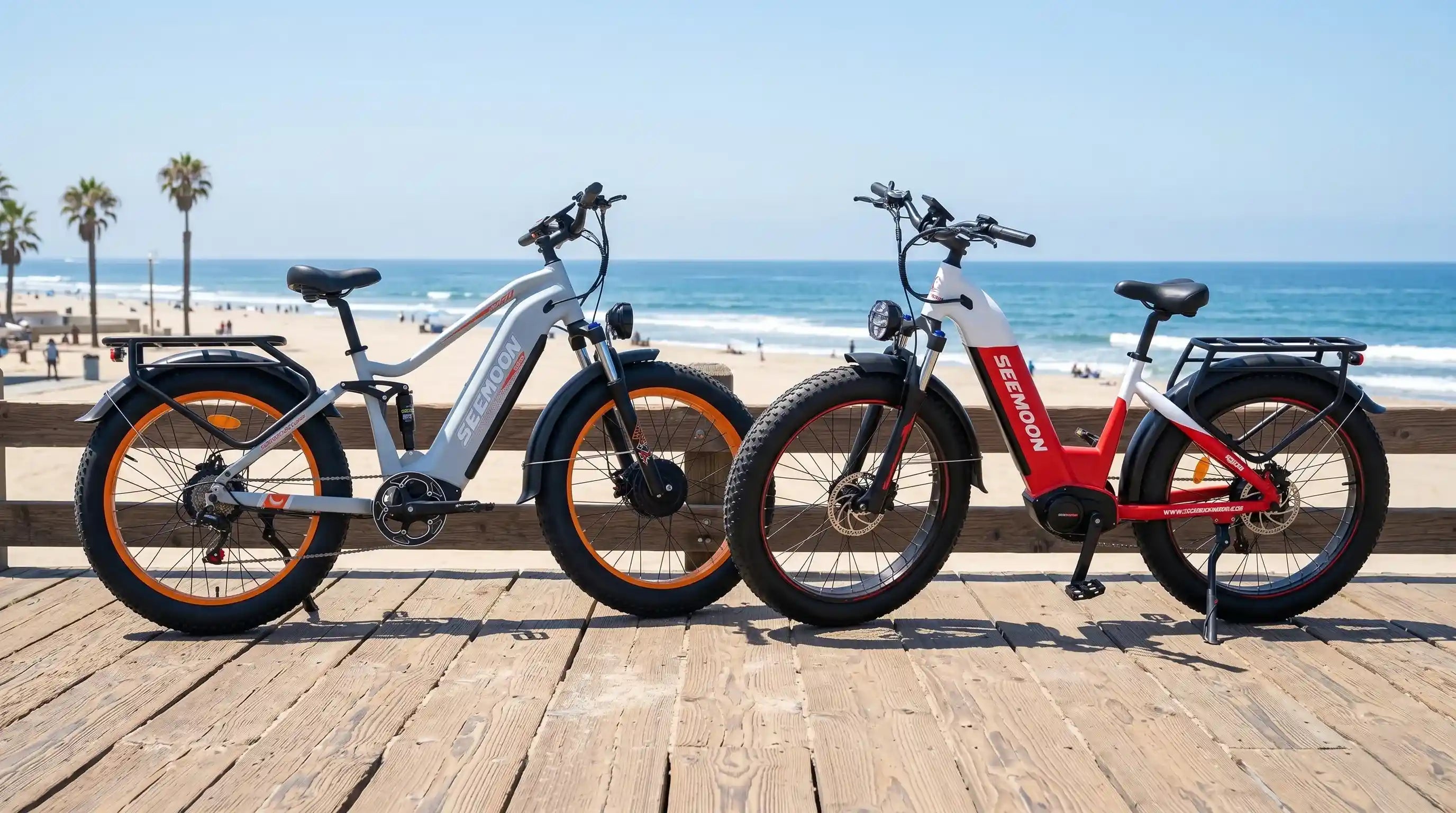
By the Seemoon E-Bike Engineering & Testing Team | Updated: June 2026 | Estimated Read Time: 6 minutes
The electric bike revolution is sweeping across the United States. However when you finally decide to buy your first e-bike, you are immediately faced with a crucial decision—one that has nothing to do with battery size or motor wattage. step over vs step through bike—which one is actually right for me?
Your frame choice dictates your riding comfort, your bike's capabilities, and how well it fits your daily lifestyle. In this comprehensive guide, we will break down the differences, pros, and cons of both frame geometries, and help you choose the perfect ride for your needs.
Table of Contents
1. What is a Step Through Electric Bike?
A step through electric bike (frequently referred to as an "open frame" or "drop frame") features a frame where the top tube is completely removed or positioned just a few inches above the bottom bracket.
Historically, this design emerged in the late 19th century to accommodate women wearing heavy, restrictive dresses. Today, that gender-specific stereotype is completely obsolete. In 2026, the step-through frame is universally celebrated by commuters of all ages and genders as the ultimate standard for accessibility and urban convenience.
The Pros:
-
Effortless Accessibility: You don't need to swing your leg high in the air. You simply step your foot through the center. This is a massive benefit for seniors, riders with limited knee/hip mobility, or anyone recovering from joint surgery.
-
The Urban Stop-and-Go Advantage: If your commute involves frequent stops at red lights, crosswalks, or navigating through dense city traffic, a step-through allows you to slide off the saddle and plant both feet flat on the pavement instantly.
-
Wardrobe Freedom: Riding to the office in a tailored suit, a summer dress, or rigid workwear? The open frame ensures you arrive looking impeccable without overstretching or ripping your clothes.
-
Rear Cargo Friendly: If you utilize your e-bike for grocery runs or have a child seat installed on the rear rack, swinging a leg over the back is dangerous and nearly impossible. The step-through design completely bypasses this issue.
The Cons:
-
Heavier Build: Because it lacks the structural top tube, engineers must use much thicker, reinforced aluminum at the base to ensure the frame doesn't bend under pressure. This usually adds a few extra pounds to the overall weight.
-
The Hitch Rack Dilemma (US Specific): Many Americans transport their e-bikes using a standard dual-arm hitch rack on their SUVs. A step-through bike cannot hang on these racks naturally; you must purchase a separate "crossbar adapter" (a temporary top bar) to mount it safely.
-
Lower Rigidity for Extreme Off-Roading: While incredibly safe for city streets and light gravel, the open frame lacks the extreme torsional stiffness required for aggressive mountain biking or big jumps.
2. What is a Step Over Electric Bike?
A step over bike features the traditional bicycle geometry that has dominated the industry for over a century. Known as a "diamond frame," it consists of a high top tube, a down tube, and a seat tube that connect to form a rigid, structurally perfect triangle.
To mount this bike, the rider must swing their leg over the rear wheel and saddle. This design remains the absolute gold standard for high-performance cycling, Class 3 high-speed commuting, and heavy-duty all-terrain exploration.
The Pros:
-
Maximum Structural Rigidity: The diamond triangle is an engineering marvel. It evenly distributes stress and impact across the entire frame, making it incredibly durable and resistant to flexing, even under extreme torque.
-
Superior High-Speed Handling: Because the frame is exceptionally stiff, step-over bikes offer highly responsive and stable handling. When you are bombing down a steep hill at 28 mph or leaning into a sharp corner, the bike feels entirely planted.
-
Lighter Tubing: The efficient distribution of weight means the aluminum tubing doesn't need to be overly thick, resulting in a slightly lighter overall frame weight.
-
Higher Payload Capacity: The solid structure allows these bikes to carry significantly heavier loads—often supporting a payload capacity of 330 lbs to 400 lbs. This makes them ideal for heavy riders, hunting gear, or packing for an RV camping trip in the Rockies.
The Cons:
-
Challenging to Mount: Swinging your leg over requires decent flexibility. If you have mobility issues or have loaded up the rear rack with tall cargo, getting on and off can be a frustrating chore.
-
Fatiguing in Dense Traffic: Constantly leaning the bike and shifting your weight to balance on one tiptoe at every stop sign can become exhausting during a long city commute.
3. Quick Comparison: Step Over vs Step Through
| Feature | Step-Through E-Bike | Step-Over E-Bike |
| Ease of Mounting | Effortless (No leg swinging) | Requires leg swing over saddle |
| Frame Stiffness | Moderate (Uses thicker tubing) | Extremely High (Diamond geometry) |
| Riding Posture | Upright & Relaxed | Active & Aggressive |
| Best Terrain | Paved roads, urban bike lanes | Off-road, steep hills, mixed terrain |
| Clothing Compatibility | Suits, dresses, casual wear | Athletic wear, flexible clothing |
4. How to Choose Based on Your US Lifestyle
Still torn? Let’s apply this to real-world scenarios. We recommend choosing based on your primary use case and local terrain.
Choose a Step-Through If:
-
You live in a dense metropolitan area (like NYC, Chicago, or LA) with endless stop-and-go traffic.
-
You are an older adult looking for a low-impact, confidence-inspiring ride to stay active.
-
You frequently use a rear child seat for school drop-offs or large pannier bags for grocery runs.
-
You prefer a relaxed, upright riding posture that is easy on the lower back.

Choose a Step-Over If:
-
You are an avid outdoorsman using the e-bike for hunting, fishing, or deep-woods RV camping.
-
You ride aggressively on extreme mountain trails, deep mud, or snow where frame flex is unacceptable.
-
You are a taller rider who prefers the classic aesthetic and locked-in feel of a diamond frame.
-
You frequently hit speeds over 25 mph and demand the sharpest possible steering response.

5. Meet the Seemoon E-Bike Lineup
At Seemoon, we engineer premium e-bikes tailored to specific riding styles. Here is how our flagship models align with your frame needs based on our rigorous 500-mile testing protocols.
The Commuter's Sanctuary: Seemoon SM1 (Step Through)
Designed for accessibility and elegance, the Seemoon SM1 is the ultimate daily driver.
-
The Frame: Built with an ultra-low 6061 Aluminum Alloy step-through frame, our test riders from ages 25 to 70 consistently praised its effortless dismounting.
-
Safety & Tech: It features advanced Hydraulic Brakes for stopping on a dime in wet city conditions, and a BMS (Battery Management System) to ensure safe, long-lasting charging in your garage.
-
Versatility: With five adjustable riding modes, you can glide effortlessly to work using the throttle, or turn off the assist for a healthy weekend pedal around the local park.

The Off-Road Beast: Seemoon SM3 (Step Over)
For those who view rough terrain as an invitation, the Seemoon SM3 is an uncompromising all-terrain monster. (Note: Due to its sheer power, this model is designed for Off-Road/Private Property use).
-
Unrivaled Power: It boasts a staggering 6000W peak output and an earth-ripping 200Nm of torque, powered by an advanced dual-hub motor system. It climbs steep mountain grades that other e-bikes can't even attempt.
-
The Frame & Suspension: The ultra-rigid step-over diamond frame is perfectly paired with a full dual-suspension system, absorbing brutal drops and rocky impacts while keeping the frame tracking straight.
-
Endless Range: Built for the deep wilderness, its high-capacity battery system delivers up to 150 miles of range—meaning your adventure stops when you want it to, not when the battery dictates.

6. Conclusion
Ultimately, in the battle of the step over vs step through bike, the winner is dictated by your personal needs.
If your life revolves around city commuting, running errands, and prioritizing absolute comfort, the accessibility of a step-through e-bike like the Seemoon SM1 is unbeatable. Conversely, if you demand maximum payload capacity, aggressive off-road handling, and raw durability, a step-over powerhouse like the Seemoon SM3 will never let you down.
Ready to find your perfect fit? Explore detailed specs, customer reviews, and current promotions by visiting the Seemoon E-Bike Collection today!

7. Frequently Asked Questions (FAQ)
Are step-through bikes only for women?
Absolutely not. While they originated as "women's bikes" in the 1800s, modern step-through e-bikes are entirely unisex. They are the top choice for delivery riders, commuters of all genders, seniors, and anyone prioritizing comfort and safety in stop-and-go traffic.
Is a step-over bike faster than a step-through?
A bike's top speed is determined by its motor wattage and software controller, not the frame. However, at extremely high speeds or during aggressive pedaling, a step-over frame provides slightly better energy transfer and stability due to its rigid diamond geometry.
Can I take a step-through e-bike off-road?
Yes, but within limits. A high-quality step-through e-bike can easily handle light gravel paths, packed dirt, and park trails. However, for extreme mountain biking, large jumps, or highly technical terrain, a step-over electric bike is necessary to prevent structural flexing.
Do I need a special car rack for a step-through e-bike?
If you are using a platform-style hitch rack (where the wheels sit in trays), no special equipment is needed. However, if you are using a traditional hanging-style trunk or hitch rack, you will need to buy a simple "crossbar adapter" (tension bar) that connects the seat post to the handlebar stem to allow the bike to hang properly.
Share:
How Long Do E-Bike Batteries Last? (Plus 7 Tips to Extend Lifespan)